
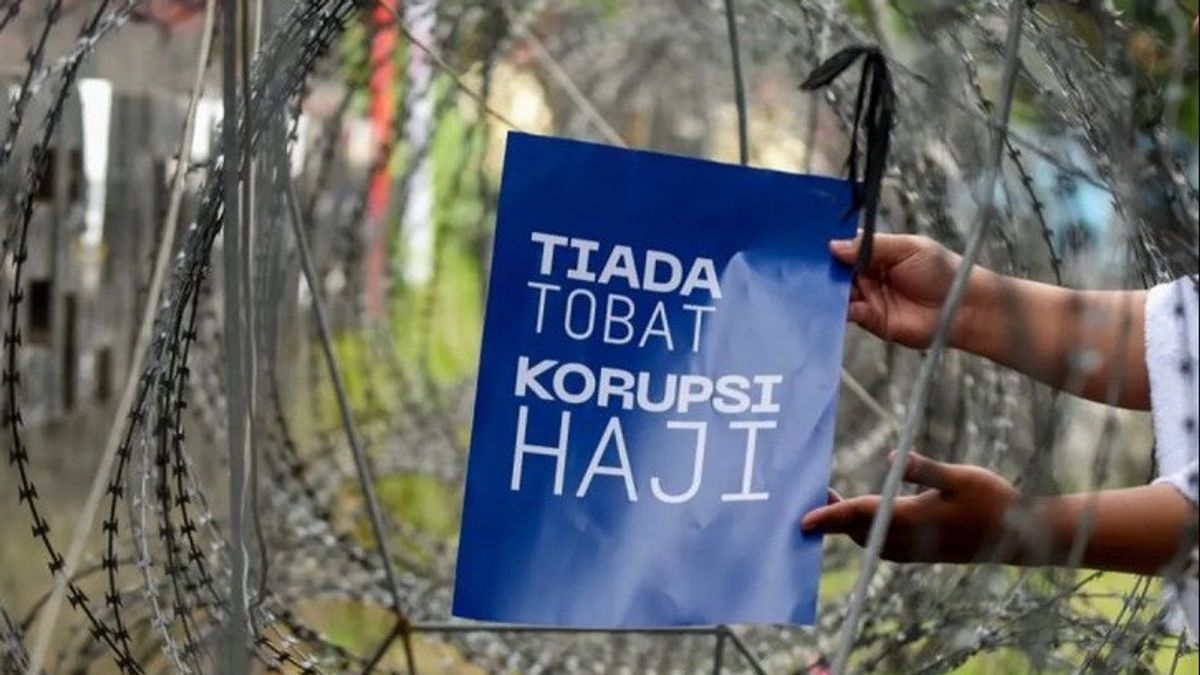


JAKARTA Indonesia is among the top 10 countries with the highest religiosity in the world. Obey in carrying out religious orders, but on the other hand, Indonesia is also included in a country with a high number of corruption.
Coeworld Magazine on April 8, 2024, placed Indonesia as the seventh most religious country in the world. A total of 98.7 percent of respondents from Indonesia claimed to be religious.
Among the G20 countries, Indonesia is the only country that is included in the world's 40 most religious countries.
This survey also strengthens previous polls by the Pew Research Center. Jonathan Evans, a senior research fellow at the Pew Research Center focused on religious research, conducted a survey on religious commitments in 102 countries in the 2008 to 2023 range.
In a report released on August 9, 2024 on the official website of the Pew Research Center, Indonesia is ranked first as a country that prioritizes religion and prays every day.
But at almost the same time, almost every day Indonesian people are presented unpleasant news, both in the mass media and national media. Starting from cases of murder, rape or obscenity, violence, online gambling, to corruption that cost the state trillions of rupiah.
Of course this is an irony and paradoxical in the midst of claims that Indonesia is a religious nation. Religion does not seem to be the basis of life anymore, but is only a symbol, ritual, and not an essential substance.
In a survey conducted by the Pew Research Center, the focus is only on two fundamental questions, namely how important is religion in your life? and how often do you pray?
Based on the survey, apparently 98 percent of adults in Indonesia say that religion is very important in life. As for praying or worship rituals, 95 percent of adults in Indonesia admit to praying every day.
If religious teachings as a guide for life are actually carried out, then in fact the Indonesian people are very close to the values of decency, morality, honesty, and great empathy. But in reality there is a contradiction in society's attitude. On the one hand, religion is considered important, and simultaneously, not a few take actions that come out of the substance of religious teachings.
The predicate of the most religious country coincides with other opposing predicates. First, the corruption perception index in Indonesia is low. The Transparency International Institute (IT) measures the index in the Corruption Perception Index (CPI), the higher the perception index, meaning that the country is cleaner.
SEE ALSO:



In 2024 CPI Indonesia was recorded at 34 and placed the country in the 110th position out of 180 countries. Denmark (90 points index) and Finland (87 points index) the highest index. Interestingly, the two countries are only 10 percent of the level of religiosity.
Because of its proliferation, this practice of corruption in Indonesia has become a culture that flows from upstream to downstream. The culture of corruption does not only occur among the government's elite, but also at the level of small communities at the grassroots.
The public must have been used to the term dawn attack, pelicin money for smooth bureaucracy, plagiarism, and taking or looting of non-owned goods has become a culture among the community.
Apart from being religious, Indonesia has long been known as a nation that is friendly and upholds decency. But lately, it is the opposite phenomenon that can be seen.
This is reflected in the Digital Civility Index (DCI) report by Microsoft at the end of 2023, which named Indonesia the country with the lowest level of validity or decency in cyberspace in Southeast Asia.
Indonesia is also the country with the most gambling players in the world, with 201,122 players. This figure far exceeds Cambodia in second place with 26,279 players according to the emprit Drone report.
This phenomenon is like a paradox in the midst of the high religious levels of Indonesian society. Paradox literally means contradicting opinions so that it is contradictory.
This fact shows that religion is not really being judged essentially by the community. And more severely, people often find corruption cases, criminal acts such as sexual violence, are actually carried out by figures who are expected to be role models.
Regarding the trend of corruption in the midst of the religiosity of the Indonesian people, political sociology researchers who are also lecturers of the Religious Sociology Study Program of the Faculty of Ushuluddin and Islamic Thoughts of the State Inslam University of Sunan Kalijaga Yogyakrta, Mahatva Yoga Adi Pradana, said that corruption carried out by religious people occurred because the religiousism they had was only symbolic, not substantial religious.
This religiosity can be seen from the identity of the display shown, ranging from religious types, routine religious rituals carried out in public spaces, the bahsa used, to their movements in living life.
Ironically, this symbolic religiousism is easier to find ahead of the political contestation or when someone is dealing with a legal case.
In the context of political contestation, a political elite often takes advantage of the symbol of religiosity, even by taking on a role or position in certain religious structures. They hope to gain sympathy and community support.
To remove the contradiction between religiousism and corrupt behavior, religion must be used as a means of release, according to Mahatva. Critical awareness of religious communities must be raised through ethical-based religious education from within the family. In addition, strengthening the role of religious groups aswatchdogs (supervisors) must also be strengthened.
He also encouraged the public not to blame religious values when they saw corrupt behavior by people who looked religious. Mahatva actually highlighted how religious teachings are understood, taught, and practiced in the social structure of society. If religion is only used as a tool of social identity and political mobility without any critical reasoning, religiosity will only become a mask to cover various depravities and injustices, including corruption committed.
"Religion ultimately does not become a means of emancipation, but is only used as a tool to maintain social domination," he said.
The English, Chinese, Japanese, Arabic, and French versions are automatically generated by the AI. So there may still be inaccuracies in translating, please always see Indonesian as our main language. (system supported by DigitalSiber.id)
Most Popular Tags
#Prabowo Subianto #donald trump #firearm #8791 #giias 2026Popular


