


JAKARTA - The proposal to move the women's special KRL carriages to the middle of the series has sparked controversy. According to Forensic Psychologist Reza Indragiri Amriel, the statement is impressive in its desire to exchange women's lives for men.
The train accident tragedy in East Bekasi on Monday (27/5/2026), not only left a deep sorrow, but also triggered a debate about the arrangement of the Women's Special Train (KKW) on the KRL. Minister of Empowerment of Women and Child Protection (PPPA) Arifah Choiri Fauzi proposed that the women's car was no longer placed at the end of the series, but in the middle.
He assessed that the placement of the women's carriages needed to be reviewed in order to improve the safety aspects of passengers. He encouraged changes by placing men's or mixed carriages at the end of the series while the women's carriages were in the middle.
"With this incident, we propose that the woman can be placed in the middle," said Arifah after visiting the victim at the Bekasi Regional General Hospital, Tuesday (28/4).
However, this proposal has provoked mixed reactions in the community. Psychologist Reza Indragiri Amriel emphasized that in a situation of such gravity, handling should not be based on the gender of the passenger.
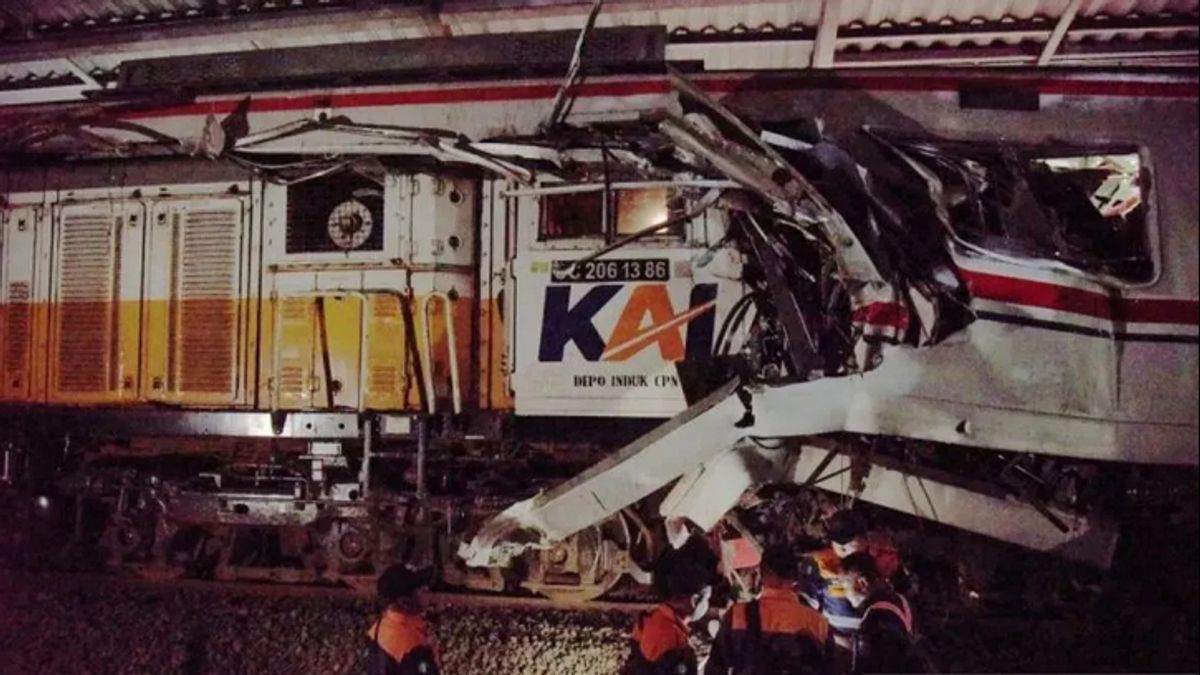
Monday evening (27/4) the community was surprised by the news of a train accident at Bekasi Timur Station. When pictures and videos after the accident circulated on social media, the public was shocked because it turned out that the accident was more severe than the shadow.
The accident involved the Cikarang-bound KRL with the Argo Bromo Anggrek train from Gambir-Surabaya Pasar Turi at the KM 28+920 Bekasi Timur Station.
According to the provisional hypothesis, the incident was triggered by an initial incident, when another KRL heading to Bekasi Station hit a taxi at the crossing. The Cikarang-bound KRL, which stopped at Bekasi Station while waiting for a sterile train line, was then hit from behind by the Argo Bromo Anggrek long-distance train, which was traveling on the same track.
The National Transportation Accident Committee (KNKT) has deployed its investigators in the field to conduct an investigation to find out the cause of the accident. Meanwhile, the Polda Metro Jaya recorded the number of victims who died in the accident reached 15 people.
In the midst of public trauma with the train accident tragedy at Bekasi Station, the Minister of PPPA proposed that the women's carriage be moved from the back to the middle of the series.
However, the proposal triggered a negative reaction. The statement of the Minister of PPPA seemed to want to "exchange the lives of women for men". Reza Indragiri Amriel said that in a situation of a severe accident like the current one, handling should not be based on the gender of the passenger.
"It seems as if the minister wants to say, when a train collision occurs, the number of female victims must be reduced and male passengers should also be victims with an equivalent number," Reza said in a written statement received by VOI.
When a fatal collision occurs that can take human lives, both men and women have one life. Being a passenger on a train hit by another train, said Reza, will expose them to the same risk of death.
Male passengers who are in the front and back of the train face the same criticality as female passengers in the same train position. So, according to Reza, gender is not a relevant element.
"Safety as a train passenger is the right of everyone, regardless of gender. Whether in the front, middle, or back of the train," he said.
"And when female passengers and male passengers are victims, the grief is the same. They deserve the same attention, the same insurance guarantee," continued Reza.
Emphasizing Safety AspectsThe same thing was also expressed by the Chairman of the Indonesian Transportation Forum for Transportation, Deddy Herlambang, who said that the proposal to move the special women's train (KKW) to the middle of the series was an absurd idea.
He explained, KKW is actually not a minimum service standard for trains. This is actually a form of service bonus that is exclusive for women who are reluctant to mingle in train sets with men.
On the other hand, Deddy explained the reason why KKW was placed at the end of the series to facilitate women's mobility to access the train. After the heartbreaking incident, Deddy emphasized that the most important thing was not the location of KKW in a train series, but the safety aspect for passengers.
"The important thing is the aspect of railway safety management itself," he said.
The first women-only train (KKW) was launched by KAI Commuter on August 19, 2010 by the then Minister of Transportation, Freddy Numberi at the Depok KRL Depot, in conjunction with the inauguration of the 7000 series KRL.
From the outside, KKW can be recognized by a pink sticker. The sticker contains an icon of a woman and an icon prohibiting non-female passengers.
This special women's train is placed at the front and back of a train set. This policy is taken into account considering the operation and conditions of the KRL station in the Jabodetabek area which is generally crowded.
The placement of KKW at the end of the line is intended to make it easier for female passengers, especially pregnant women, the elderly, and those carrying children to access the car without having to jostle towards the middle of the train.
In addition, from the side of monitoring the location at the end, it is also easier for officers to monitor the area, especially for women, by monitoring the special area for women more focused because it is localized.
The English, Chinese, Japanese, Arabic, and French versions are automatically generated by the AI. So there may still be inaccuracies in translating, please always see Indonesian as our main language. (system supported by DigitalSiber.id)
Most Popular Tags
#Prabowo Subianto #donald trump #2026 World Cup #Febrie Adriansyah #8791Popular


