
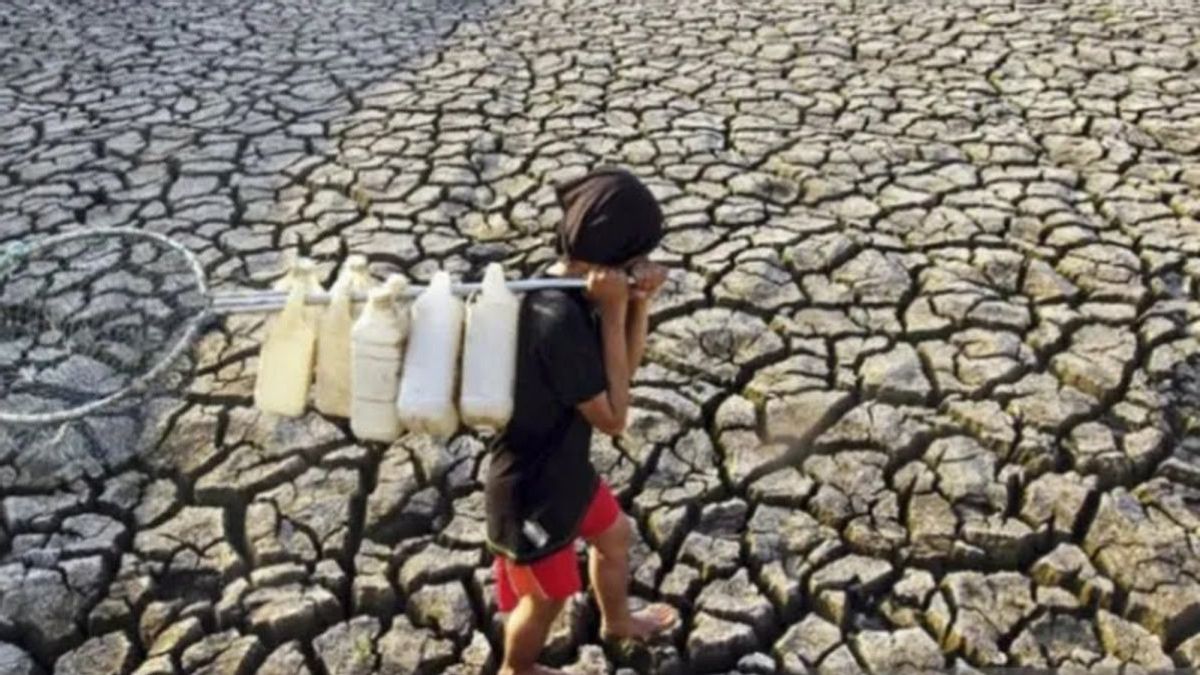


JAKARTA - The extreme El Nino phenomenon not only has an impact on hot weather, but also has consequences for health, including children.
As a tropical country, Indonesia is currently facing an extreme El Nino phenomenon, or better known as El Nino Godzilla, during the dry season this year. The Indonesian Pediatric Doctors Association (IDAI) said children are a group vulnerable to El Nino.
Chairman of IDAI DR. Dr. Piprim Basarah Yanuarso, Sp.A, Subsp.Kardio (K) emphasized that there were several serious impacts that parents needed to be aware of in the midst of the Godzilla El Nino phenomenon, such as dehydration, diarrhea, respiratory disorders, and decreased body resistance.
But more than that, one of the serious threats that Indonesia faces in the face of Godzilla El Nino is the increased risk of stunting and malnutrition in children. This happens because Indonesia will experience a long drought that causes disruption to food security.
"The prevalence of stunting in 2022 according to the Basic Health Research (Riskesdas) is 21.6 percent and increases with the presence of El Nino to increase by 15-25 percent," said the Head of the Environmental Health and Climate Change Task Force IDAI dr. Darmawan Budi Setyanto, Sp.A, Subsp.Respi(K) in an online seminar entitled The Impact of El Nino on Children's Health.
Vulnerable Group Children"Godzilla" El Niño is predicted to start in April 2026. This phenomenon of warming sea temperatures in the Pacific can make the dry season in Indonesia longer and drier. This condition will be strengthened by a positive IOD in the Indian Ocean. pic.twitter.com/UyMxTJt4U5
— BRIN Indonesia (@brin_indonesia) March 19, 2026
El Nino Godzilla is a popular term used to describe an unusually strong and destructive El Nino event, characterized by drastic increases in sea surface temperatures in the central and eastern Pacific Ocean.
The term Godzilla was first coined by NASA scientist Quirin Schiermeier in 2015. This climate phenomenon can trigger severe and widespread droughts, heat waves, and agricultural disruptions.
Erma Yulihastin, researcher at the National Research and Innovation Agency (BRIN) Climate and Atmosphere Center, said that the Godzilla El Nino in Indonesia occurred starting in April 2026. As a result, the dry season in Indonesia becomes longer and drier than before.
This extreme hot weather is a serious threat to public health, including children. Piprim reminds of a number of potential health disorders in children, ranging from dehydration, heat stroke, to diseases due to the clean water crisis.
"This Godzilla El Nino phenomenon can trigger extreme drought and also extreme temperature increases. Moreover, when exacerbated by global climate, the impact can be quite serious for our children," said Dr. Piprim.
Children, he added, are a group of ages that are very vulnerable to extreme weather changes. Prolonged hot temperatures can increase the threat of dehydration and heat stroke in children.
Heat stroke is an emergency condition when the body temperature rises very high due to excessive heat exposure or dehydration, so that the body is unable to cool itself. In addition, the crisis of clean water due to drought also risks causing water-based diseases or waterborne diseases.
"Some areas may force children to drink dirty water, then as a result, waterborne diseases such as diarrhea, dysentery, typhoid can occur," he said.
Extreme hot weather can also cause an increase in acute respiratory tract infections (ISPA). In addition, rainwater puddles that appear sporadically are said to trigger a population explosion of mosquitoes that cause dengue fever (DBD).
Drought and Crop FailureThe Godzilla El Nino phenomenon that is happening now is causing prolonged drought conditions. Several areas are experiencing drought at the moderate, severe, and extreme levels.
In addition to potentially triggering a spike in various diseases in children such as dehydration, heat stroke, diarrhea, and pneumonia, El Nino also increases the risk of malnutrition and stunting.
Citing the Indonesian Environmental Society (WALHI) website, drought and the El Nino phenomenon have a serious impact on food production in Indonesia, especially through reduced rainfall and increased drought risk.
Historically, the El Nino in 1997/1998 caused a 3.6 percent decline in rice production compared to 1997 and up to six percent compared to 1996. The crisis at that time not only suppressed production, but also triggered a spike in food prices that exacerbated the national economic crisis. Meanwhile, the 2024 El Nino caused a 2.28 million ton decline in rice production in the January-April period, or down 17.52 percent compared to the same period last year.
The disruption of food security due to the Godzilla El Nino phenomenon is closely related to the potential increase in the risk of stunting and malnutrition in children.
Doctor Darmawan explained that El Nino caused an extreme dry season which had an impact on crop failure and rising food prices. This condition, he said, can reduce people's access to nutritious food, especially for children.
"With El Nino, drought and crop failure, food prices rise, many people are unable to meet their nutritional needs, so there is malnutrition both acute and chronic, in the short and long term, so there is stunting and of course it will interfere with the intellectual ability of children," he said.
For this reason, Darmawan encouraged the government to strengthen the mitigation of the impact of El Nino through strengthening health services, food security, access to clean water, and a system of preparedness to face a surge in child disease cases.
Meanwhile, Piprim also asked the government to make access to clean water and food security a national priority amid the threat of El Nino. "This El Nino issue is not just a normal environmental change, but we also need to pay attention to the issue of children's health," he concluded.
The English, Chinese, Japanese, Arabic, and French versions are automatically generated by the AI. So there may still be inaccuracies in translating, please always see Indonesian as our main language. (system supported by DigitalSiber.id)
Most Popular Tags
#Prabowo Subianto #donald trump #earthquake #independence day #8791 #hut riPopular


