


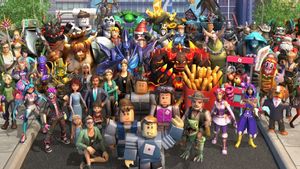
JAKARTA One of the most popular online games today, Roblox, is being discussed following the government's plan to block it because it is considered dangerous for children.
The discourse was conveyed by the Minister of Elementary and Secondary Education (Mendikdasmen) Abdul Mu'ti and Minister of State Secretary (Mensesneg) Prasetyo Hadi. Roblox is considered dangerous because it contains hidden violent content that is prone to being imitated by children in the real world.
If Roblox is completely blocked, Indonesia will follow several other countries that have already done so, such as the United Arab Emirates, Oman, and Turkey, even though the first two countries have now reopened access to this online game.
In Indonesia, Roblox's existence is still the pros and cons. But one thing is certain, all parties agree that digital literacy needs to be increased from an early age so that children can distinguish between virtual and real worlds.
Talking about Roblox's blocking plan, clinical psychologist and forensic psychologist Kasandra Putranto admitted that he had actually restricted his children's access to Roblox's game since 2013, when the game had only been running for seven years. He took the decision because of a lot of exposure to harsh language that was out of place.
But now with the increasing abuse of Roblox for pornographic practices, dangrooming harassment and even access to sexual violence, of course, surveillance of Roblox must be increased, because children are very easy to switch to other platforms or games that have similar risks.
However, Kasandra emphasized that effective protection for children requires a combination of parental assistance, screen time restrictions, digital literacy education, and consistent monitoring of content, so that children are not only protected from one source of risk, but also have the ability to filter harmful content throughout the digital world.
"Parents need to limit their time and monitor their children's digital activities, as well as discuss the content they encounter. Teach children to recognize and avoid violence, abusive speech, or inappropriate content and differentiate between the virtual world and real life," Kasandra told VOI.
Protecting children from online violence also requires the role of the government by evaluating and classifying content.
"The government can tighten the age classification system and content moderation. Their own game already has an age category system: All Ages, 9+, 13+, to 17+ with ID verification and check-up," he continued.
Observer of the issue of Pormadi Simbolon's education in his opinion in Antara stated,Robloxis actually not a bad platform. There is educational potential that can actually be an educational tool if directed properly.Roblox Studio, for example, allows children to learn the world of game design and the basics of programming in Lua.
"Many children learn to think logically, formulate algorithms, and solve problems creatively when they build their own games," wrote Pormadi.
SEE ALSO:
-
 | BERNAS
Gerai Jajanan China Invansi Indonesia, Awas Eksistensi UMKM Lokal Terancam!
10 Agustus 2025, 19:00 -
 | BERNAS
Polemik Rencana Pemblokiran Roblox, Cukupkah Melindungi Anak dari Kekerasan?
09 Agustus 2025, 10:00 -
 | BERNAS
Kegaduhan Royalti Lagu di Restoran karena Adanya Ketimpangan Pemahaman
08 Agustus 2025, 12:00 -
 | BERNAS
Seberapa Penting Indonesia Borong Jet Tempur di Tengah Efisiensi Anggaran?
08 Agustus 2025, 11:00

Unfortunately, this potential is often not recognized because we are too focused on the dark side. In fact, like the real world, the digital world is also not black-and-white. What determines whether it brings benefits or harm is not only from the media, but from the way we use it, access it, and accompany it.
Kasandra Putranto also agreed with this view. He believes certain games are able to improve cognitive skills such as problem solving and hand-to-hand coordination. The game can also be an effective means of learning because it triggers active engagement and curiosity.
"Roblox, for example, has a creative mode where children can create their own world and game, which can hone design logic and skills," he said.
Online games, whatever their name, risk having a negative impact if played out of age, without time limit, resulting in addiction, and without parental supervision.
Currently, in an increasingly digital era, the boundaries between private and public spaces are increasingly blurred, especially for children. In the past, the world of children was limited by the fence of houses or school grounds, now it is no longer.
The world of children is now directly connected to the global digital world for 24 hours a day. Not only playing, they are also 'living' and socializing there. Prohibiting Roblox, or other online games, it is recognized that a number of experts can be a short-term solution to protect children from the negative effects of the digital world.
However, in the long term it is still needed how parents, educators, and the state are present in the digital world inhabited by children.
"The key is not only to prohibit, but to ensure content according to age, balanced playing time, and active parental assistance," said Kasandra.
We all may agree, in this digital era separating children completely from gadgets is impossible. However, said Kasandra, parents can change the way they are used so that the benefits outweigh the risks.
Kasandra shares things that can be done so that the use of gadgets by children does not have a negative impact. Starting from the duration of using gadgets for entertainment for two hours a day for children 6-12 years old, to choosing age-appropriate content.
Furthermore, according to Kasandra, parents also need to occasionally play or see children's games and discuss their content. Children also need to get digital literacy from an early age, so that it can hit signs of harmful content, hate speech, or suspicious invitations.
By building digital literacy from an early age, children are expected to be able to distinguish the real world and cyberspace, as well as the consequences of behavior on the internet.
"Child protection in the digital world is the most effective if it combines parental active supervision, education, and participation, not just restrictions," Kasandra concluded.
The English, Chinese, Japanese, Arabic, and French versions are automatically generated by the AI. So there may still be inaccuracies in translating, please always see Indonesian as our main language. (system supported by DigitalSiber.id)
Most Popular Tags
#Prabowo Subianto #donald trump #firearm #8791 #giias 2026Popular


