
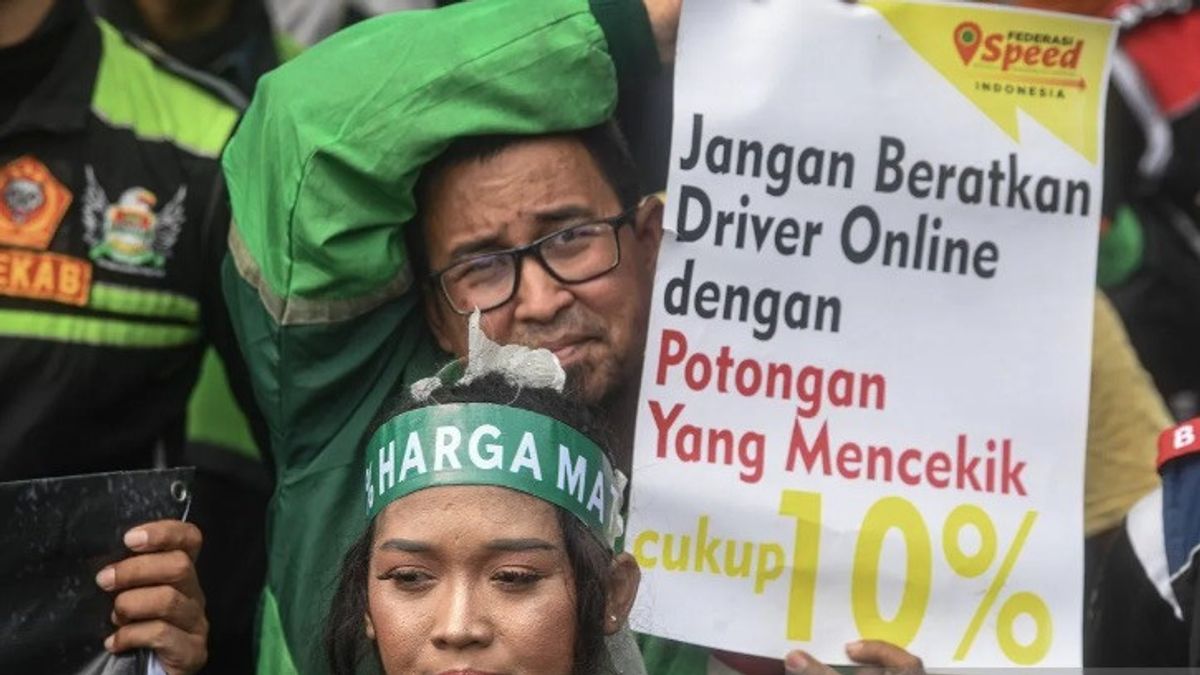


JAKARTA The existence of an untransparent cut is the root of the problem of online motorcycle taxi services in Indonesia, whose drivers continue to complain about, according to economic observer Nailul Huda from the Center of Economic and Law Studies (Celios).
On Wednesday, May 20, 2025, thousands of ojol drivers held demonstrations in various areas in Java and Sumatra. They are said to have turned off the online bid transportation application for 24 hours in big cities.
In Jakarta, for example, the Indonesian Transportation Discussion Forum and the Indonesian Online Workers Union (Sepoi) gathered in front of the Arjuna Wijaya Statue Roundabout. This forum consists of oline motorcycle taxi drivers from various applications.
This ojol driver organization has a number of demands in yesterday's demonstration yesterday afternoon, one of the highlights is the demand to reduce the cost of cutting applications from 20 percent to 10 percent.
The government has actually set the application discount tariff in the Decree of the Minister of Transportation (Kepmenhub) Number 1001 of 2022.
The regulation states that application companies apply indirect costs in the form of rental fees for the use of applications at a maximum of 15 percent and/or app companies can apply supporting costs in the form of driver-partner welfare support costs of up to 5 percent. This support cost includes insurance, safety, the provision of driver-partner service facilities; information center support; operational assistance and/or; other assistance.
Yesterday's massive demonstration was not the first time ojol drivers had done it. In recent years, ojol drivers have often voiced their worries while paving the highway.
In mid-February, demonstrations were also carried out by partners contained in the Indonesian Transport Workers Union or SPAI. One of their demands is the payment of holiday allowances (THR) which are fought for almost every year.
Transportation observer Djoko Setijowarno emphasized that the complaints and frequent demonstrations by ojol drivers reflected the failure of the online transportation business.
The status of online motorcycle taxi drivers who are only partners, will force them not to experience an increase in revenue because it is eroded by very large pieces of application facilities.
"The failure of the online transportation business has been seen from the income earned by its partner or online motorcycle taxi driver," said Djoko, in a statement received by VOI.
Djoko said that currently the average income of online motorcycle taxi drivers is below Rp. 3.5 million per month, by working 8-12 hours a day, and for 30 working days in a month without holidays, it is appropriate to refer to the labor regulations that have been regulated by the Ministry of Manpower.
The average online motorcycle taxi income is still less than IDR 3.5 million per month. This is not in accordance with the promise of online-based transportation applicators in 2016 which reached IDR 8 million per month, Djoko continued.
According to him, making ojol drivers a living support will be difficult. That's because the applicator does not limit the number of drivers, causing a supply and demand imbalance.
"Working is not in certainty, the status is cool as a partner but in reality without a fixed income, there is no holiday schedule, there is no health insurance, working hours are unlimited," he said.
Meanwhile, Director of the Digital Economy Center of Economic and Law Studies (Celios) Nailul Huda said that the occurrence of the ojol mass strike did not have a significant impact on the national economy. He said that people who cannot use motorcycle taxi services can still be supported by public transportation or private vehicles. In addition, there are no offices that are closed just because motorcycle taxi drivers strike.
However, he underlined that this action was not a matter of stopping the economy, but a strong warning that the digital market structure in Indonesia must be reorganized. To understand this issue, said Huda, the public must first dissect what the cost components in online transportation services are.
"We often think that the cost of travel is only a matter of tariffs per kilometer. In fact, behind it there are a number of additional costs paid by consumers and drivers," said Huda.
According to Huda, the first component paid by consumers is the travel rate regulated through the Decree of the Minister of Transportation (Kepmenhub) Number 1001 of 2022. Belid determines the lower, upper limits, and minimum rates that must be accepted by the driver.
Beyond that basic fee, consumers also pay platform fees that vary depending on promotion, distance, or busy time and additional costs such as insurance. But the most crucial thing is the indirect cost component borne by the driver, and this is the source of unrest that has blown up into protests.
In the Minister of Transportation's Decree, drivers should only be burdened with an indirect fee of a maximum of 20 percent of the travel rate. However, according to Huda, the practice in the field is not that simple, because many drivers admit that the cut they experienced could exceed 20 percent.
This happens because there are additional components such as feature subscription fees, performance penalties, or deductions from certain programs that are not described openly. This situation, explained Huda, makes the information between the platform and partners out of balance. This is because the additional costs were not explained from the start as part of the tariff, but suddenly appeared as another cut.
"This creates confusion and distrust among partners," he explained.
However, the demands of motorcycle taxi drivers so that application costs are cut from 20 percent to 10 percent need to be read carefully. Because, the platform is a private company that has its own cost structure, ranging from human resources, technology, to promotion. If the cost of cutting the application is lowered, it is not impossible for the company to transfer the burden to consumers through an increase in service costs.
"Of course the platform is a private company that aims to benefit where there is a cost of human resources, buildings, and technology that must be issued by the platform every year," said Huda.
If that happens, the impact of the ojol tariff can be even more expensive and actually turns to harm the driver himself. The reason is, the majority of consumers of online transportation in Indonesia are price-sensitive consumers, namely users who are very sensitive to price changes. When the rate increases or promotions decreases, demand can decrease and the driver's income is also affected.
SEE ALSO:





"With the form of the multi-sided market, when prices are increasingly expensive with limited promos, driver income will also decrease. Even if this indirect cost is reduced, the company will also definitely increase the platform fee to cover its losses," Huda explained.
Looking at the unresolved online transportation problems, Huda sees that this is not just cutting the cut in the application costs, but clarifying the cost components and ensuring that there are no hidden fees that burden the driver. All drivers must be treated equally and programs that make the driver have to pay extra fees to be able to 'play' at the platform need to be abolished.
"Tudiors from one to another must be treated equally. What makes the difference is only performance in the transportation field, not by spending additional costs," he concluded.
The English, Chinese, Japanese, Arabic, and French versions are automatically generated by the AI. So there may still be inaccuracies in translating, please always see Indonesian as our main language. (system supported by DigitalSiber.id)
Most Popular Tags
#Prabowo Subianto #donald trump #earthquake #independence day #8791 #hut riPopular


