
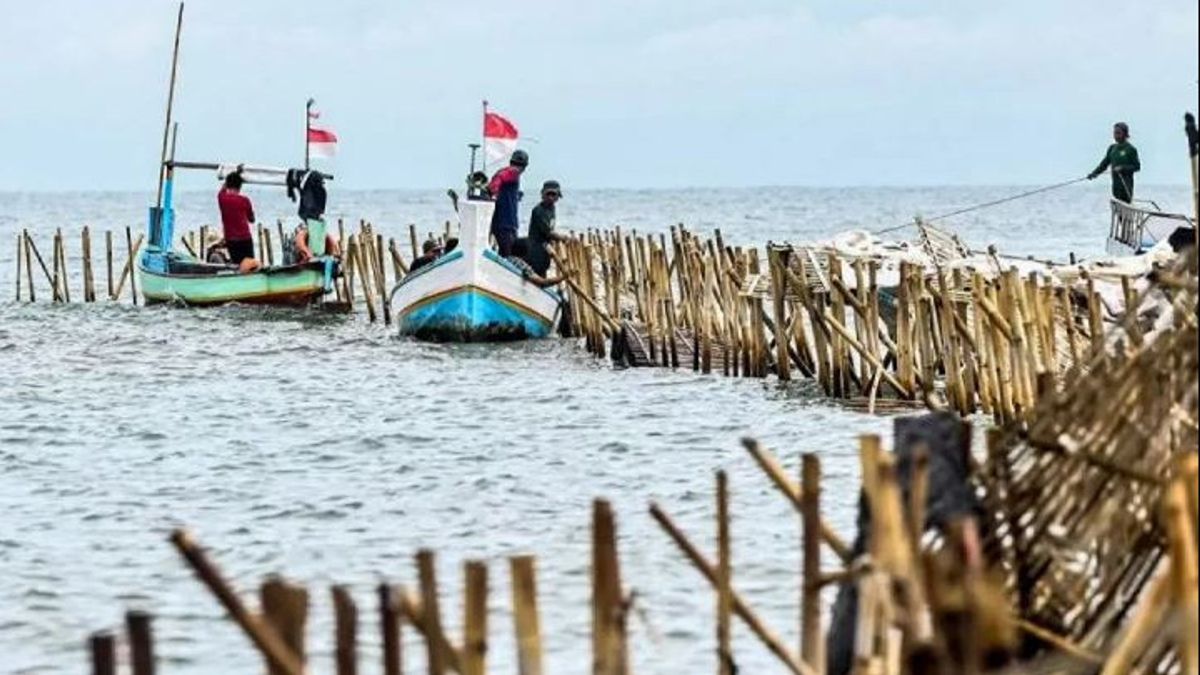


JAKARTA The mystery of the sea fence that stretches across the Tangerang coast is starting to be revealed. However, the findings of the right to build certificate (HGB) and the title certificate (SHM) over the sea invite question marks.
The 30-16-kilometer bamboo fence on the coast of Tangerang has continued to be a public conversation in recent weeks. The problem is, the tens of kilometers long fence is not known who the owner is, although a number of people claim that Agung Sedayu Group is the party most responsible for this, but the allegations are pointed out.
The allegation that sea fencing in Tangerang was carried out for the reclamation of the development of Pantai Indah Kosambi (PIK) 2 was also raised by Wahana for the Indonesian Environment or Walhi. National Walhi Spatial Planning and Infrastructure Campaign Manager, Dwi Sawung while talking to VOI admitted that he was surprised because none of the regional and central authorities knew anything about the stretching of the sea.
They pretend not to see it, pretend they don't know. It's been a long time since the fishermen complained to them that it was difficult to go to the sea because of this fence," said Dwi Sawung when contacted by VOI some time ago.
"People at this lower level don't dare because they know there are people or large forces that make it difficult to take action," he continued.
On that occasion, Dwi Sawung also shared Walhi's findings showing that the location of the 30.16 m long sea fence in Tangerang had received a HGB certificate. The discovery was based on BHUMI's power, a spatial information website managed by the Ministry of Agrarian Affairs and Spatial Planning.
Urban observer Elisa Sutanudjaja also found the same thing. He shared his findings on the X account several watu ago. According to BHUMI data shared by Elisa, the estimated total marine area that is included in the HGB area reaches 537.5 hectares.
Responding to this, the Minister of Agrarian and Spatial Planning, Nusron Wahid confirmed that the HGB certificate had been issued for 263 fields in and around the territorial waters. In addition, there are SHM for 17 other fields.
Nusron explained, there are nine fields that have received HGB certificates on behalf of individuals, while the HGB certificate for 254 fields is owned by two companies.
In a press conference session earlier this week, Nusron revealed the owner of the certificate, namely on behalf of PT Intan Agung Makmur as many as 234 fields, and on behalf of PT Cahaya Inti Sentosa as many as 20 fields.
It turned out that the two companies belonged to PT Agung Sedayu and several other entities, which were controlled by the family of conglomerate Sugianto Kusuma alias Aguan.
As is known, Agung Sedayu Group is the developer of the PIK 2 area which is adjacent to the starting point of the sea fence in Tanjung Burung Village, Teluknaga District, Tangerang Regency.
Agung Sedayu Group also intends to build Tropical Coastland PIK which has been included in the national strategic project or PSN since last year. The location is not far from the sea fence.
The question of many people, how can HGB be published at sea?
Urban observer Elisa Sutanudjaja tries to explain public confusion. According to Elisa, there is a possibility that the HGB certificate will be issued through a reconstruction mechanism or reclamation of destroyed land as stipulated in the Regulation of the Minister of Agrarian Affairs and Spatial Planning No.3/2024.
Land destroyed is land that has changed from its original form because of natural events so that it cannot be used, used, and utilized properly, which is determined to be destroyed in accordance with the provisions of laws and regulations related to procedures and determination of destroyed land.
SEE ALSO:
-
 | BERNAS
Raline Shah Perpanjang Daftar Artis di Pemerintahan, Tren Kabinet Obesitas Berlanjut
20 Januari 2025, 15:00 -
 | BERNAS
Pantauan Netray Soal Program Makan Bergizi Gratis: Warganet Soroti Potensi Food Waste
20 Januari 2025, 09:09 -
 | BERNAS
Israel dan Hamas Sepakati Gencatan Senjata: Apa yang Tersisa setelah Perang 15 Bulan?
18 Januari 2025, 07:30
He suspects that there are parties who are trying to reclamation the Tangerang coastal area on the pretext that the area was originally land for residents that had been destroyed.
"So the land that is considered abrasion, which was previously said to have been worked on by residents for empang, was then claimed and submitted to the government for an HGB certificate", said Elisa.
He also added that there are indications that the sea fences there are aimed at limiting the HGB area to be reclamationd.
Elisa explained that the issuance of HGB should go through a reclamation process first. After the land is reduced, the management rights are issued by the government, then the developer gets a HGB certificate. But in the case in Tangerang, the land at sea has not been reduced but already has HGB.
This is unusual. HGB is a Building Use Right, which means there is a building plan on it. How can a building be planned over the sea without backfilling it first?' said Elisa.
Meanwhile, Nicholas Martua Siagian, an academic student at the Faculty of Law, University of Indonesia, highlighted the provision of HGB to SHM marine fences. He indicated this as maladministration and abuse of authority from the Ministry of Agrarian Affairs and Spatial Planning (ATR)/National Defense Agency (BPN), because its implementation was not based on the provisions of the legislation.
One of the references is the mandate of the Constitutional Court's Decision Number 3/PUU-VIII/2010 on the testing of Law Number 27 of 2007 concerning Management of Coastal Areas and Small Islands, that the sea belongs to a fair and open common property to all.
"The issue of HGB Pagar Laut is actually not just the issuance of permits from the relevant ministries, this is a systematic problem ranging from the government's domain at the village level to the central government," wrote Nicholas.
This issue, said Nicholas, would be mysterious if the local government to the village government level deliberately turned a blind eye and ignored the construction of the sea fence.
In fact, in the mandate of the Constitution of the Republic of Indonesia (UUD) article 33 paragraphs 2, 3, and 4 which he quoted, it was stated that the economic system used and developed should not use the principle of competition and individualistics.
The production branches are important for the state and those that control the lives of many people are controlled by the state. The earth and water and natural resources contained therein are controlled by the state and used for the greatest prosperity of the people. The national economy is held based on economic democracy with the principles of togetherness, efficiency. fair, sustainable, environmentally friendly, independent, and by maintaining a balance of progress and national economic unity," the Constitution reads.
This article clearly provides a constitutional landscape for the implementation of the national economy and social welfare in Indonesia. As a state of law, the mandate of Article 33 implicitly shows that the power of the state is not greater than the strength of individuals, groups, or a handful of people.
"The state must not lose to the interests of a handful of people. Actually, it is not difficult to find who is behind this sea fence," he concluded.
The English, Chinese, Japanese, Arabic, and French versions are automatically generated by the AI. So there may still be inaccuracies in translating, please always see Indonesian as our main language. (system supported by DigitalSiber.id)
Most Popular Tags
#Prabowo Subianto #donald trump #firearm #8791 #giias 2026Popular


