

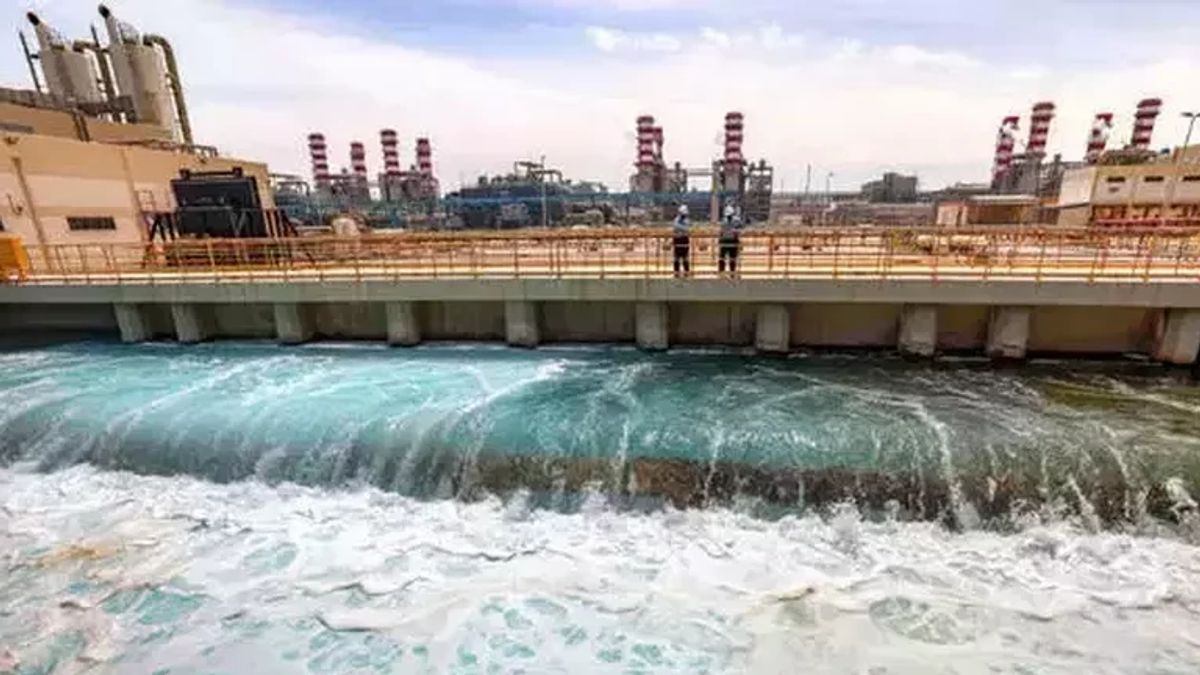


JAKARTA - Iran is targeting desalination plants in the Middle East region after US President Donald Trump threatened to destroy the Persian country's power plant if the Strait of Hormuz was not opened. This threat has the potential to expand the impact of the war on the vital water supply sector.
"Following up on the previous warning, if Iran's fuel and energy infrastructure is violated, then all energy, information technology, and desalination infrastructure owned by the US and Israel in the region will be targeted," said the statement from the Khatam Al-Anbiya Operational Command, which was carried by the Fars news agency. reported by Arab News, Monday, March 23.
This threat comes amid rising tensions in the Middle East region. Previously, the strategic route of the Strait of Hormuz was reported to have been disrupted since the beginning of the conflict, triggering global concerns about energy distribution.
Attacks on water infrastructure are themselves relatively rare in modern conflicts. But the latest tensions show the potential for an expansion of targets to vital civilian facilities.
On March 8, 2026, Bahrain reported that an Iranian drone attack damaged a water desalination plant. However, the local government stated that water supplies remained safe.
Iran has also previously accused the United States of attacking a desalination facility on Qeshm Island that supplies water to dozens of villages. Iranian Energy Minister Abbas Aliabadi said the attack damaged an important water supply network.
Experts warn that attacks on water infrastructure could trigger a larger crisis. Water economist Esther Crauser-Delbourg said the potential for conflict could extend much further if water supplies were disrupted.
The Middle East is one of the driest regions in the world. According to the World Bank, water availability in this region is about 10 times lower than the global average.
This makes desalination facilities very crucial. Around 42% of the world's desalination capacity is in the Middle East, with a major contribution to the supply of drinking water in various countries.
In the United Arab Emirates, desalinated water supplies 42% of drinking water needs, while in Saudi Arabia it reaches 70%. Even in Oman and Kuwait, dependence on desalinated water reaches more than 80%.
This supply is vital for major cities such as Dubai and Riyadh. Disruption to the facility has the potential to trigger a humanitarian and economic crisis.
A number of countries in the region have increased security around desalination facilities. Air defense systems and additional protection are on alert to anticipate drone and missile attacks.
"Recent events have of course encouraged us to be very vigilant," said Philippe Bourdeaux, a representative of the water management company.
In addition to military threats, these facilities are also vulnerable to other disturbances such as power outages and marine pollution due to oil spills.
If attacks on water facilities increase, the impact could be very wide. Starting from disruptions in water supply to the potential exodus of residents in major cities.
"We have the potential to see major cities face an exodus and water rationing," he said.
However, a number of facilities have a water reserve system that can last for two to seven days. This can be a temporary buffer if there is a short-term disruption.
The English, Chinese, Japanese, Arabic, and French versions are automatically generated by the AI. So there may still be inaccuracies in translating, please always see Indonesian as our main language. (system supported by DigitalSiber.id)
Most Popular Tags
#Prabowo Subianto #donald trump #2026 World Cup #venezuela #konflik timur tengahPopular


