

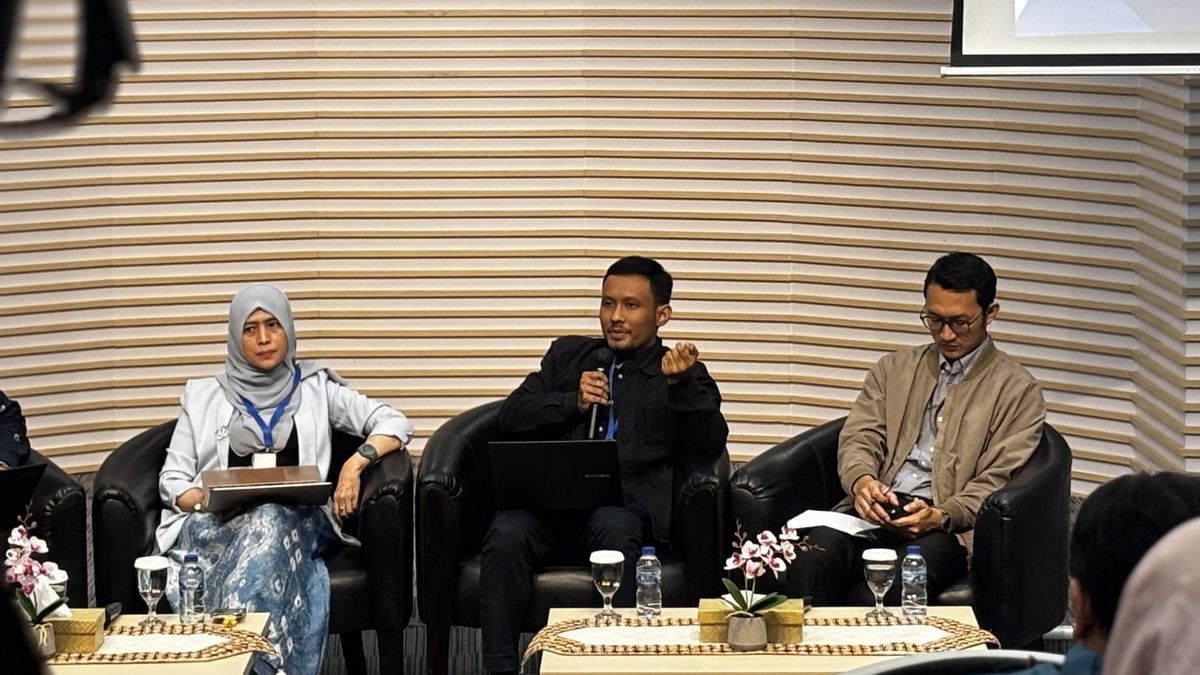


JAKARTA - Indonesian Transparency International (TI) researcher Sahel Al Habsyi said that the participation of experts to discuss the revision of the Law on the Criminal Procedure Code (RKUHAP) was just a patch.
This was conveyed by Sahel in a media discussion organized by the KPK today, Tuesday, July 22. He said that TI Indonesia was not invited to discuss the RKUHAP but many stories that had been heard from experts, such as drafts, were not given in full.
"The consultation process is unique. Complete Draft is not given, only certain articles that want to be consulted are screenshots and then sent to experts," said Sahel at the KPK's Merah Putih building, Kuningan Persada, South Jakarta.
"Then (the experts, ed) were asked their opinion. Wow, how come the process is patchy, how come the involvement of experts (such as, red) patchy embroidery," he continued.
Sahel regretted this condition because the law should have been read in full. "From general provisions to the provisions of the transition, until the provisions are closed. It cannot only be cut into one article like that. So once again, we have many problems," he said.
In addition, the pretext of draft RKUHAP is not open to the public to minimize noise is also highlighted by TI Indonesia. "It's amazingly dangerous (this reason, ed)," said Sahel.
SEE ALSO:
-
 | BERITA
Pramono Klaim Pengelolaan Transportasi Jakarta Lebih Baik Ketimbang New York
22 Juli 2025, 14:38

SEE ALSO:
-
| BERITA
Pramono Klaim Pengelolaan Transportasi Jakarta Lebih Baik Ketimbang New York
22 Juli 2025, 14:38
Furthermore, Sahel stated that the process of making laws that were not transparent could actually create a commotion.
"So during the process of making an abusive law, this abusive law makes this process continue, then any law will definitely be a problem," he said.
"Never, right, have we felt that in the last 10 years, oh the DPR has worked and then the people are calm, people are happy, nothing. The DPR works, we take to the streets. That must be the reaction. Even though it's our representative," said Sahel.
As previously reported, Commission III of the DPR and the government have completed the discussion of the problem inventory list (DIM) for the Revision of the Criminal Procedure Code (RKUHAP). Activities are carried out for two days from 9-10 July.
The discussion was carried out by Commission III of the DPR and the government represented by Deputy Minister of Law (Wamenkum) Edward Omar Sharif Hiariej or Eddy. There were 1,676 DIM RKUHAP with details of DIM remaining 1,091, DIM editorial as many as 295, 68 DIM amended, 91 DIM removed, 131 DIM new substance.
The RKUHAP was then in the spotlight of the Corruption Eradication Commission (KPK). KPK Chairman Setyo Budiyanto revealed that the revision of the policy has the potential to reduce the authority of his institution based on discussions with a number of experts.
"We see that there are potentials that can then affect authority, reduce the authority of duties and functions of the Corruption Eradication Commission," Setyo told reporters at the KPK's Merah Putih building, Kuningan Persada, South Jakarta, Thursday night, July 17.
Setyo said there were 17 crucial points that were the most highlighted by his institution. Thus, legislators are asked not to rush.
"In principle, the KPK hopes that the Criminal Procedure Code Bill is prepared openly, meaning that it is open, yes, transparent," said the former Director of KPK Investigation.
The following 17 problems in the RKUHAP that can interfere with the work of the KPK are as follows:
1. The KPK Law which regulates investigators and investigators as well as special procedural law or lex specialists has the potential to be interpreted as not in sync because Articles 329 and 330 of the RKUHAP have phrases: ... as long as it does not conflict with the provisions in this law.;
2. Continuation of case handling carried out by the anti-corruption commission can only be resolved based on the Criminal Procedure Code. In fact, the Criminal Procedure Code, the KPK Law, and the Anti-Corruption Law have been guidelines;
3. The existence of KPK investigators is not accommodated in the Criminal Procedure Code Bill. Investigators only come from the National Police and investigators are supervised by Police Investigators. The regulation is not in sync with the duties and functions of the KPK because of the authority to carry out investigations, appoint and dismiss investigators;
4. Investigations are only looking for and finding criminal incidents. In fact, the KPK investigation has found at least two pieces of evidence;
5. Witness testimony recognized as evidence is only obtained at the stage of investigation, prosecution, and/or examination at trial;
6. Determination of the suspect is determined after investigators collect and obtain two pieces of evidence. So this is not in line with Article 44 paragraph (1) and paragraph (2) of the KPK Law regarding investigation;
7. Termination of investigations must involve Police Investigators. The KPK Law has regulated the termination of investigation by the KPK and based on the Amar Decision of the Constitutional Court Number 70/PUU-XVII/2019 number 6, then the termination of investigation by the KPK must be notified to the Supervisory Board;
8. Submission of case files to the Public Prosecutor through Police Investigators;
9. Search of the suspect and accompanied by Police Investigators from the jurisdiction of the search site;
10. Confiscation with a request for permission from the Chairman of the District Court. This is contrary because this forced effort has been regulated by the KPK Law and no longer needs permission from other parties and the Supervisory Board must also have been informed;
11. Wiretapping. The KPK has so far had the authority to conduct wiretapping since the investigation stage without the permission of the Head of the District Court and was notified to the Supervisory Board;
12. Prohibition of traveling abroad is only against suspects. In fact, the KPK has been able to disentangle abroad for witnesses as stipulated in the KPK Law;
13. The principal of corruption cases cannot be tried during the pretrial process;
14. The authority of the KPK in the case of connectivity is not accommodated;
15. Protection of Witnesses/Reporters only by LPSK;
16. Prosecution outside the jurisdiction with the temporary appointment of the Attorney General. In fact, so far the KPK prosecutor has been appointed and dismissed by the KPK and has the authority to prosecute throughout Indonesia; and
17. The public prosecutor consists of officials from the Prosecutor's Office and an institution authorized based on the provisions of the law. The KPK considers that the regulation should be written by KPK officials as part of the public prosecutor.
The English, Chinese, Japanese, Arabic, and French versions are automatically generated by the AI. So there may still be inaccuracies in translating, please always see Indonesian as our main language. (system supported by DigitalSiber.id)
Popular


