
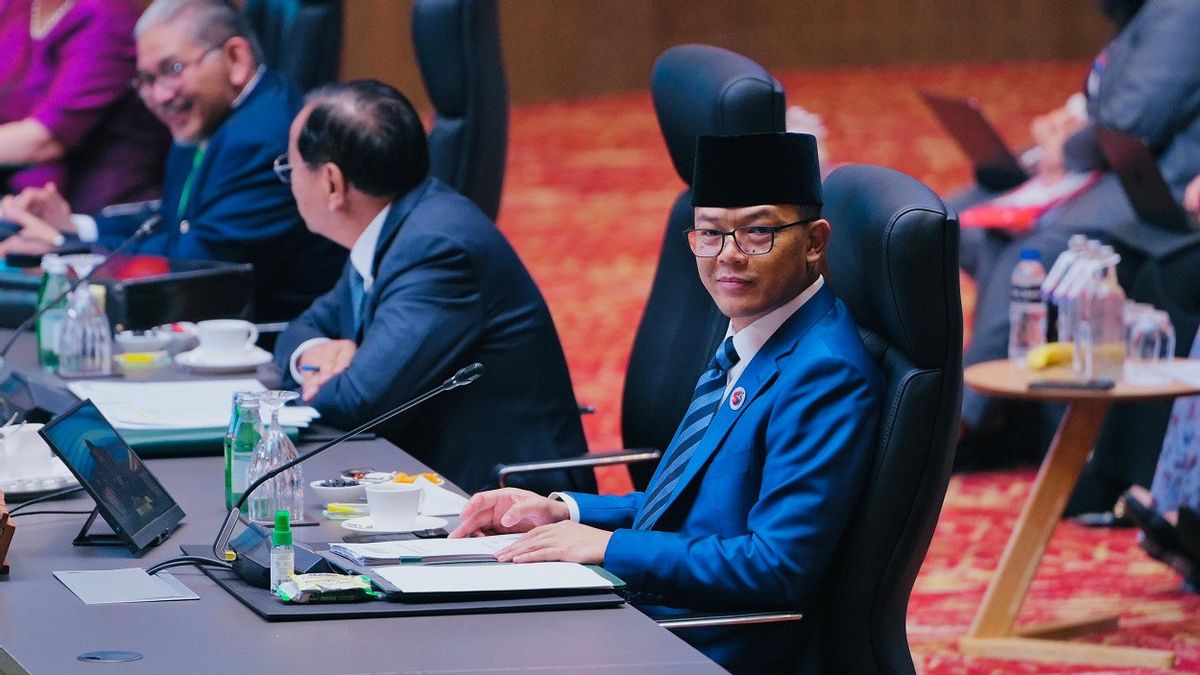


JAKARTA - ASEAN chose to focus on strengthening the economies of each country and ASEAN as a whole, amid the implementation of reciprocal rates starting next month, said Indonesian Foreign Minister Sugiono on the sidelines of a series of ASEAN Foreign Ministers Meetings/Post Ministerial Conferences (AMM/PMC) 58 at the Kuala Lumpur Convention Center (KLC) on July 8-11.
Foreign Minister Sugiono said, one of the things that surfaced during today's AMM plenary session was the existence of a higher awareness to be able to make ASEAN a regional organization that has high bargaining power, especially in terms of the economy.
"How not to eliminate dependence, but to look for alternatives to face a global economic situation like this," he said in a statement to reporters, Wednesday, July 9.
"Earlier, all said that the same concern, ASEAN is actually a large area, there are 700 million people, a large market. This actually has to be used, it must be encouraged to cooperate again," he continued.
"So far, we already have a lot of frameworks for cooperation, but it has not been implemented optimally," said the Indonesian Foreign Minister.
Foreign Minister Sugiono assessed that awareness about ASEAN's position was one of the positive steps to strengthen ASEAN's position.
Regarding the reciprocal tariff of the President of the United States Donald Trump, the Indonesian Foreign Minister said it was not discussed in detail at today's meeting.
"Not discussing tariffs in detail. I think each country has a negotiation mechanism," he explained.
"But the point is, we agree that there will be no retaliation (retaliation), then how to strengthen our respective economies as ASEAN countries and as ASEAN as a whole," he said.
SEE ALSO:
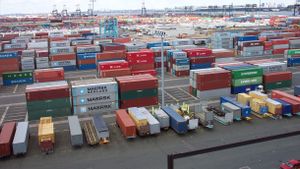
It is known that President Trump this week signed an executive order regarding the imposition of reciprocal rates which will take effect on August 1.
A number of countries have been affected by this policy with different amounts, Malaysia (25 percent), Indonesia (32 percent), Cambodia and Thailand (36 percent) and Laos and Myanmar 40 percent). Meanwhile, Vietnam, which is currently subject to 46 percent, managed to reduce it to 20 percent.
The English, Chinese, Japanese, Arabic, and French versions are automatically generated by the AI. So there may still be inaccuracies in translating, please always see Indonesian as our main language. (system supported by DigitalSiber.id)
Most Popular Tags
#Prabowo Subianto #donald trump #firearm #8791 #giias 2026Popular


