

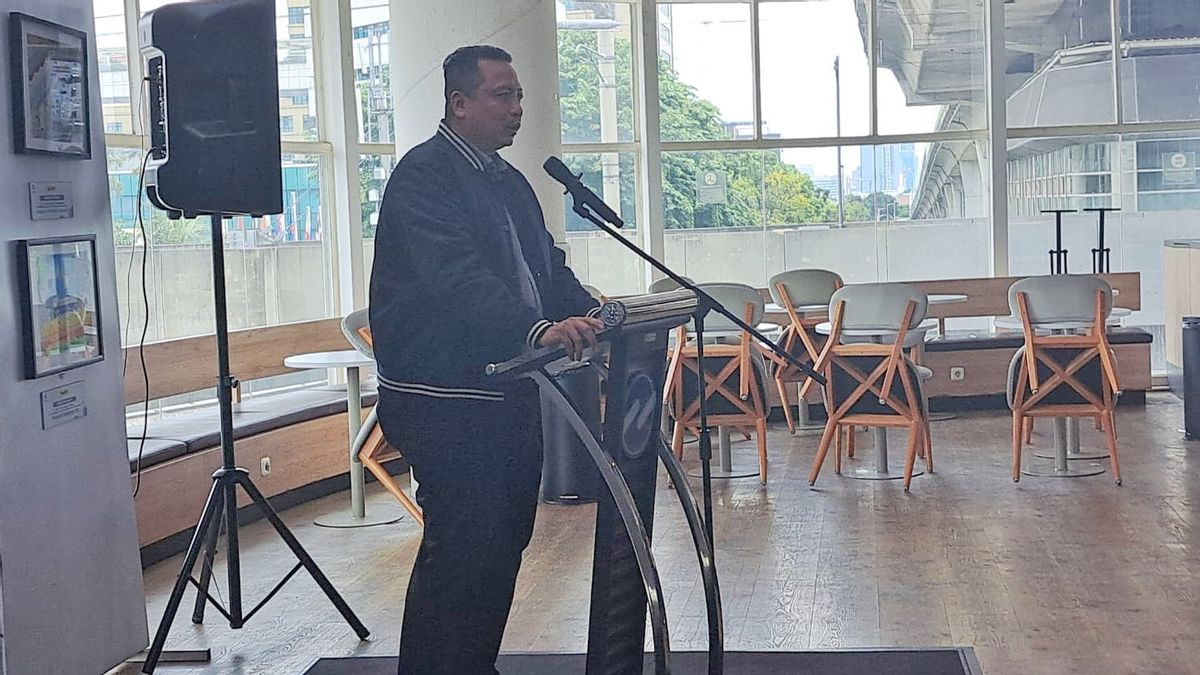


JAKARTA - Chairman of Commission B of the DKI Jakarta DPRD, Nova Harivan Paloh, approved the cancellation of the plan to abolish the Transjakarta route in corridor 1, namely Blok M-Kota. He revealed this after testing the Transjakarta service corridor 1.
Nova and the ranks of Commission B of the DKI DPRD directly inspected the activities of Transjakarta passengers corridor 1, starting from the Monas Bus Stop to the Wahana Selaras Cakra Bus Stop (CSW).
"Of course we also see that currently the number of passengers from Transjakarta is 1.3 million per day. Earlier in corridor 1 it was almost tens of thousands. If we look at corridor 1, there are a lot of passengers, like that," Nova said at the CSW Transjakarta Bus Stop, South Jakarta, Wednesday, January 15.
According to Nova, what needs to be prioritized by the DKI Provincial Government is efforts to increase the capacity and facilities of Transjakarta services so as not to accumulate in a handful of corridors or routes with dense mobility, especially in bulk public transportation integration nodes.
"Later, there will also be LRT from Rawamangun to Manggarai. We will extend this MRT again to the city route again, maybe even later to Ancol. Well, these integration routes must also be created how there is comfort for customers," explained Nova.
SEE ALSO:
-
 | BERITA
Kejagung Soal Pemeriksaan Tom Lembong: Puncak Penyelesaian Hingga Saksi Mahkota
14 Januari 2025, 14:21 -
 | BERITA
Kejagung Bakal Lakukan Langkah Perlindungan Usai Bambang Hero Dilaporan
14 Januari 2025, 13:58
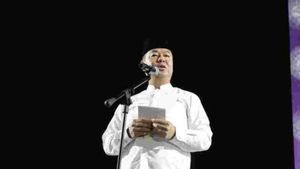
Previously, the Head of the DKI Jakarta Transportation Agency, Syafrin Liputo, revealed that there was a plan to remove the Transjakarta corridor 1 Blok M-Kota route after the MRT Jakarta phase 2A officially started operating.
When MRT Jakarta phases the Lebak Bulus-Kota route is run, the route passed will be similar to the Transjakarta Blok M-Kota route. Meanwhile, the DKI Provincial Government needs to save on APBD expenditure for transportation subsidies or public service obstruction (PSO) whose value reaches trillions of rupiah per year.
Meanwhile, in the future, the main modes of transportation in Jakarta are rail-based public transportation such as MRT Jakarta, LRT Jakarta, and KRL. Thus, Transjakarta is projected to be a feeder service to the station.
Syafrin emphasized that in the future, bus stops and buses that have been serving routes in corridor 1 will still exist. However, there will be changes in routes and stop points from serving the 1 Blok M-Kota corridor.
"For the Blok M-Kota corridor, rerouting will be carried out, but waiting after the completion of the phase 2 A MRT construction and the full operational MRT to the City, God willing, we hope that later it will be operational in 2029," said Syafrin some time ago.
The discourse on removing the Transjakarta corridor 1 has drawn public criticism. Many people think that the Blok M-Kota route is still needed because the passenger volume on the route is quite large even though the MRT Jakarta phase 1 has been operating.
Later, Syafrin admitted that the plan to abolish the Blok M-Kota route has now been canceled. "Regarding the issue of closing corridor 1, we convey that there is no closure of corridor 1," said Syafrin, Wednesday, January 15.
So far, the DKI Provincial Government has had a number of studies on mass transportation patterns in Jakarta on a macro basis. Instead of removing one of the routes, Syafrin revealed that his party will continue the study comprehensively and in parallel to the development of the transportation system in Jakarta.
"This year we will conduct a comprehensive study, including updating the studies that have previously been carried out. Of course we will conduct a thorough evaluation in line with the DKI Jakarta Provincial Government's policy of making rail-based transportation a backbone of Jakarta's mass public transport services," said Syafrin.
The English, Chinese, Japanese, Arabic, and French versions are automatically generated by the AI. So there may still be inaccuracies in translating, please always see Indonesian as our main language. (system supported by DigitalSiber.id)
Most Popular Tags
#Prabowo Subianto #donald trump #firearm #8791 #giias 2026Popular


