
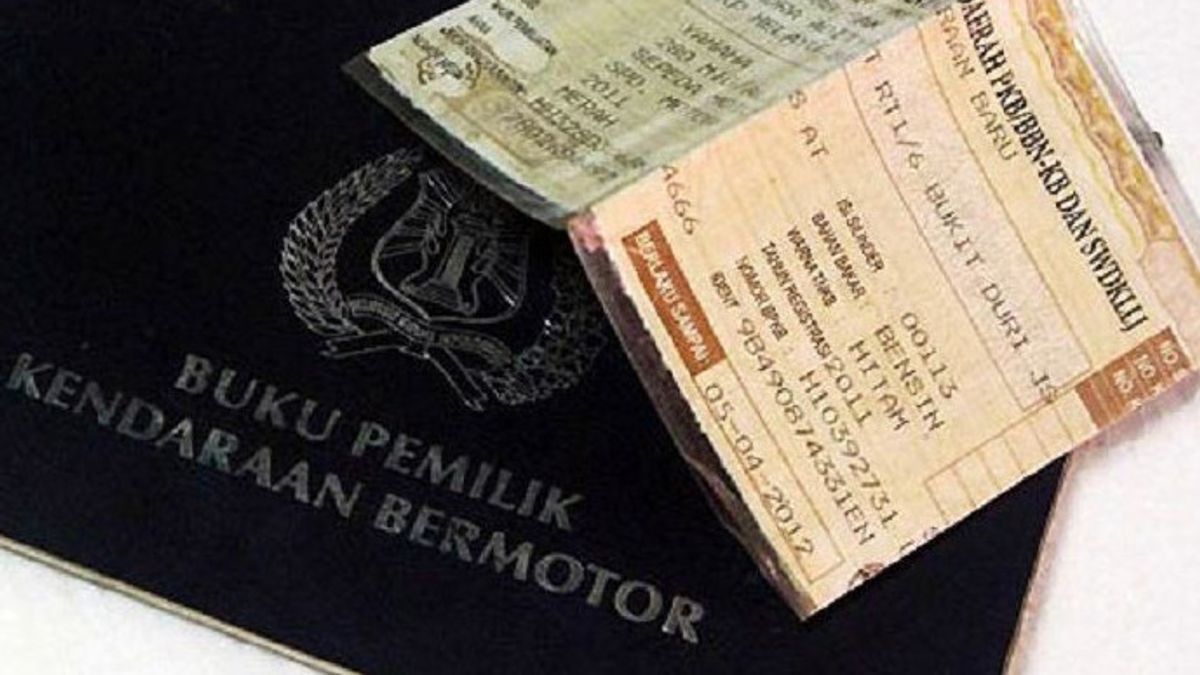


YOGYAKARTA - Motor vehicle tax operations (PKB) will be implemented by the government starting in 2025. In addition, the government will also impose motor vehicle duties (BBNKB). So what is vehicle tax opsen and what are the rules?
Provisions related to tax opents have been regulated in Law Number 1 of 2022 concerning Financial Relations between the Central Government and Regional Governments (HKPD). In the law, opsen is defined as an additional levy on taxes based on certain percentages.
In accordance with Article 191 paragraph (1) of the HKPD Law, the implementation of regional tax options begins three years after this regulation is ratified. Thus, tax options will take effect on January 5, 2024. To facilitate understanding and management of tax obligations, let's discuss further regarding motor vehicle tax options and their objectives.
Motor vehicle tax operations are levies imposed by the district/city government on the principal of the Motor Vehicle Tax (PKB) in accordance with the provisions of the legislation.
Meanwhile, the Motor Vehicle Transfer Fee (BBNKB) opsen is an additional levy applied by districts/cities at the BBNKB principal based on applicable regulations.
The tax opent levy is carried out by the district/city government and functions as a substitute for the mechanism for the distribution of provincial tax revenues (PKB and BBNKB) to districts/cities.
With this application, provincial tax payments such as PKB and BBNKB will automatically allocate parts that become district/city rights to district/city governments.
The tax payment process is carried out through a separate deposit mechanism (split payment), where funds are automatically channeled to the provincial General Cash Account (RKUD) for PKB and BBNKB, as well as to the district/city RKUD for PKB Opsen and BBNKB Opsen.
This tax opsen scheme not only accelerates district/city regional revenue, but also aims to increase synergy between provincial and district/city governments in collecting and supervising taxes.
In addition, the opsen mechanism is expected to be able to improve the structure of the district/city Regional Revenue and Expenditure Budget (APBD) which previously relied on income transfer through provincial tax revenue sharing. Thus, the opsen can be part of Regional Original Revenue (PAD).
As an adjustment to the opsen rate, the maximum tariff for the parent tax has been lowered. Under Law Number 1 of 2022, the maximum tariff for vehicle taxes is set at 1.2 percent for the first vehicle and a maximum of 6 percent for the next vehicle (progressive tax).
Meanwhile, the maximum tariff for BBNKB for new vehicles is 12 percent, while used vehicles are no longer the object of BBNKB.
SEE ALSO:
-
 | INFO SEHAT
Benjolan di Bawah Dagu Sakit jika Ditekan, Waspada Flu hingga Kanker!
11 Januari 2025, 05:55 -
 | LIFESTYLE
Minuman Khas Riau yang Banyak Dicari, Khususnya di Bulan Ramadhan
11 Januari 2025, 00:55 -
 | LIFESTYLE
Apakah Minum Membatalkan Wudhu? Begini Penjelasan Hadits dan Ulama
11 Januari 2025, 01:55


Regional tax operations aim to accelerate the acceptance of district/city sections of PKB and BBNKB. Previously, according to Law No. 28 of 2009 concerning PDRD, PKB and BBNKB, it was included in the category of provincial taxes whose revenues were divided into revenues to districts/cities.
The distribution process for profit sharing from the Provincial RKUD to Regency/City RKUD has so far been regulated through the regional head regulations (Perkada) of each province. In its implementation, revenue sharing of results that enter the Regency/City RKUD sometimes exceeds the applicable budget year.
With the implementation of Regional Tax Operations, distribution is carried out directly through a split payment mechanism. The provincial section is directly distributed to the Provincial RKUD, while the district/city section goes directly to the Regency/City RKUD. This allows the Regency/City Government to immediately utilize the funds as soon as possible.
This operation is designed to increase income sources for districts/cities. Through PKB opsen and BBNKB opsen, it is hoped that it can provide significant additional revenue for the Regency/City Government. Another goal is to improve the structure of the district/city APBD and reduce the mandatory expenditure burden for the province.
Through the implementation of Regional Tax Opsen, PKB and BBNKB revenues for regencies/cities are diverted from the profit sharing mechanism to be part of PAD in the form of Regional Taxes. The Provincial Government will receive PKB and BBNKB in a clean manner (netto) without the obligation to share the results again to districts/cities as mandatory expenditures.
Regional Tax Opsen also aims to strengthen the synergy between provinces and districts/cities in terms of collection and tax supervision. With this opinion, the Regency/City Government has a greater role in collecting PKB and BBNKB. Meanwhile, the Provincial Government has played a role in collecting MBLB Taxes.
Demikianlah penjelasan apa itu opsen pajak kendaraan yang perlu diterami oleh setiap pemilik motor. Rencananya, opsen pajak ini akan diterapkan mulai Januari 2025. Baca juga Menperin ungkap opsen pajak kendaraan beratkan industri otomotif.
Stay up to date with the latest domestic and other overseas news on VOI. We present the latest and updated information nationally and internationally.
The English, Chinese, Japanese, Arabic, and French versions are automatically generated by the AI. So there may still be inaccuracies in translating, please always see Indonesian as our main language. (system supported by DigitalSiber.id)
Most Popular Tags
#Prabowo Subianto #donald trump #firearm #8791 #giias 2026Popular


