

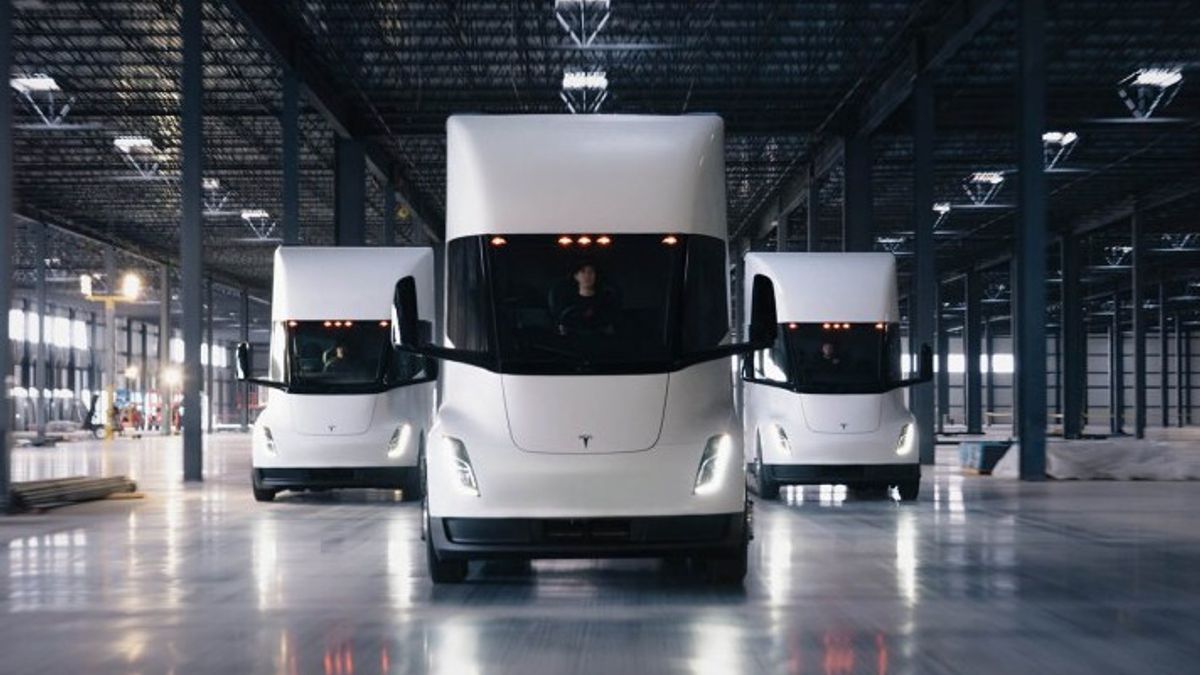


JAKARTA - The long wait for Tesla's large electric truck has finally been answered. The company has completed the first Tesla Semi unit on a new high-capacity production line at a special facility in Nevada. This moment is an important milestone for Tesla, which has developed the project for years before now actually entering the stage of large-scale manufacturing.
Tesla also shared the latest look of the truck through its official social media account. Production is carried out in a building with an area of approximately 157,935 square meters which stands next to the Gigafactory Nevada. Previously, Tesla had assembled several Semi units, but the process was still limited and carried out manually so that it could not meet the needs of mass production.
Tesla Semi's journey itself is quite long since it was first introduced to the public in 2017. At that time, the company promised production would begin in 2019. However, the realization continued to be delayed to 2020, then 2021, until finally entering 2022. Tesla had sent a number of units to PepsiCo, although not on a large-scale production scale.
This situation even raised public doubts, especially since Tesla is known for the term "Elon time," where "next year" sometimes means "in five years." Behind the delay, Tesla engineers made various improvements. One of them is to reduce the weight of the vehicle to around 454 kilograms, which directly impacts the increase in carrying capacity.
This truck is designed to carry a total load of up to 37,190 kilograms in a fully loaded trailer. Tesla offers two new Semi variants.
The Standard Range version can travel up to 523 kilometers on a single charge with a starting price of 222,000 euros. Meanwhile, the Long Range variant can travel up to 805 kilometers before needing to be refueled, with prices starting at 248,000 euros.
Although it looks expensive, the figure is still considered competitive compared to other electric trucks in its class. In terms of performance, the Tesla Semi is equipped with three independent motors on the rear axle that produce a total of 1,072 horsepower.
To support this performance, Tesla uses the latest 4680 battery cells. The advantage of the facility in Nevada is that all battery components are produced in the same complex, thus minimizing potential logistical obstacles.
For charging needs, Tesla presents Megacharger technology with a capacity of up to 1.2 megawatts. This system allows the battery to be charged from almost empty to 60 percent in just 30 minutes.
This solution is considered ideal for truck drivers who are required to rest periodically, so that the break time can be used for charging. Tesla itself has built a Megacharger station in Ontario, California, and plans to expand the network to 66 points in 15 states.
In the market competition, Tesla is not alone. Manufacturers such as Volvo and Daimler Truck have already marketed their electric trucks. In fact, Volvo has already delivered thousands of units. Even so, Tesla offers an advantage in a longer range and a relatively lower price.
Launching from ArenaEV, Monday, May 4, the company targets production of up to 50,000 units per year, although a number of analysts estimate a realistic figure in 2026 to be in the range of 5,000 to 15,000 units. Market interest in Tesla Semi is also quite high.
In California, there is an incentive program for environmentally friendly vehicles that encourages the adoption of electric trucks. From the beginning of 2025 to the beginning of 2026, 965 Tesla Semi units were recorded in the program. Meanwhile, all of its competitors combined only recorded less than 100 applications, showing the dominance of interest in Tesla products.
As interest increases, new business models have emerged to facilitate adoption. One of them comes from the Alyath company which offers a "Semi as a Service" scheme.
Through this concept, business actors do not need to buy trucks at a price of around 290,000 US dollars, but simply pay a monthly fee that includes vehicles, charging infrastructure, and electricity. This scheme is considered capable of opening up opportunities for small businesses to switch to electric vehicles without the burden of large initial investments.
The English, Chinese, Japanese, Arabic, and French versions are automatically generated by the AI. So there may still be inaccuracies in translating, please always see Indonesian as our main language. (system supported by DigitalSiber.id)
Most Popular Tags
#Prabowo Subianto #donald trump #Febrie Adriansyah #8791 #giias 2026Popular


