

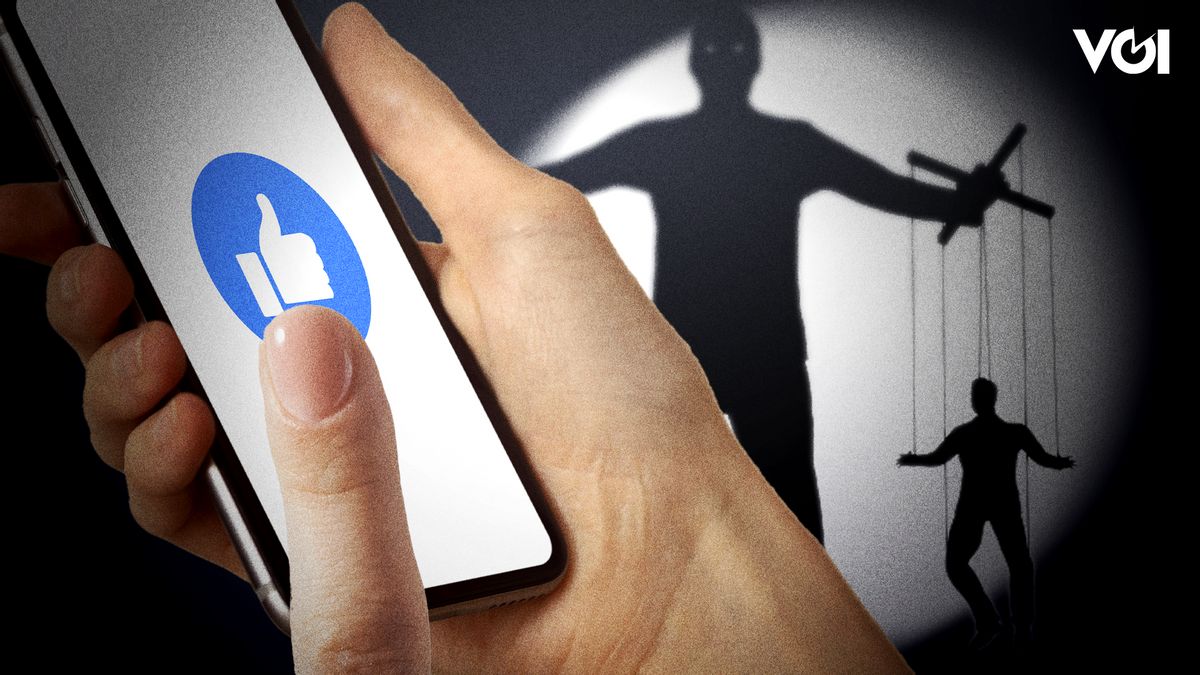
JAKARTA - Democracy is not always killed by the sound of guns or the tread of military boots. In many contemporary cases, it actually disappears quietly, without a coup, without the dissolution of parliament, without mass imprisonment for the opposition. Democracy dies slowly, through public opinion engineering, information manipulation, and the silencing of criticism wrapped in the name of stability and nationalism.
One of the most striking symptoms is the engineering of public opinion through anonymous accounts and buzzer networks. The digital space that should be an arena for citizen discussions has turned into a propaganda field. Accounts without clear identities work in a coordinated manner, leading to perceptions, flooding the timeline with uniform narratives, and creating and illusions of public support. Truth is no longer determined by rational arguments, but by who is the loudest and most dominant in the algorithm.
Here a new force called social media emerged, even according to Social Media Expert, Professor Merlyna Lim, a lecturer at ITB graduate from Carleton University, Canada and the Global Network community, once said who often makes noise on Social Media can win in the presidential election. See the case of the election of President Ferdinand Marcos Jr. / Bongbong in the Philippines even though he was overshadowed by his father's image as a dictator. Here is a power where whoever controls social media or online media will win the election.
Also no less intense is the discussion of legal cases, Komika Pandji Pragiwaksono Wongsoyudo, who is currently being debated by the people of the country's netizens about the legality of the detention and the legal process, netizens agree and disagree with the legal process. They consider the enforcement of the law as a restraint on criticism that was previously guaranteed its freedom.
It started from Pandji's material in the comic script Pandji entitled "Mens Rea", which offended many parties, which was then responded to with a report to the police, so that various pro-contact responses appeared in cyberspace.
Now there is also an idea of holding the election through the DPRD, which is no longer directly elected, the idea was then supported by President Prabowo Subianto. This seems to be the idea of a number of coalition party chairmen of Prabowo, who had met at the residence of Golkar Chairman Bahlil Lahadalia at the invitation of Golkar Chairman. The idea was then officially conveyed again at the 61st anniversary of the Golkar Party at Istora Senayan, Jakarta, Friday night.
The idea to make the election of the Regional Head through the DPRD according to Doli Kurnia, a member of the DPR from the Golkar Faction, because the cost of the election organizer is expensive. So the alternative is to change the process not through direct elections.
Meanwhile, according to Deddy Yevri Hanteru Sitorus, Chairman of the PDI-P DPP, he does not agree with the discourse. According to him, the direct election is the fruit of reform that produces qualified leaders. He regrets that the results of this reform are traded for the sake of political elite interests alone.
Dedy called the analysis an attempt to deprive the people of the right to directly choose regional heads. He accused it of being part of a conspiracy and collusion of elites to perpetuate their power.
In this situation, criticism is narrowed in meaning. Instead of being understood as a pillar of democracy, criticism is suspected of being a threat. A narrative that is different from the voice of power is quickly labeled: radical, hateful, anti-state, or un-nationalist. This labeling is not just a social stigma, but a political weapon. It is effective in silencing, because anyone who is critical is forced to choose, silence or face digital, social, even legal persecution.
Digital Persecution
More dangerous still, states often allow, or even enjoy, this situation. When public opinion has been "secured" by buzzers and stigma, power no longer needs open repression. There are no official bans on demonstrations, but criticism is considered immoral. There is no formal censorship, but different voices are drowned out by mass attacks. This is the face of modern authoritarianism: subtle, procedural, and seemingly democratic on the surface.
Pro-procedural democracy is still going on. Elections are still held, institutions still stand, the constitution is still quoted. But the substance of democracy - freedom of thought, opinion, and criticism - has suffered serious erosion. When citizens are afraid to speak, when intellectuals choose to be safe, and when the media are dragged into the propaganda flow, democracy turns into an empty ritual.
The death of democracy without a coup is a digital age tragedy. It does not come suddenly, but rather through constant small compromises, toleration of lies, normalization of labeling, and censorship that is considered normal for stability. If criticism continues to be suspected of being hostile, then the country is walking towards the most dangerous paradox: in the name of democracy to kill democracy itself.
It is at this point that civil courage becomes decisive. Democracy will only live if criticism is restored as a citizen's right, not a state threat. Without it, we are not facing a military coup, but a coup of common sense and its effects are much longer and more damaging.
Social Media is Never Neutral
Meanwhile, according to Professor Merlyna Lim, a lecturer at Carleton University, not to see social media naively. He rejected the simplistic narrative that calls social media neutral or just a communication tool. "Social media is never neutral. It was created with a design that has intensity, not to build democracy, but to expand the market," he said when speaking at UNDIP.
He is a global expert on digital media and network society, according to him, "Social media is never neutral. It was created with a design that has an intensi - not to build democracy, but to expand the market," said the ITB lecturer.
According to him, the relationship between social media and the quality of democracy is very complex, digital technology increases participation, transparency, and access to information (digital democracy), but also raises serious challenges such as disinformation, manipulation of narratives, privacy hacking, and polarization, which can threaten the quality of democracy if it is not balanced by strong digital literacy, media ethics, and adequate regulation to ensure that cyberspace becomes a strengthening tool, not a destroyer, of democracy.
The English, Chinese, Japanese, Arabic, and French versions are automatically generated by the AI. So there may still be inaccuracies in translating, please always see Indonesian as our main language. (system supported by DigitalSiber.id)


