

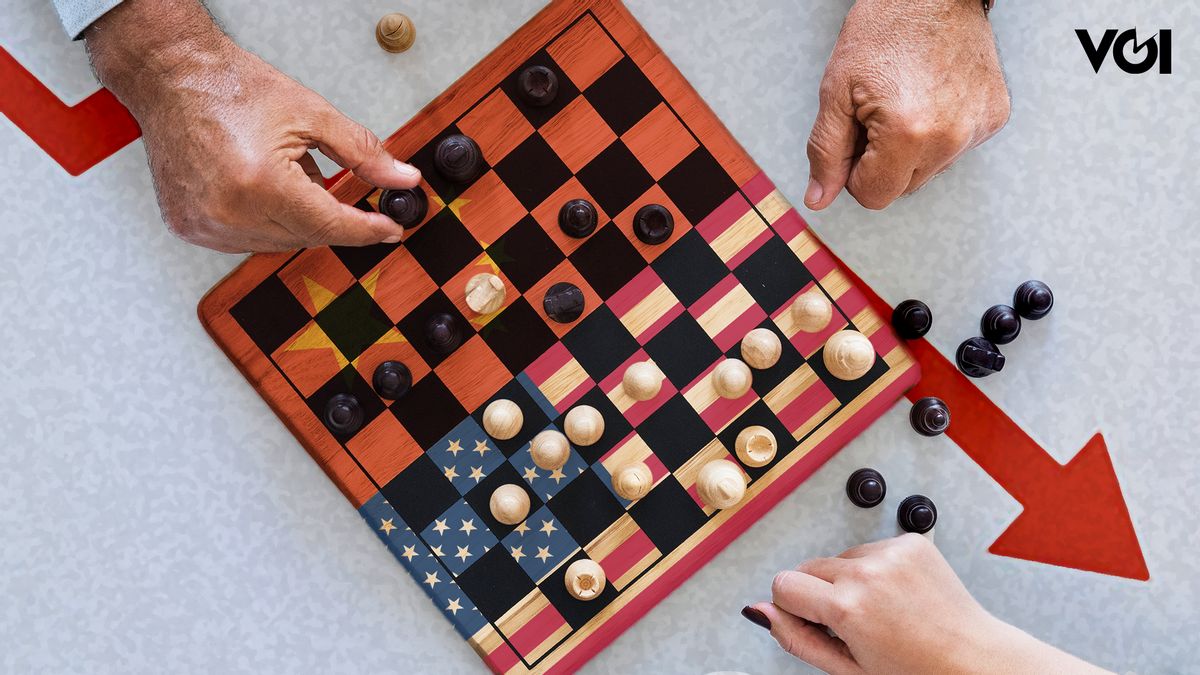
JAKARTA - The trade war between the United States (US) and China is heating up and getting fiercer. The imposition of the known trade tariff (reciprocal tariff), which was originally added from Trump's statement regarding the imposition of imports of Chinese products that entered America by 10 percent, was charged a fare of 125 percent by the President of America.
The policy of imposing tariffs can actually affect the US community itself, because the manufacturing industry in the US, because the raw materials come from imports. If it is subject to high costs, America's economy will definitely be affected. But why was the policy carried out by Trump. "We have to look at the marineing game context, I see that trade is a tool, bargaining," said former Finance Minister of the Presidential Era of SBY, Chatib Basri at the Panel Discussion event The Yudhoyono Institute, Sunday, April 13, 2025.
Trump's policy is considered to weaken the US manufacturing industry, which will create a high dependence on their defense industry, this articulation is being sold everywhere. But in fact, this is to force several countries to come for negotiations to the US, including all Asian countries flocking to negotiations to the US. It's just that what the US doesn't count is that China actually retaliates (retaliatory actions for the imposition of tariffs).
China replied to Trump's policy by blocking American products from the border. They said if America continued to impose a tariff increase on goods from China, it would ignore the policy.
As is known, the US is China's largest market besides Canada and Mexico. According to data from the American Census Bureau in 2024, American exports to China were only US$143.5 but Chinese exports to America reached US$439 billion, which describes US buyers having greater challenges finding sources of imports to goods such as smartphones, laptops, batteries, electricity and children's toys, which are the largest parts of goods purchased from China.
US President Donald Trump was upset and accused other countries - especially China of exploiting the US in trading, and stated that his protectionism agenda was needed to revive their manufacturing industry. Seeing the surge in US imports to China which only reached around $145, compared to the other $440 billion imports. This means China has a huge trade surplus with the US.
On February 3, 2025, two weeks after Trump was sworn in, the US President announced the imposition of an additional 10 percent tariff for all goods purchased from China. The policy was also applied to a number of countries, including Indonesia, which received a 32 percent tariff, because Indonesia is considered to have imposed a higher withdrawal of Etanol Imports from the US.
A number of countries reacted to Trumps' tariff policy, a number of countries fought back and partially responded, others had negotiations, including Indonesia, stating that they chose the negotiation route.
But for countries that have a strong economy like China, they are fighting back. Trump's policy was replied by the Beijing government. Through an announcement made by the Chinese Tariff Council, it stated that it would increase the import rate of American goods from 84 percent to 125 percent.
In retaliation for the imposition of the import rate has been going on since 2017, the additional tariff, levies on Chinese imports jumped to 104 percent at the start of the Trump administration. And Beijing responded to an increase. Trump's move doesn't seem to have much effect, because when there is pressure on the US. China has instead shifted its views to other countries such as Thailand and Vietnam for its import purposes.
So that as a result, the target to reduce the value of China's economic growth to 3 percent was not achieved. Instead, they are worried about the regulatory growth in the US side.
However, China's trade war with America still has a worrying impact on the global climate and threatens to have an impact on the economy widely. Indeed, in general, Trump's policy is not worrying for Indonesia. The value of Indonesia's exports to America in 2023 is only 23.3 billion US dollars.
Coordinating Minister for Economic Affairs, Airlangga Hartarto, said that there are several industries that will be affected by Trump's tariff policy, many superior products such as textiles, electronics, footwear, palm oil, rubber, furniture, and fisheries will be affected.
The national export-dependent industry to the US, such as textiles, garment, footwear, and palm oil products, will feel the direct impact of this policy. According to information from the official website of the Indonesian Ministry of Trade. The trade war between the United States (US) and China has recently caused significant disruption to the global supply chain, with the impact felt by various countries, including Indonesia. Here are some major developments related to this:
The US has raised the import rate of Chinese products to 145%, while China retaliates by increasing the import rate of US products to 125%. This policy takes effect from April 12, 2025, and exacerbating global trade tensions.
China also accused the US of "extortion" and violating the principles of the World Trade Organization (WTO), while the US argued that this policy was necessary to protect its domestic industry.
This tariff war threatens the stability of global supply chains, especially for commodities such as wheat, soybeans, and manufactured products. Indonesia, as the largest importer of wheat, relies on supplies from the US, Russia, and Ukraine, so that tariff increases can affect basic food prices such as instant noodles, bread, and tempeh.
Electronic, textile, and footwear sectors were also affected because many global companies are looking for alternative supplies outside China to avoid high tariffs.
Some analysts see this trade war as an opportunity for a country like Indonesia to enter a global supply chain that is changing. The manufacturing, energy, and mineral resources sector of Indonesia is considered to have great potential to attract foreign investment.
A study from the Indonesian Chamber of Commerce and Industry estimates that the US tariff policy against China could have the opportunity to increase Indonesia's exports to the US to USD 1.69 billion, especially in the textile, footwear and electronics sectors.
President Prabowo Subianto emphasized that Indonesia would not take sides in this conflict and would act as a "bridge" between the US and China. He also stated that Indonesia would not cut off trade relations with China.
The Indonesian government is trying to take advantage of this situation to strengthen the domestic industry and expand the export market, even though competition challenges with Vietnam, Malaysia and Thailand remain high.
Global Recession Concerns
Some analysts warn that this trade war could trigger a recession in the US and slow global economic growth. JP Morgan and Goldman Sachs warned of the possibility of a recession in the US due to rising prices and inflation triggered by tariffs.
The US-China trade war has disrupted the global supply chain, increased economic uncertainty, and triggered an increase in commodity prices. However, on the other hand, countries such as Indonesia have the opportunity to take advantage of this situation to attract investment and expand exports. A strategic response from the government and business actors will determine the extent to which Indonesia can survive and develop in the midst of this turmoil.
The trade war between the United States (US) and China has created disruptions in the global supply chain. But behind these challenges, Indonesia has a great opportunity to accelerate industrialization. Here are some positive impacts and strategies that can be exploited:
Many multinational companies, particularly in the electronics, textiles and manufacturing sectors, are considering moving their production bases from China to lower production costs, such as Indonesia, Vietnam, and Mexico.
Indonesia has cheap labor, abundant natural resources, and a large domestic market, which is attractive to investors who want to avoid high US-China rates. With a high tariff on Chinese products, the US is looking for alternative suppliers. Textiles, footwear, and Indonesian light electronic products can fill this gap, with an additional export potential of up to USD 1.69 billion.
Opportunities are also open in non-traditional markets such as Africa, Latin America, and the Middle East, which have been dependent on China. Indonesia can take advantage of this momentum to reduce the export dependence of raw materials and increase added value through downstreaming, such as nickel, palm oil, and rare earth metal processing. Rare earth metal (LTJ) is a group of 17 chemical elements on a periodic table that has similar properties and is often used in various modern technologies. LTJ is also known as Rare Earth Element (REE) or rare earth elements.
Strategic sectors such as electric automotive, vehicle battery, and renewable energy can develop with foreign investment support. Catalan, Indonesia must be able to improve the investment climate and infrastructure. The government needs to accelerate bureaucratic reform, provide fiscal incentives, and improve infrastructure quality to attract more industrial relocation.
Special economic zones (SEZs) and industrial parks can be a new growth center for the manufacturing industry. Small and medium industries (IKM) need to adopt digital technology for global production and marketing efficiency. Strengthening human resources through vocational education will help Indonesia compete with Vietnam and India in attracting technology-based investment.
So how is Indonesia's strategy in responding to the tariff policy. The relevant Ministry reported that it has established communication with the United US government, the US Chamber of Commerce, asking other governments to choose the lines of communication to find mutually beneficial solutions.
Three Indonesian strategies in maintaining the national economy, expanding trading partners by signing various agreements and trade agreements both bilaterally and multilaterally. Providing Danantara's strength to accelerate downstreaming and accelerate added value, bringing people's purchasing power, one of which is the establishment of 80,000 Red and White Cooperatives. With these 3, it is hoped that the economy will continue to grow during uncertain situations.
The former 6th President, Susilo Bambang Yudhoyono, appreciated Prabowo's actions in responding to Trump's Resipprocal tariff policy. SBY assessed that the government's move was right to choose negotiations over retaliation. According to him, Prabowo's move to send a negotiating team to Washington DC is right. The steps taken by the monetary authority with the fiscal sector to continue to maintain the economy, including fiscal control, including the state debt.
Meanwhile, former Vice President to I0 and 12, Jusuf Kalla said that Indonesia does not need to worry about Trump's tariff policy, Trump's import tariff policy of 32 percent is estimated to have a 10 percent impact on Indonesia. He emphasized that this policy will not have much impact on the Indonesian manufacturing industry.
He also advised the government to supervise industry players to stay afloat and continue to contribute to Indonesia's economic growth. Jusuf Kalla also advised Indonesia not to rush to reply to US tariff policies but to focus more on negotiating and diplomacy efforts.
The English, Chinese, Japanese, Arabic, and French versions are automatically generated by the AI. So there may still be inaccuracies in translating, please always see Indonesian as our main language. (system supported by DigitalSiber.id)


