


JAKARTA - Apple is reportedly preparing its first foldable device, which is temporarily dubbed the "iPhone Ultra." However, the latest leaks have raised a big question: why does a device with a price tag of almost US$2,000 or around Rp34 million actually lose a number of premium features?
The latest report says that there are at least five important features that will not be present in the Ultra iPhone, even though this device is positioned as the most expensive and futuristic model in the iPhone lineup.
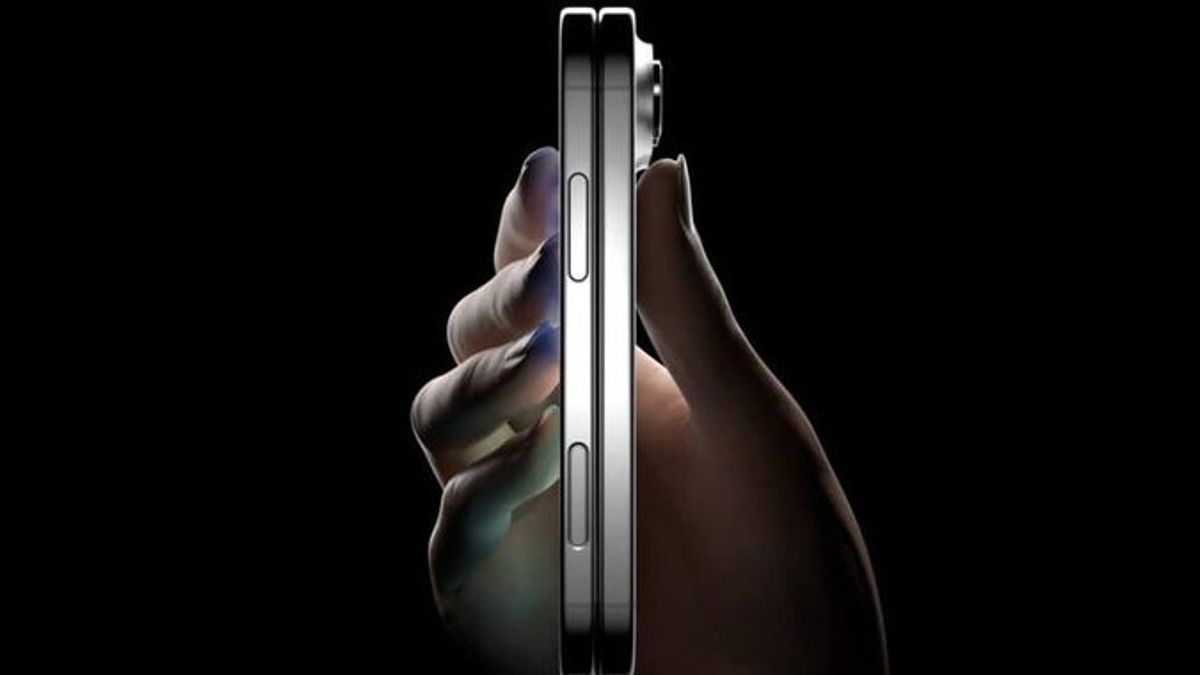
Based on the dummy unit images shared by leakers Sonny Dickson and Vadim Yuryev, the iPhone Ultra will likely not have MagSafe or Action Buttons. In fact, both features are already an important part of the modern iPhone ecosystem.
The absence of MagSafe is quite surprising because this technology has become the standard for wireless charging and Apple's magnetic accessories. However, with a thickness of only about 4.5 mm, the Ultra iPhone is said to be the thinnest iPhone ever made.
The condition is suspected to make the internal space too limited for the MagSafe magnetic system. If true, the thin design comes with a price of compromise.
Not only that, the iPhone Ultra is also expected not to be equipped with the TrueDepth camera system that is the basis of the Face ID feature. Instead, Apple is said to be bringing back Touch ID as the main authentication method. This is a pretty drastic move.
The last time the iPhone used Touch ID was on the iPhone SE (3rd generation), while the last flagship with that technology was the iPhone 7. If this rumor is true, then the Ultra iPhone will be Apple's first flagship in a decade that abandons Face ID. The reason is suspected to be the same: a body that is too thin to accommodate the complex front camera components.
In the photography sector, the iPhone Ultra is also said to only carry two rear cameras - wide and ultra wide. This means that there is no telephoto camera like the one available in the Pro line. In fact, optical zoom capabilities have become one of the hallmarks of premium iPhones in recent years.
The absence of a third camera could be a weak point for users who want high-end photography flexibility.
Another feature that is predicted to be lost is the physical SIM slot. The device is said to only support eSIM, following a trend that Apple has already started to implement in some markets.
In total, five features that are expected to be absent from the Ultra iPhone are Face ID, telephoto camera, MagSafe, Action Button, and physical SIM slot. Even so, Apple seems to still rely on the appeal of the design.
The iPhone Ultra is said to come with a titanium frame, a super thin body, and a premium glass back. Aesthetically, this device is expected to be similar to the iPhone Air concept, but in a folding format.
The initial price of this device is said to be no less than 1,999 US dollars. For comparison, the iPhone 17 Pro is priced starting at 1,099 US dollars and still has all the features that are actually missing in the Ultra iPhone.
It is this significant price difference that has the potential to spark controversy. Because consumers may have to pay almost twice as much for a more innovative device, but not necessarily more complete.
Apple seems to be testing one important thing: whether a revolutionary design is enough to cover the compromise of features.
Follow VOI Whatsapp Channel
The English, Chinese, Japanese, Arabic, and French versions are automatically generated by the AI. So there may still be inaccuracies in translating, please always see Indonesian as our main language. (system supported by DigitalSiber.id)
Most Popular Tags
#Prabowo Subianto #donald trump #firearm #8791 #giias 2026Popular


