
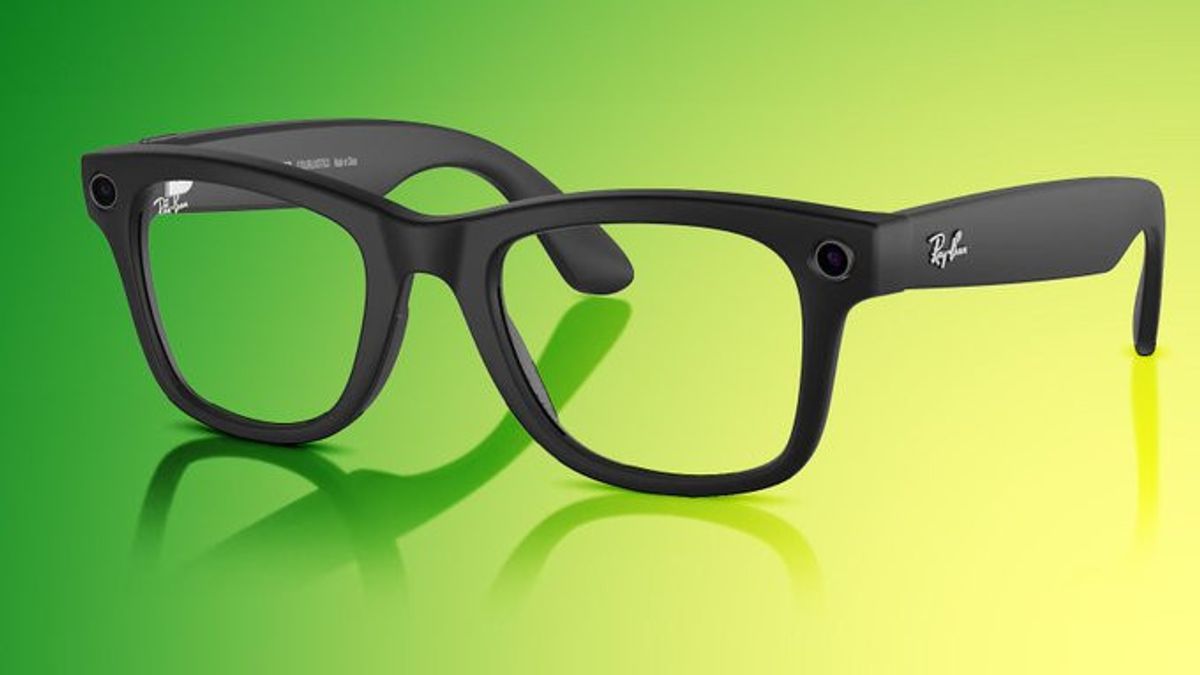


JAKARTA - Smart glasses are getting thinner, but the privacy issue is getting thicker. In the midst of the controversy over the use of Meta Ray-Ban to record in the bathroom, the courtroom, to the doctor's clinic, an Android app called Nearby Glasses actually emerged as an example of a security that is worth emulating before Apple actually launches Apple Glass.
The app was developed by Yves Jeanrenaud and works by detecting Bluetooth "advertising frames" - a kind of small signal emitted by nearby wireless devices. If a smart glasses are detected, the user's phone will give a warning. Jeanrenaud calls his work "a small part of the resistance to surveillance technology."
Currently, Nearby Glasses is only available on Android via Google Play and GitHub. The application can indeed generate false positives, for example when it is near a VR headset such as the Apple Vision Pro. However, practically, it is unlikely that people will walk around in public spaces while wearing a large and conspicuous VR headset. Smart glasses like Meta Ray-Ban are designed to look like regular glasses - just thick, maybe, but still "normal" in the eyes of the public.
The problem is not with the technology, but with how it is used. Meta Ray-Ban is basically a camera that can be worn on the face and connected to social media.
The emerging trend shows that some users use it to record spa staff without permission, live streaming in a private room, and even taking it to the courtroom.
A judge in California, Carolyn Kuhl, has publicly voiced concerns that such devices, if combined with facial recognition, could identify jurors in court.
This is where Apple's dilemma emerges. The company is known for its "privacy-first" approach. However, the smart glasses market has already been formed by Meta and Snap as a device for recording and sharing content instantly. Consumer expectations have already been formed: smart glasses are live cameras.
If Apple chooses an extreme ethical path - for example, presenting glasses without the ability to record photos or videos - then the device may be praised by privacy activists, but it risks being considered a commercial failure. On the other hand, if Apple follows the market trend and includes full recording features, it will enter the same gray area that is now being debated publicly.
Technically, there is a middle ground. Cameras can be restricted to utilitarian functions such as navigation, object identification, or visual accessibility, without opening up free live streaming access. The recording LED indicator can be made larger and cannot be modified. Even detection systems such as Nearby Glasses can be integrated natively into iOS as a community protection feature.
But the reality of the industry is often more pragmatic than idealistic. Integration with social platforms is a vending machine. The camera is the main magnet. History shows that the actual use of a device often defines its purpose, not the original intention of its creator.
Consumer surveillance technology - from doorbell cameras to AI glasses - doesn't seem to be going away. Regulation is still limping along, while innovation is racing ahead. In that context, a small app like Nearby Glasses feels like a smoke alarm in a room that's starting to get hot.
If Apple really wants to differentiate itself, it may not just be about elegant design or power-efficient chips, but rather about how it designs ethical fences around its products. In an increasingly filled future lenses and sensors, transparency could be the most revolutionary feature.
The English, Chinese, Japanese, Arabic, and French versions are automatically generated by the AI. So there may still be inaccuracies in translating, please always see Indonesian as our main language. (system supported by DigitalSiber.id)


