

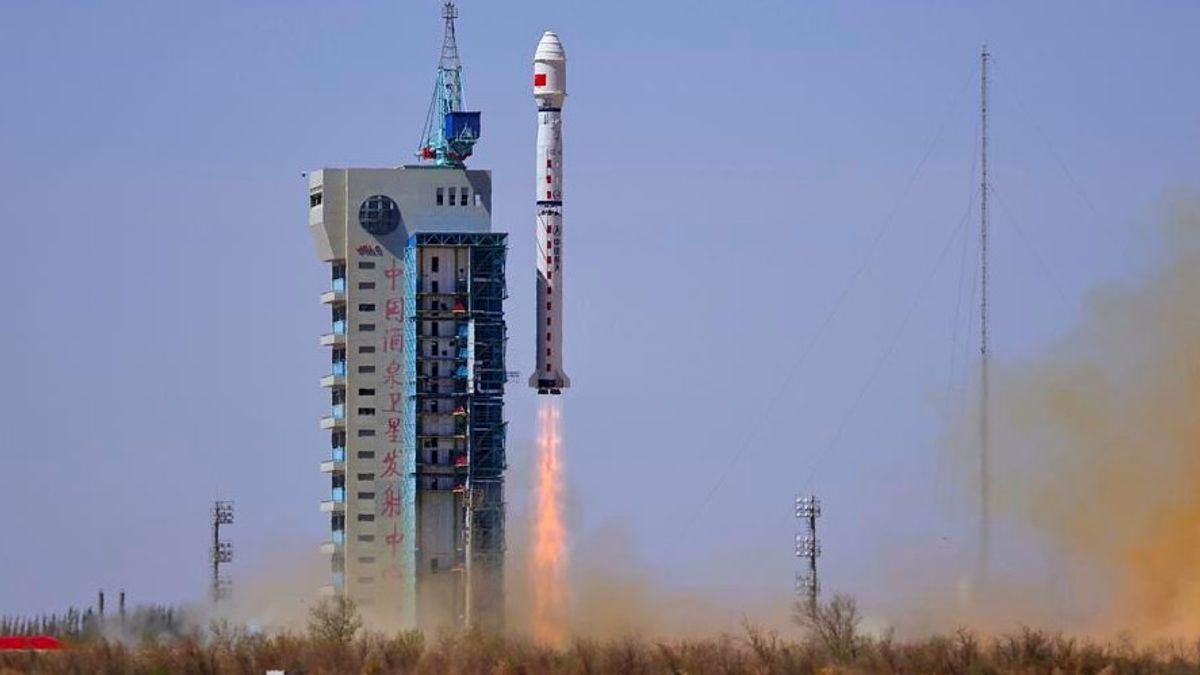


China is getting more serious about using space technology to monitor carbon emissions. The latest step was taken through the Tianzhou-10 cargo spacecraft, which sent a greenhouse gas monitoring device to the Chinese space station.
Quoted from Xinhua, Tuesday, May 12, the device is a high-resolution lightweight instrument to detect the source of greenhouse gas emissions. Its development is led by Hong Kong University of Science and Technology.
The instrument will be installed on the outside of the space station. Its function is to measure the concentration of carbon dioxide and methane in the main emission sources at medium to low latitudes in the world.
Data from this tool will be used to support monitoring, reporting, and verification of greenhouse gas emissions. More accurate data is needed so that the implementation of climate targets can be measured more clearly.
"This equipment will provide strong data support for China's 'double carbon' initiative and contribute China's wisdom to the global response to climate change," said the National Space Science Center under the Chinese Academy of Sciences.
China has set a double carbon target, with carbon dioxide emissions peaking before 2030 and carbon neutral before 2060.
The launch of the Tianzhou-10 cargo was part of China's series of steps in building a carbon monitoring system from orbit. Last month, China also launched a high-precision greenhouse gas detection satellite equipped with an atmospheric lidar.
Lidar is a laser-based long-distance scanning technology. In this context, lidar is used to read the atmospheric composition more carefully.
In April 2022, China launched an atmospheric environment monitoring satellite. In July 2024, the satellite is said to be able to detect the concentration of carbon dioxide columns with a precision of 1 ppm and operate globally all the time. Ppm or parts per million is a unit to indicate the amount of substances in very small amounts.
China first launched TanSat in 2016 as its first global CO2 monitoring satellite. Data from the satellite was then used for global carbon cycle research and scientific cooperation, including with a team from Finland.
Carbon monitoring is becoming more important after China launched a national emissions trading market in July 2021. The market is said to be growing to become the largest in the world based on the total greenhouse gas emissions traded.
China Aerospace Science and Technology Corporation expert Zhu Wenshan said traditional carbon accounting still relies on estimates of activity data and emission factors. That way it can create data gaps.
"Although meteorological satellites such as Gaofen and Fengyun have some carbon monitoring functions, their accuracy is not enough to systematically meet our comprehensive needs in tracking greenhouse gas emissions," Zhu said, quoted by Xinhua.
China also launched the Goumang satellite in 2022 to monitor forest carbon uptake. The satellite is fully operational in 2024 and is designed to detect biomass, vegetation productivity, and atmospheric aerosol distribution.
The private sector is also involved. Dyscienc, a start-up company from Ningbo, is preparing a constellation of 28 satellites, seven to monitor carbon sources and 21 to monitor carbon absorption. The first carbon source satellite is targeted to be launched by the end of 2026, with global carbon monitoring almost in real time before 2030.
The English, Chinese, Japanese, Arabic, and French versions are automatically generated by the AI. So there may still be inaccuracies in translating, please always see Indonesian as our main language. (system supported by DigitalSiber.id)
Most Popular Tags
#Prabowo Subianto #donald trump #firearm #8791 #giias 2026Popular


