



JAKARTA - In the midst of the digital rush, children are now more familiar with the screen of their gadgets than the playing room. This condition raises the importance of returning children to real movement, play, and physical experiences.
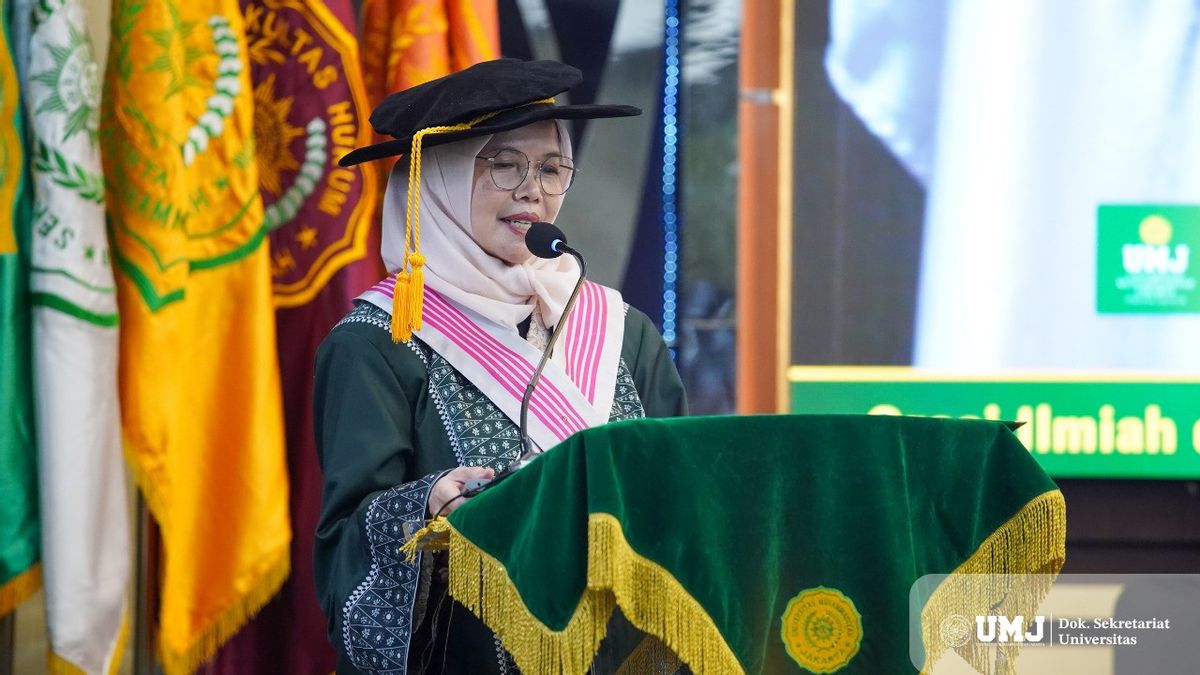
The message was conveyed by Prof. Dr. Diah Andika Sari, M.Pd., a professor at the Faculty of Educational Sciences (FIP) UMJ who was confirmed in the Open Senate Session of the University of Muhammadiyah Jakarta (UMJ) at the Auditorium of dr. Syafri Guricci Faculty of Medicine and Health (FKK), Tuesday, May 12, 2026.
In the academic toga, he delivered a scientific oration entitled "Physical Sovereignty: Through the Revitalization of the Motoric Foundation of Children Based on Local Culture in the Middle of Digital Hegemony".
The Professor of the Branch of Science/Expertise in Early Childhood Motor Development of the Faculty of Education Sciences, UMJ, highlighted how technological advances are slowly disrupting children's activity patterns. Children are now more often interacting with screens than the physical environment around them.
"The rapid development of technology disrupts children's activity patterns, creates dependence on screens and reduces children's natural movement space," said Diah.
According to him, this condition has created a phenomenon of sedentary behavior or minimal movement behavior which has an impact on the decline in the quality of children's growth and development. Not only physical health, but also motor, cognitive, and emotional maturity.
He explained that the lack of motor stimulation during the golden age has the potential to inhibit the optimal formation of the child's neural architecture. Therefore, motor development must be re-placed as the main foundation of early childhood development.
In his presentation, Diah revealed a gap between the theory of child development and educational practices in the field. Theoretically, physical-motor development has long been placed as the foundation of learning. However, in practice, early childhood education is more oriented towards academic ability.
"Although experts agree that motor skills are 'brain nutrition', the reality is that 92 percent of additional activities for young children are focused on cognitive abilities such as reading, writing, and counting," he said.
He assessed that the condition was a criticism of the modern education approach that unwittingly gave birth to a generation that was agile digitally through scrolling and swiping, but experienced a slowdown in body movement.
In the midst of this condition, Diah emphasized the importance of family and school involvement in building a balance of children's digital activities. The concept of digital parenting and neuroparenting, according to him, is an important part of reducing screen dependence while building a real movement experience for children.
"Technology must be used as a catalyst for learning, not a substitute for children's real experiences," he said.
Apart from family and school, local culture is also an important part of the "Physical Sovereignty" concept that he carries. Diah considers traditional games and regional dances not only as cultural heritage, but also as a contextual and meaningful motor learning medium.
The research he presented showed that learning traditional dance based on movement play was able to improve gross motor skills, body coordination, balance, movement creativity, and children's confidence. Children are also judged to be more enthusiastic when learning is packaged through a play, storytelling, and creative movement exploration approach.
Through the concept of embodied cognition, he invites the public to build children's understanding through real body experiences. For Diah, Indonesian children are not only academically and digitally superior, but must also grow healthy, creative, adaptive, resilient, and have a strong national identity.
The English, Chinese, Japanese, Arabic, and French versions are automatically generated by the AI. So there may still be inaccuracies in translating, please always see Indonesian as our main language. (system supported by DigitalSiber.id)
Popular


