
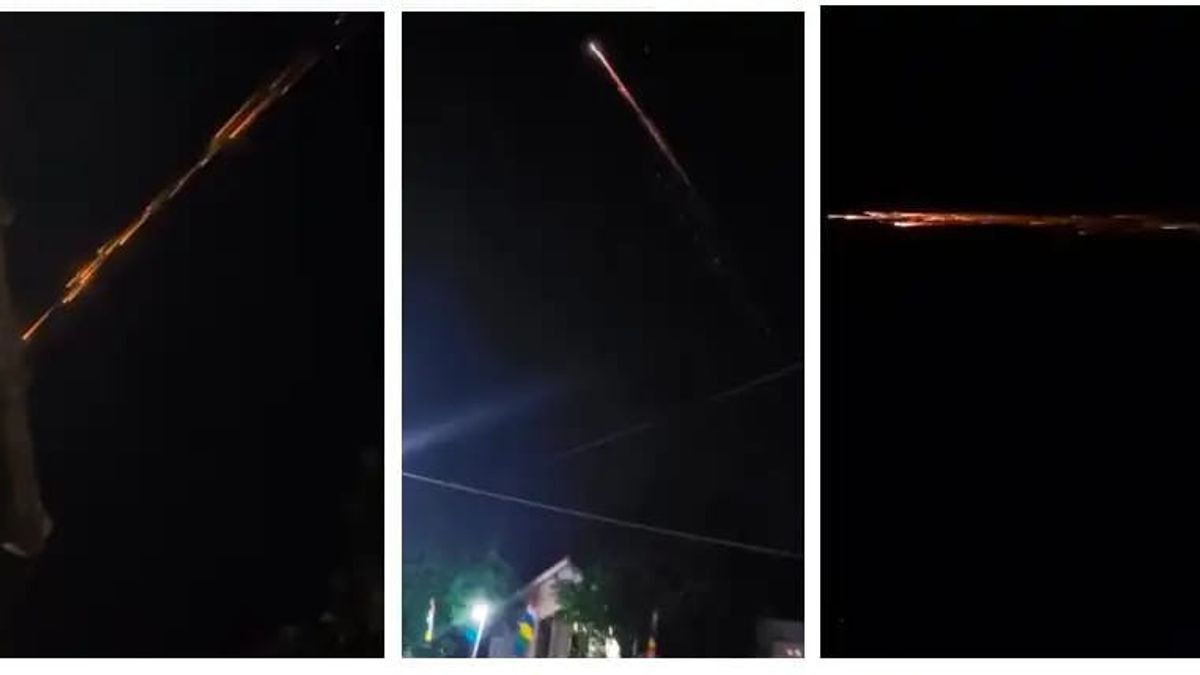


YOGYAKARTA - Some time ago, a glowing object that passed across the Lampung sky briefly made residents excited and was widely discussed on social media. The National Research and Innovation Agency (BRIN) revealed that the mysterious celestial object was space debris. What is space debris?
"People around Lampung and Banten were shocked by the bright object that slid across the sky and seemed to be broken into several parts. That is a piece of space debris," said BRIN Astronomy Professor Thomas Djamaluddin when confirmed in Jakarta, reported by the Antara website, Sunday (5/4/2026).
What is Space Junk?Space debris is a man-made object that is in outer space and no longer has a function. Quoted from the Natural History Museum's website, space debris can be the parts of a rocket, a dead satellite, to small fragments from the collision of objects in orbit.
The object still orbits the Earth at high speed and as the launch activity of satellites and space missions increases, the number is increasing. This condition attracts the attention of scientists because space debris can interfere with activities in orbit.
The Natural History Museum revealed that some space debris can eventually return to the Earth's atmosphere and burn so that it looks like a bright light from the Earth's surface.
Where Does Space Junk Come From?Space debris is formed from various human activities in space. Quoted from the BRIN page regarding the dangers of space debris, the main source comes from rocket launch debris, inactive satellites, and debris caused by object collisions in orbit.
The increasing activity of launching satellites makes the number of objects in orbit more and more. Objects that are no longer useful remain in orbit and if not controlled have the potential to become space debris.
BRIN revealed that space debris is a challenge in space management because its movement is difficult to control and can invite risks for active satellites or space missions.
Is Space Junk Dangerous?Space debris carries risks that need to be watched out for because it moves at very high speeds in orbit. Reported from the BRIN website, there are at least two dangers of space debris, namely when in orbit and when falling to the Earth's surface.
"During orbiting, there is a potential for space debris to collide with active satellites. This will cause problems for the active satellite so that there are efforts to limit space debris. Another danger is when it falls on the Earth's surface, it can be seen in terms of size can be up to tons. This has the potential to be dangerous but the occurrence is rare," explained BRIN Astronomy Professor Thomas Djamaluddin, reported on the BRIN website.
Space Debris that Fell in IndonesiaBRIN stated that space debris had fallen several times in Indonesian territory. Based on data collected by BRIN, the incident occurred in 1981 in Gorontalo owned by Russia, 1988 in Lampung owned by Russia, 2004 in Bengkulu owned by the Republic of Indonesia, 2016 in Sumenep Madura owned by the United States, 2017 in West Sumatra owned by the Republic of Indonesia, and 2022 in West Kalimantan owned by the Republic of Indonesia.
If you refer to BRIN's explanation, Indonesia has the potential to be crossed by space debris because it is located in the equatorial region which is the orbit path for many satellites and rockets. Therefore, monitoring of space objects must continue to be carried out as a step to anticipate the potential for space objects to fall into Indonesian territory.
BRIN also said that space debris that falls is the responsibility of the owning country. Ownership of objects can be known from space catalogs and orbit trajectory analysis, so if there is a large loss it can involve the launching country in accordance with international legal provisions.
That's an overview of what space debris is. Hopefully useful. Visit VOI.id for other interesting information.
The English, Chinese, Japanese, Arabic, and French versions are automatically generated by the AI. So there may still be inaccuracies in translating, please always see Indonesian as our main language. (system supported by DigitalSiber.id)
Most Popular Tags
#Prabowo Subianto #donald trump #firearm #8791 #giias 2026Popular


