
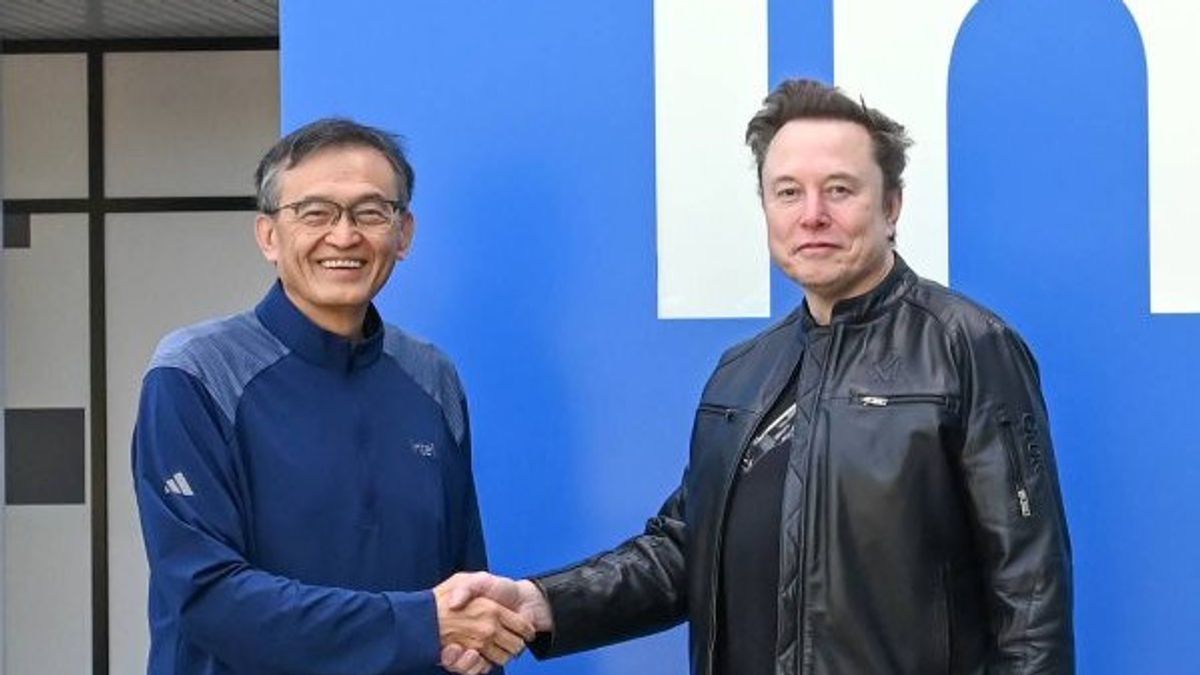


JAKARTA - Intel officially joined Elon Musk's ambitious "Terafab" project, strengthening an industry-wide collaboration that targets the production of artificial intelligence (AI) chips for humanoid robots to the next generation of data centers, including in space.
In this project, Intel will work with Tesla and SpaceX to develop high-performance processors that are the backbone of Musk's AI ambitions. The announcement had an immediate positive impact on the market, where Intel shares jumped more than 2 percent.
Intel CEO, Lip-Bu Tan, called Musk the right disruptor to change the semiconductor industry. "Elon has a track record of reimagining entire industries. This is what the semiconductor industry needs today. Terafab is a big leap in the way logic chips, memory, and packaging will be produced in the future," he said.
The Terafab project is designed to generate computing capacity of up to 1 terawatt per year - a figure that reflects the massive scale of future AI needs, especially for robotics and autonomous systems.
A few months earlier, Musk had revealed plans to build two advanced chip facilities in Austin, Texas. One facility will be focused on supporting Tesla's autonomous vehicles and humanoid robots, while the other facility is intended for AI data centers, including potential implementation in space.
This step further reinforces Musk's strategy of integrating AI across sectors - from electric cars, robots, to orbital computing infrastructure.
"Intel is proud to join the Terafab project with @SpaceX, @xAI, and @Tesla to help refactor silicon fab technology.
"Our ability to design, fabricate, and package ultra-high-performance chips at scale will help accelerate Terafab's aim to produce 1 TW/year of compute to power… pic.twitter.com/2vUmXn0YhH
— Intel (@intel) April 7, 2026
On the other hand, SpaceX is also reported to have filed confidential documents for an initial public offering (IPO) in the United States. If realized, this move has the potential to be one of the largest stock listings in the history of the global capital market.
For Intel, this partnership is an important momentum in its efforts to revive after falling behind in the AI chip race against competitors such as Nvidia. D.A. Davidson analyst Gil Luria assessed the cooperation with Tesla as a strong signal that Intel is starting to regain the trust of major clients.
"Intel needs to prove it can support the most critical projects of its largest customers, and the partnership with Tesla shows it," Luria said, calling it a "pivotal step" in the company's restructuring.
Over the past year, Intel has been undergoing an aggressive transformation under Tan's leadership, including cost efficiency, layoffs, and asset sales. The company also received a major investment injection from the US government and industry players such as Nvidia.
But challenges still loom, especially in their contract manufacturing business, Intel Foundry, which recorded an operating loss of more than 10 billion US dollars in 2025 despite only a slight increase in revenue.
Now, Intel is betting on its latest manufacturing technology, 18A, which it has begun opening up to external customers as part of a strategy to claw back global chip market share.
Follow VOI Whatsapp Channel
The English, Chinese, Japanese, Arabic, and French versions are automatically generated by the AI. So there may still be inaccuracies in translating, please always see Indonesian as our main language. (system supported by DigitalSiber.id)
Most Popular Tags
#Prabowo Subianto #donald trump #firearm #8791 #giias 2026Popular


