

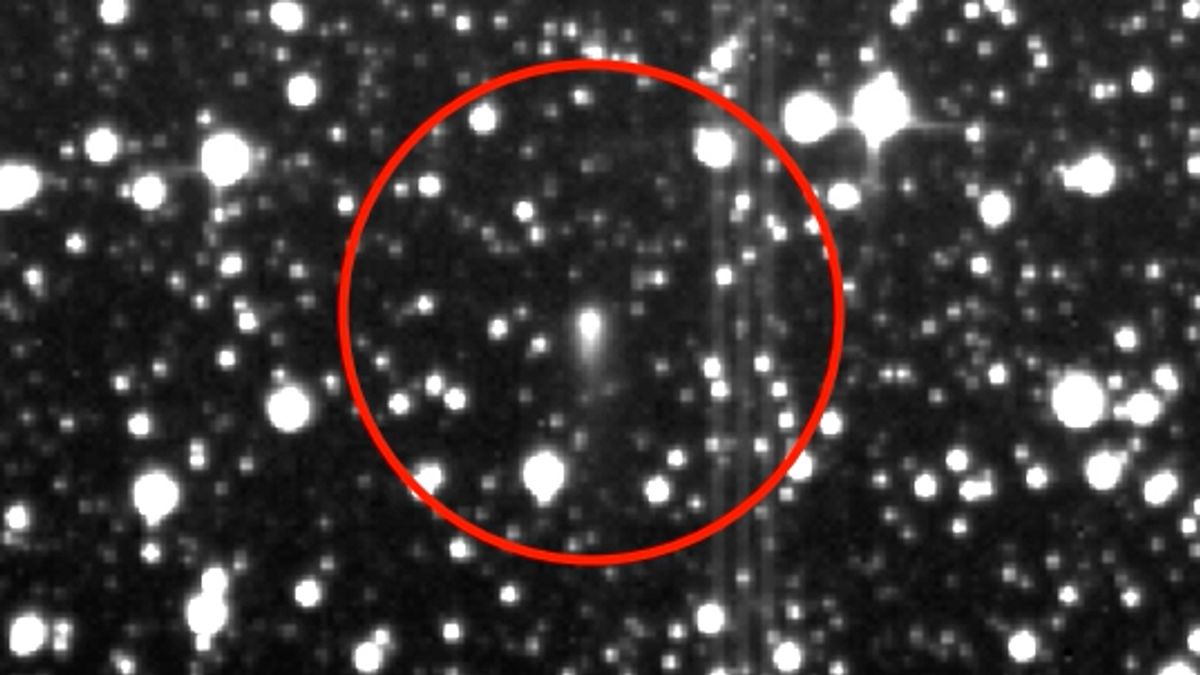


JAKARTA - NASA's TESS satellite has observed the interstellar comet 3I/ATLAS again. This observation was carried out by scientists to study the activity and rotation of the foreign object.
Daniel Muthukrishna from MIT, as reported by NASA, has compiled a series of images from the satellite into a short video. In the footage, 3I/ATLAS is seen as a bright point that moves agilely with its comet tail.
The brightness level of this comet was recorded at magnitude 11.5, which is very dim for human vision. Its light is 100 times weaker than objects that can be seen directly with the naked eye.
The data taken from January 15 to 22 have now been published and are accessible to the public. Astronomers can download it through the Mikulski Archive for Space Telescopes.
The TESS satellite is designed to search for exoplanets by scanning the light variations of distant stars. This technique has proven to be very effective for monitoring the movement of comets and asteroids at very long distances.
Interestingly, TESS once captured the image of 3I/ATLAS in May 2025 before the comet was officially discovered. The discovery of this long trail was identified after astronomers combined several observations from the past.
This observation had technical problems and was temporarily halted for three days. The vehicle went into safe mode due to a problem with its solar panel. Fortunately, NASA technicians were able to overcome the problem.
The English, Chinese, Japanese, Arabic, and French versions are automatically generated by the AI. So there may still be inaccuracies in translating, please always see Indonesian as our main language. (system supported by DigitalSiber.id)
Most Popular Tags
#Prabowo Subianto #donald trump #earthquake #independence day #8791 #hut riPopular


