
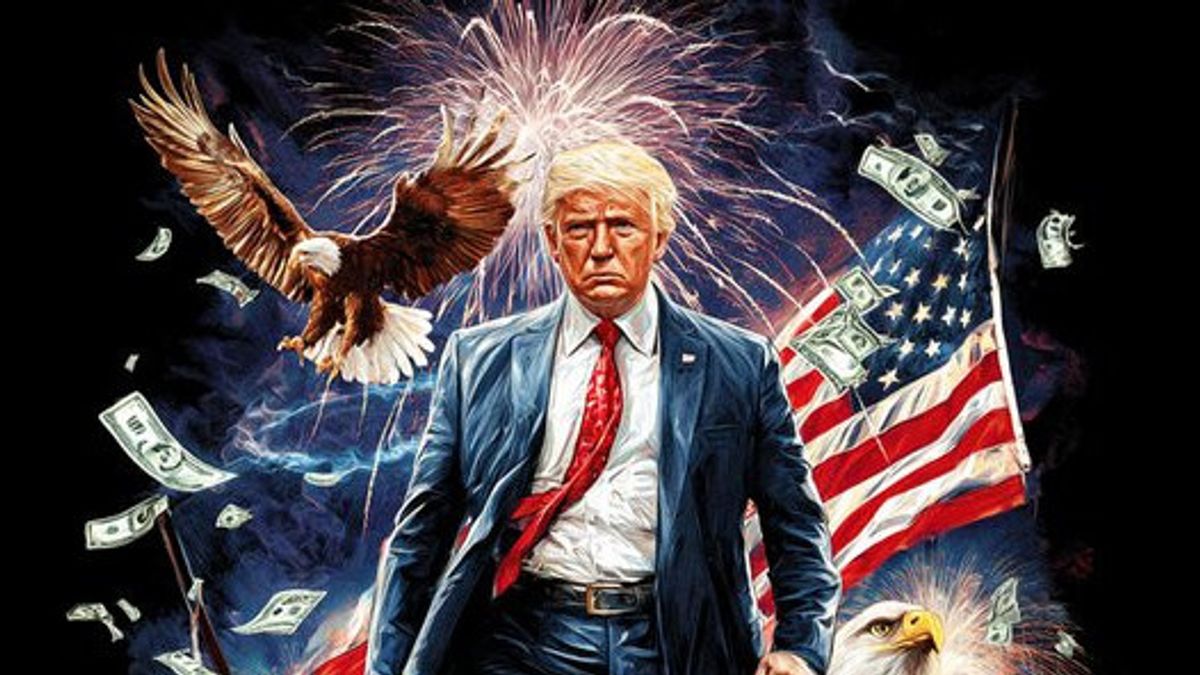


JAKARTA The administration of the President of the United States, Donald Trump, is preparing to announce a new blueprint for the development of artificial intelligence (AI) on Wednesday, July 23. The plan aims to relax various domestic rules governing the AI industry, while strengthening US positions in technological competition with China.
President Trump will deliver an important speech emphasizing US strategy to win the AI technology mastery race. Competition in this field is increasingly seen as one of the determining factors in the 21st century geopolitical map. Both the US and China have disbursed massive investments to develop AI technology to strengthen their economic and military positions.
The new plan will drive US AI technology exports overseas. The federal government will also take steps to limit laws at state levels that are considered too strict and deemed to be hampering the development of the AI industry. One concrete step that will be taken is to cut federal funding for AI projects in states that implement regulation is too strict.
The Federal Communications Commission (FCC) will be asked to evaluate whether various AI rules at the state level are against policies set by the central government. These measures mark significant changes to President Joe Biden's era policies that implemented more protective approaches, including limiting exports of advanced AI chips to various countries due to concerns about their abuse.
The launch of the plan titled "Winning the AI Race" will be attended by a number of top Trump administration officials, including Foreign Minister Marco Rubio and National Economic Advisor Kevin Hassett. David Sacks, who serves as Head of AI and Crypto Policies at the White House, will be one of the keynote speakers at the event with his colleagues from the famous podcast All-In.
The Hill and Valley Forum group, an informal forum consisting of thinkers and venture capitalists who helped design Trump's AI policy during the campaign, will host the event. This forum is known to have a strong influence in the preparation of various Trump's government technology policies.
In the coming weeks, Trump is expected to take additional steps to support the big tech industry in meeting their electricity supply needs. This need is increasingly pressing as AI data center developments are known to be very wasteful of energy.
Recent data show that demand for electricity in the US has hit record highs this year, ending a stagnation period that lasted nearly two decades. The surge in demand was mainly driven by the widespread development of data centers for AI purposes and cloud computing across the country.
Trump's new policy reflects fundamental differences with the Biden administration's approach. Trump has focused more on removing various regulatory barriers to accelerate AI development, while Biden has previously emphasized more on restrictions to prevent the misuse of technology by countries like China.
The Biden administration has previously implemented various export restrictions on state-made AI chips such as Nvidia and AMD to China, due to concerns that the technology could be used to strengthen China's military capabilities.
SEE ALSO:




Trump has revoked these various policies, including Biden's executive order to limit exports of AI chips and regulations that limit AI computing capacity that may be imported by certain countries.
In May 2025, Trump even announced a deal with the United Arab Emirates that provides broader access to the Gulf state to advanced AI chips from the US. Whereas previously, the United Arab Emirates was one of the countries facing restrictions over concerns that the technology could reach China.
These measures are part of Trump's great strategy to maintain US dominance in mastery of AI technology at the global level, as well as encourage the growth of the domestic technology industry. By reducing various regulatory barriers and expanding the export market, the Trump administration hopes to spur innovation and development of AI in the country while strengthening US influence in the international arena.
Analysts predict the new policy will gain support from the tech industry, but may draw criticism from those concerned about the impact of national security due to easing various sensitive technology export restrictions.
The English, Chinese, Japanese, Arabic, and French versions are automatically generated by the AI. So there may still be inaccuracies in translating, please always see Indonesian as our main language. (system supported by DigitalSiber.id)


