
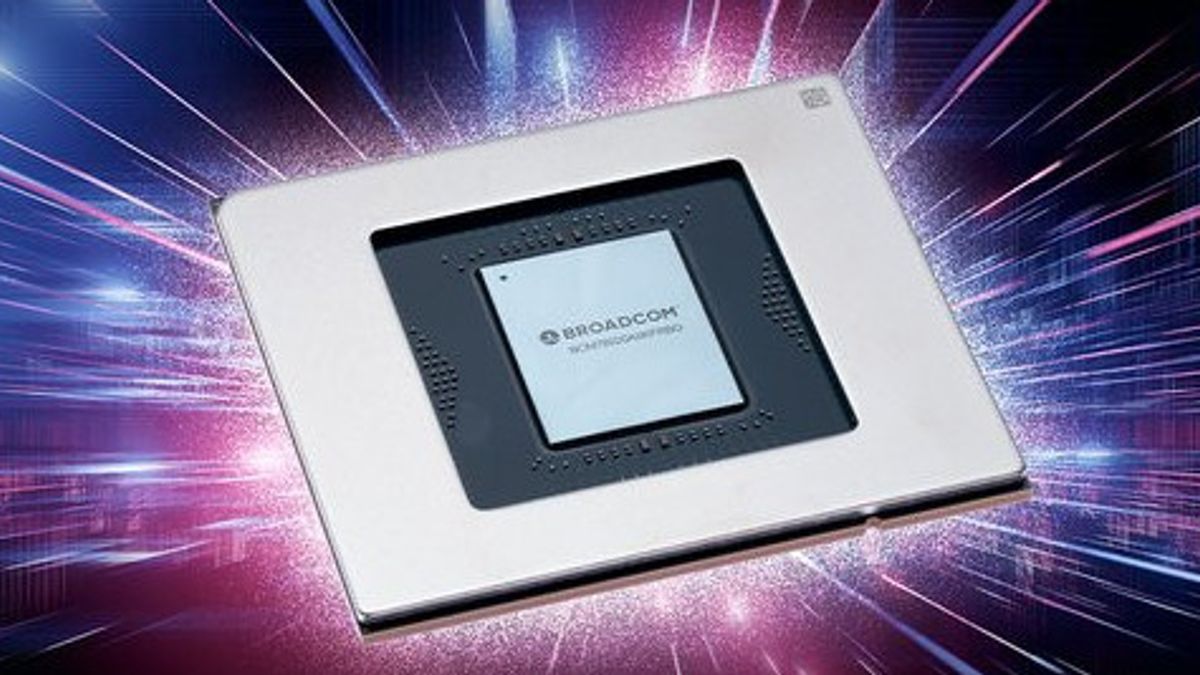


JAKARTA - Broadcom chip units on Tuesday 15 July introduced a new network processor designed to accelerate artificial intelligence (AI) data processing, which requires hundreds of chips to work together.
This new chip, called the Tomahawk Ultra, is part of Broadcom's efforts to rival AI giant, Nvidia. Broadcom also helps Alphabet's Google produce AI chips, which developers and industry experts consider a viable alternative to Nvidia's powerful graphics processor (GPU).
The Tomahawk Ultra functions as a fast-moving data traffic controller between tens or hundreds of chips that are in close proximity within the data center, as in one server rack. According to Velaga, Broadcom Senior Vice President, this chip is capable of connecting four times more chips than Nvidia's NVLink Switch chip which has similar functions. Unlike Nvidia's ownership protocol, the Tomahawk Ultra uses an enhanced version of Ethernet for speed.
Both chips from the company allow data center builders to connect as many chips as possible within a few meters, a technique the industry calls "scale-up" computing. By ensuring adjacent chips can communicate quickly, software developers can leverage the required computing power for AI.
"The Tomahawk Ultra processor is produced by Taiwan Semiconductor Manufacturing using five nanometer process technology," Velaga said. This processor has now begun to be delivered.
The development of this chip design took about three years by a team of Broadcom engineers. Initially, the chip was designed for a market segment known as high-performance computing. However, as the AI boom is generative, Broadcom adapted this chip to be used by AI companies because it is suitable for large-scale computing needs.
The English, Chinese, Japanese, Arabic, and French versions are automatically generated by the AI. So there may still be inaccuracies in translating, please always see Indonesian as our main language. (system supported by DigitalSiber.id)


