

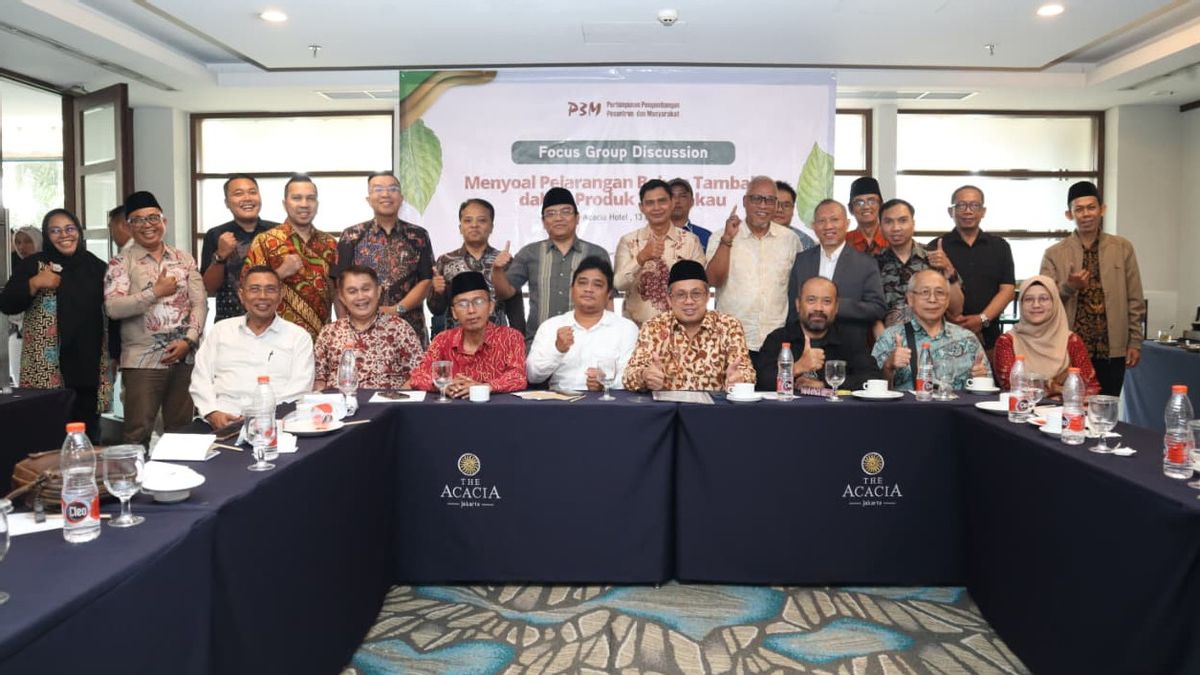


JAKARTA - The Association for the Development of Pesantren and Society (P3M) held a Focus Group Discussion (FGD) entitled "Questioning the Prohibition of Additives in Tobacco Products" on Wednesday (13/5/2026) at the Acacia Hotel, Jakarta.
This discussion aims to dissect the impact of the plan for the derivative rules of Government Regulation (PP) No. 28 of 2024 which is considered to exceed the mandate of regulation, especially regarding the prohibition of additives, restrictions on nicotine and tar levels, and standardization of tobacco product packaging.
The Balance Between Health and the Economy
Director of P3M, KH. Sarmidi Husna, MA., emphasized that tobacco regulation should not be seen from only one side. According to him, there is a large social and economic ecosystem behind this industry.
"The policy of banning additives must consider the social, economic, and sustainability impacts of communities that depend on the tobacco sector," said KH. Sarmidi Husna in his remarks.
He also emphasized the importance of cross-sectoral dialogue so that policies produced by the government are fair, proportional, and data-based (evidence-based).
Threat to 6 Million Workers
This FGD highlights the massive concerns of industry players and the tobacco community. Some of the crucial points that were highlighted by the participants in the discussion include:
Economic Impact: The national tobacco sector absorbs around 6 million workers and supports more than 24 million Indonesians. State Contribution: This industry contributes to state revenue through taxes of up to hundreds of trillion rupiah every year. Threat to Kretek: The plan to limit nicotine levels and ban additives has the potential to kill the national kretek cigarette industry, which is a cultural heritage as well as the backbone of the economy. Risk of Layoffs: Trade union representatives warn that overly restrictive regulations will increase the risk of mass layoffs in the manufacturing sector.Policy Recommendations for the Government
The activities attended by pharmaceutical experts, legal academics, scholars, and industry players will produce a policy brief (policy recommendation). This document is planned to be submitted to:
Ministry of Coordinating Human Development and Culture (Kemenko PMK) Ministry of Health (Kemenkes) Food and Drug Supervisory Agency (BPOM)P3M is committed to continue advocating for the government to produce inclusive regulations and consider the social-economic impact thoroughly.
"We hope that the results of this discussion can be a real contribution in encouraging policies that are more in favor of the wider community," concluded KH. Sarmidi Husna.
The English, Chinese, Japanese, Arabic, and French versions are automatically generated by the AI. So there may still be inaccuracies in translating, please always see Indonesian as our main language. (system supported by DigitalSiber.id)
Most Popular Tags
#Prabowo Subianto #donald trump #2026 World Cup #Febrie Adriansyah #8791Popular


