

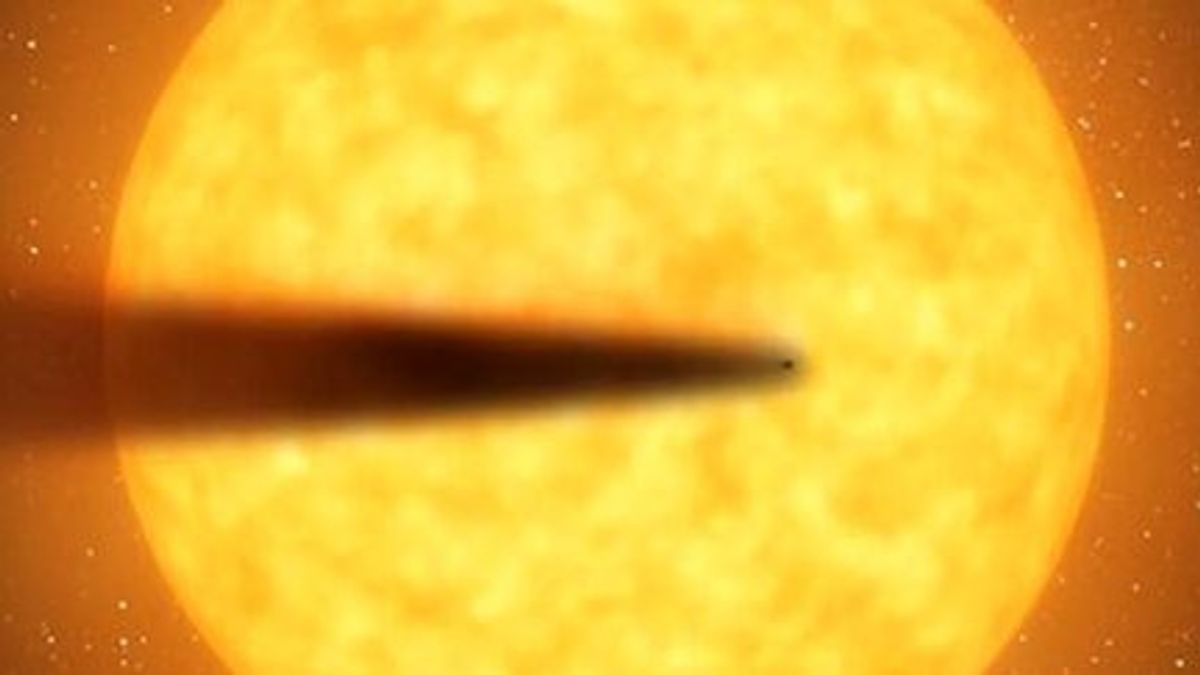


JAKARTA A group of scientists discovered exoplanets or planets outside the solar system that were destroyed by their stars. There were two exoplanets that were destroyed and left traces of debris that looked similar to comets.
Quoting from the Sciencealert report, these two planets are part of very short-period planets (USPs). The orbit is very fast and the USP is usually very close to the star. Therefore, both planets were destroyed due to very high heat.
Apart from being unable to withstand material from its stars, stellar radiation and gravity can be a driving factor in USP's destruction. Fortunately, two groups of astronomers managed to find USPs that are usually difficult to observe because they are so close to the star.
The first research group from TESS MIT created a paper entitled Planet Berbatu which was decomposable with a Comet-like tail that was prominent around a Bright Star. One of these destroyed exoplanets was named BD+054868Ab and was discovered by the TESS ride.
The planet orbited the bright dwarf K for a period of 1.27 days. Before experiencing destruction, astronomers managed to see signs of damage to the planet. The USP formed a tail ahead of its destruction, one on the front and one on the back.
The size of the particles in each tail is also different because of its content. The tail on the front contains larger dust, while the tail on the back contains finer dust grains.
"The speed of the planet's evaporation is really powerful, and we are very lucky to be able to see the last hours of this dying planet," said Marc Hon, lead author of the paper at MIT's ESS Science Office.
Hon explained that the dust tail of the planet BD+054868Ab evaporated rapidly and in enormous size. The dust length reaches 9 million kilometers and surrounds more than half the planet's orbit every 30 and a half hours. The planet is expected to be completely destroyed in just a few million years.
SEE ALSO:
-
 | TEKNOLOGI
Sport Interactive dan SEGA Resmi Batalkan Peluncuran Football Manager 25
09 Februari 2025, 20:45 -
 | TEKNOLOGI
Orang Tua Wajib Perhatikan Keamanan Anak Saat Bermain Roblox, Simak Tips Ini!
09 Februari 2025, 20:23 -
 | TEKNOLOGI
Twilio Berkolaborasi dengan Chelsea FC, Tingkatkan Interaksi Digital dengan Penggemar
09 Februari 2025, 15:33


The next planet is K2-22b which was observed using JWST's MIRI. Based on research results, the planet has an asymmetric profile. Dust clouds from K2-22b are visible in front of the star, suggesting that the planet has an elongated tail like a comet.
The core of this finding is almost the same as the planet BD+054868Ab, which is to have a tail that shows the destruction of the planet. Both of them poured their stomachs into space and were clearly visible from a number of telescopes, one of which was James Webb.
There is still much to learn from these two planets, both using NASA's James Webb telescope and other advanced telescopes. Scientists want to study the planet's composition to find out the material for making exoplanets orbiting stars other than the Sun.
The English, Chinese, Japanese, Arabic, and French versions are automatically generated by the AI. So there may still be inaccuracies in translating, please always see Indonesian as our main language. (system supported by DigitalSiber.id)


