
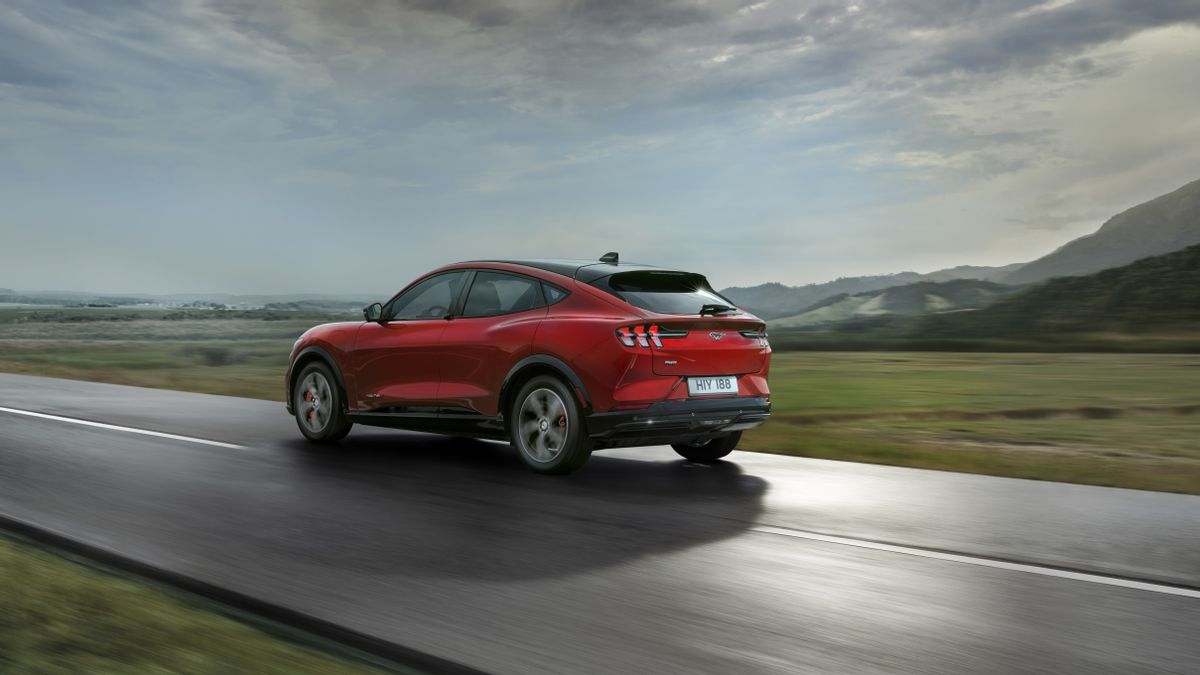


JAKARTA - Ford CEO Jim Farley in a recent interview gave a surprising confession. He revealed the process of dismantling and studying electric vehicles (EVs) from his main rivals, Tesla and Chinese manufacturers.
To Business Insider, quoted Wednesday, November 12, Farley said the process was a "surprising" experience and ultimately forced him to completely overhaul the American giant automotive company's strategy.
Speaking on the podcast "Office Hours: Business Edition," Farley acknowledged that the progress competitors like Elon Musk's Tesla and China's EV startup company have brought Ford out of sleep.
He talked about the most significant shocks when his team dismantled the first Tesla Model 3 unit. Farley found that the Ford Mustang Mach-E has about 1.6 kilometers of electric wires more than the Model 3. The excess of these cables not only adds to Ford's vehicle weight, but also demands a much larger and more expensive battery use, a finding highlighting the superiority of design efficiency from its competitors.
In response to the brutal reality, Farley took drastic steps in 2022 by separating EV Ford's operations into a new division called the Model E. Although the division is expected to face losses of more than $5 billion by 2024 and is projected to suffer similar losses this year, Farley does not regret the move. He argued that separating the EV division was important to create accountability to investors and to solve the most difficult issues as quickly as possible.
SEE ALSO:

Apart from Tesla, Farley has repeatedly warned that Chinese EV giants pose an existential threat to Ford and other Western automakers. He even described China's EV as "far superior" and "independently dominating" the global EV landscape, where about 50 percent of new car sales in China are electric vehicles, compared to only about 10 percent in the United States. This advantage is supported by high-tech models at very affordable prices.
"We can't leave the EV... I won't hand it over to China," he stressed about facing this intense competition.
However, Ford's EV ambitions in the US face different realities. Farley admits that the EV market in the US is "completely different" from imagined, with decelerating demand and consumers likely looking for an affordable electric model, not a vehicle worth US$70,000-80,000 (equivalent to Rp1.1-1.3 billion).
To adapt to this new market condition and face competition, Ford is again shifting its EV strategy. In August, Farley announced a new EV production line designed to help Ford compete directly with BYD and Tesla. The first vehicle to launch from this production line is an intermediate-sized truck at a price of around US$30,000 (Rp500 million), which is expected to launch in 2027, marking Ford's new focus on the easier-to-reach EV segment.
The English, Chinese, Japanese, Arabic, and French versions are automatically generated by the AI. So there may still be inaccuracies in translating, please always see Indonesian as our main language. (system supported by DigitalSiber.id)


