
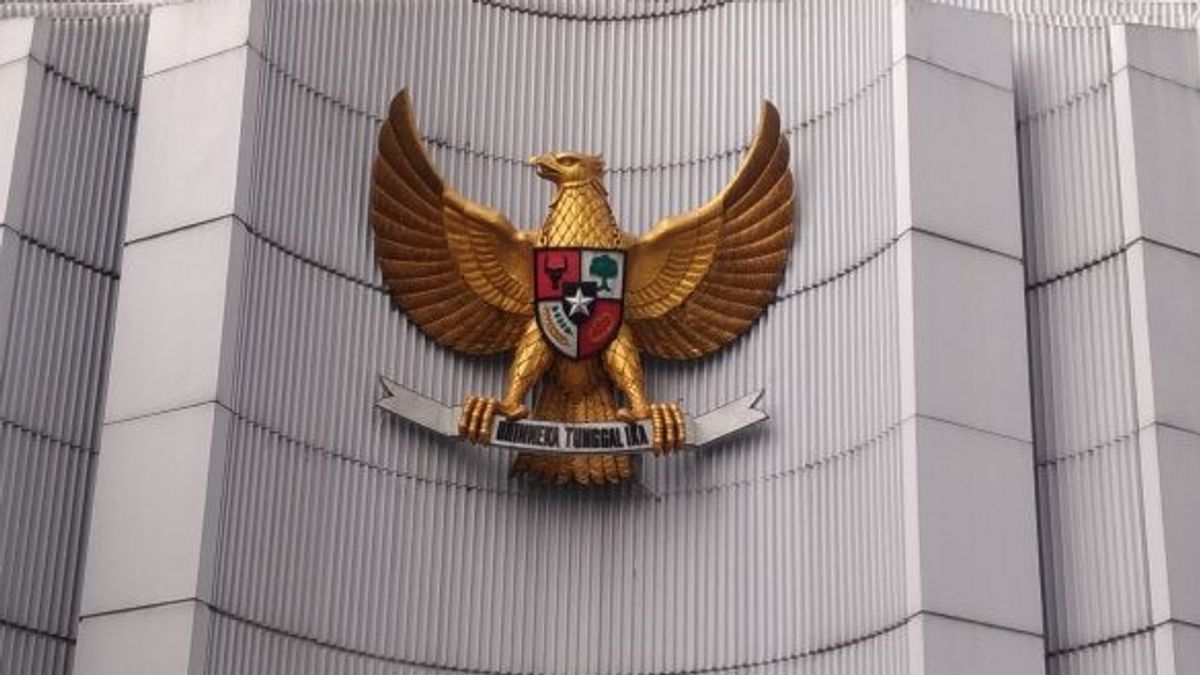


Every June 1, Pancasila is again commemorated with solemnity. The ceremony is held. Speeches are read. Bung Karno's quotes are repeated. The country seems busy showing respect for the basis of the republic. But in the midst of the ceremony, a question arises that is increasingly relevant. Is Pancasila still alive in the practice of daily power?
The question is important when the country today is entering deeper into the people's economic affairs. The Free Nutritious Meal program is being carried out on a large scale. Red and White Cooperatives are being formed in various regions. Danantara and PT Danantara Sumber Daya Indonesia are prepared by the government to strengthen the management of state assets and the governance of strategic resources.
All use language familiar to Pancasila, namely mutual cooperation, people's welfare, and state control over natural resources.
On paper, the direction makes sense. The state wants to be present more strongly in the economy. The state wants to ensure that development is not only enjoyed by the market and large capital owners. The state wants to take back control.
The problem is, Indonesian history also shows something else. Too much power often grows faster than its supervisory system. Therefore, the question is not whether the state needs to be present in the economy. The question is, for whom is the state present?
Here, the fifth Pancasila is relevant to be read again. Social justice for all Indonesian people. The sentence is not just a closing sentence. It is the republic's main promise. The most concrete measure to assess whether the state is really working for the masses or only increasing the power of a few elites.
Mohammad Hatta's thinking about cooperatives provides an important context. In various writings that were later collected in the book Building Cooperatives and Cooperatives Building, Hatta saw cooperatives not just as a business entity. Cooperatives are a path to economic democracy. Small people must be the main actors of the economy, not just beneficiaries of development.
This view could be derived from the awareness that a market that is left to work on its own tends to generate capital accumulation in certain groups. Therefore, the state needs to be present. But the presence of the state, in Hatta's view, must still maintain public participation.
This spirit is felt strongly in Article 33 of the 1945 Constitution. The Constitution emphasizes that the important branches of production and natural wealth must be controlled by the state for the greatest prosperity of the people. The basic idea is clear. The state must not allow national wealth to be controlled only by a few groups.
But that's where the challenge always comes up. State control over the economy does not automatically bring about justice. In many experiences, too concentrated economic power has given birth to a large bureaucracy, a new elite, and weakened supervision.
Indonesia has had experiences that are not always simple. Cooperatives often arise through bureaucratic instructions, not the needs of the people. State-owned enterprises have grown several times into large organizations that are difficult to monitor. The jargon of national interests is not uncommon to become a legitimacy for the concentration of economic power.
Therefore, the fifth precept should not stop as a constitutional slogan. It must be a yardstick to assess whether development really brings a sense of fairness.
Data from the Central Statistics Agency shows Indonesia's gini ratio in September 2025 at 0.363, down from March 2025 at 0.375 and September 2024 at 0.381. The gini ratio is a measure of inequality. The closer it is to 1, the wider the economic gap between the rich and poor groups. Inequality is improving. But the distance still feels, especially in urban areas. The bottom 40 percent group only enjoys about 19.28 percent of the national expenditure distribution.
At the same time, Indonesia's economy in the first quarter of 2026 grew 5.61 percent year-on-year. The figure looks strong. But the old question remains unresolved. Who benefited the most from that growth?
The CELIOS report in April 2026 showed that the wealth of the 50 richest people in Indonesia was equivalent to the wealth of tens of millions of other citizens. Most of the wealth comes from natural resource industries such as palm oil, minerals, mines, coal and energy.
The data is not important to arouse social jealousy. The data is important to show that economic growth has not automatically brought about equality.
This is where the classic novel by Pramoedya Ananta Toer feels relevant to be read again. In Human Land and Children of All Nations, Pramoedya describes how power, capital, and knowledge can make some people marginalized in their own land. He does not write economic theory. But he shows how inequality works in everyday life. Who has access, who is heard, and who ends up just being a spectator.
Between Hatta and Pram, the fifth principle finds two footholds, namely economic democracy and human dignity. Without both, social justice easily turns into an administrative slogan.
Therefore, the Birthday of Pancasila should not stop as a symbolic celebration. It must be a moment to test whether the country is really building social justice, or actually enlarging the new economic power structure with a different name.
Do social programs really strengthen the people, or just create new dependencies? Are cooperatives built as a citizen movement, or just a bureaucratic project? Does state control over natural resources really bring broad benefits, or ultimately only enlarge the elite of state managers?
These questions are important because Indonesian history shows that economic power that grows in the name of the people does not always end for the people. And maybe that's where the fifth precept is being tested today. Not on how often it is said. But whether this republic is still able to make the little people feel part of the nation's future.
In the end, the people do not measure justice from state speeches, but from whether their lives really become more worthy. Because Pancasila does not lose its meaning because it is not commemorated. Pancasila loses its meaning when its values are slowly lost in daily life.
The English, Chinese, Japanese, Arabic, and French versions are automatically generated by the AI. So there may still be inaccuracies in translating, please always see Indonesian as our main language. (system supported by DigitalSiber.id)
Most Popular Tags
#Prabowo Subianto #donald trump #Febrie Adriansyah #8791 #giias 2026Popular


