

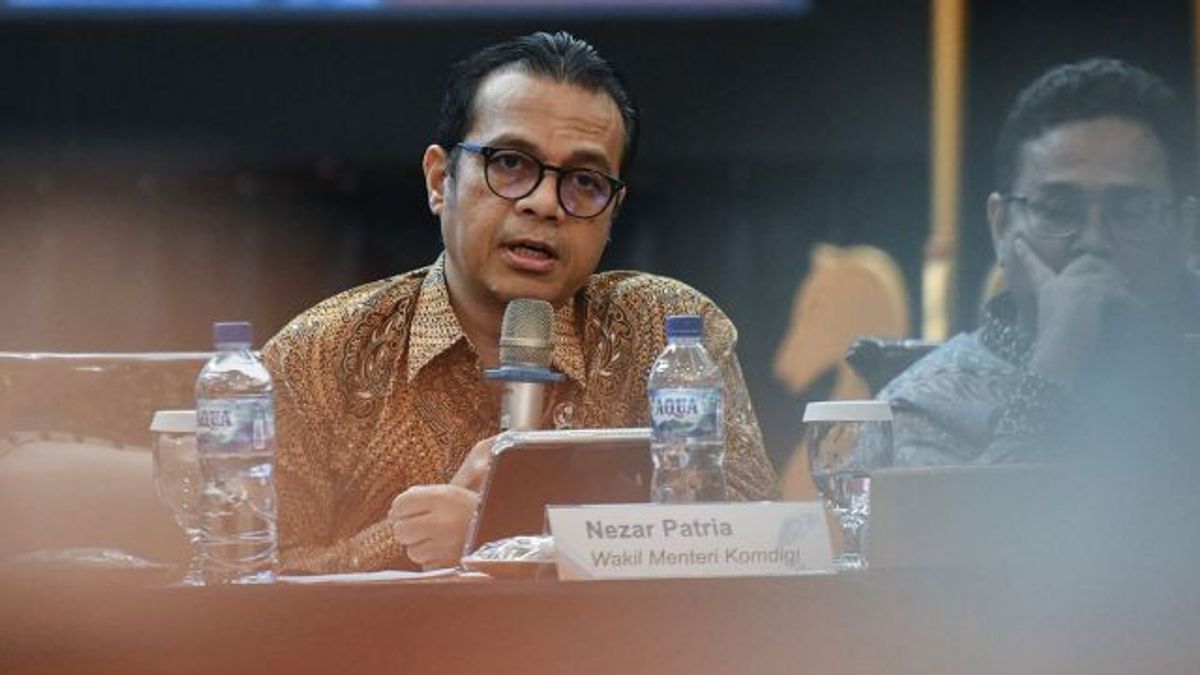


JAKARTA - Deputy Minister of Communication and Digital (Wamenkomdigi) Nezar Patria revealed that the strategy for digital platform governance in Indonesia is now more accountable by starting to shift the approach from content control to system-level governance.
One of the steps for its implementation is through Government Regulation Number 17 of 2025 concerning the Governance of the Implementation of Electronic Systems in the Protection of Children or also known as PP Tunas.
"The approach to regulating these platforms must be balanced. How to protect the rights of citizens, and how to make these platforms safe and protected for everyone," said Nezar in his statement received and confirmed in Jakarta, Friday.
This view was also conveyed by Nezar in the UNESCO Capacity Building Workshops for Southeast Asia Regulators, Digital Platforms, and Civil Society in Semarang, Thursday (7/5).
Sharing this view with other Southeast Asian country representatives, Nezar said in PP Tunas, the Indonesian government regulates the provisions of access to digital platforms based on age and this mechanism is referred to as a system-level instrument.
The latest approach balances between the aspects of digital security and also freedom of expression in the digital space.
The reason for this approach, he explained, is that if the government focuses too much on the security approach, the space for civil freedom to express itself will be reduced.
On the other hand, an approach that emphasizes freedom without governance is at risk of opening up space for the spread of disinformation and misinformation.
"The regulator's approach is how to balance these two things," he said.
In order for the approach to digital platform governance to be optimal, Nezar said, Indonesia based it on three main pillars, namely strengthening the legal framework, systemic governance for vulnerable groups, as well as digital literacy and multi-stakeholder dialogue.
In addition to PP Tunas, the update of the Information and Electronic Transaction Law (ITE) and the Personal Data Protection Law (PDP) also implement the three pillars as the basis for the national digital law.
With these three pillars, the government also actively involves the role of digital platforms, civil society organizations, educational institutions, and even religious communities to then educate digital governance in the national digital literacy program.
In that way, the digital governance approach is not only built through closed negotiations between the government and digital platforms alone.
"One of the things we have to stop is treating digital platform governance as a series of bilateral, ad hoc, and closed negotiations between governments and individual platforms," said Nezar.
Indonesia believes that in the future, the governance of digital platforms must be built institutionally, systematically, and transparently by involving all elements ranging from regulators, digital platforms, civil society, journalists, academics, to young groups.
Discussing digital platform governance more broadly in Southeast Asia, Nezar said that countries in the region need to ensure that the principles of human rights, transparency, and accountability are truly applied in the daily practices of digital platforms.
The approach taken by Indonesia can be one of the practices that other countries can follow because it emphasizes the balance between freedom of expression and ensuring security in the digital space.
He also said that cooperation between ASEAN and UNESCO was an important step to build a standard for more accountable regional digital platform governance while still respecting freedom of expression.
"The goal is a digital environment that protects users, especially the most vulnerable, without reducing open, plural, and democratic public spaces," said the Deputy Minister of Communication and Information.
As a joint learning material, Nezar said Indonesia is ready to become one of the countries that will test the implementation of the assessment of systemic risk of digital platform based on human rights in the ASEAN region.
"I think Indonesia is ready to test this approach based on the PP Tunas and to share the findings with our ASEAN partners," said Nezar.
The English, Chinese, Japanese, Arabic, and French versions are automatically generated by the AI. So there may still be inaccuracies in translating, please always see Indonesian as our main language. (system supported by DigitalSiber.id)
Most Popular Tags
#Prabowo Subianto #donald trump #2026 World Cup #Febrie Adriansyah #8791Popular


