

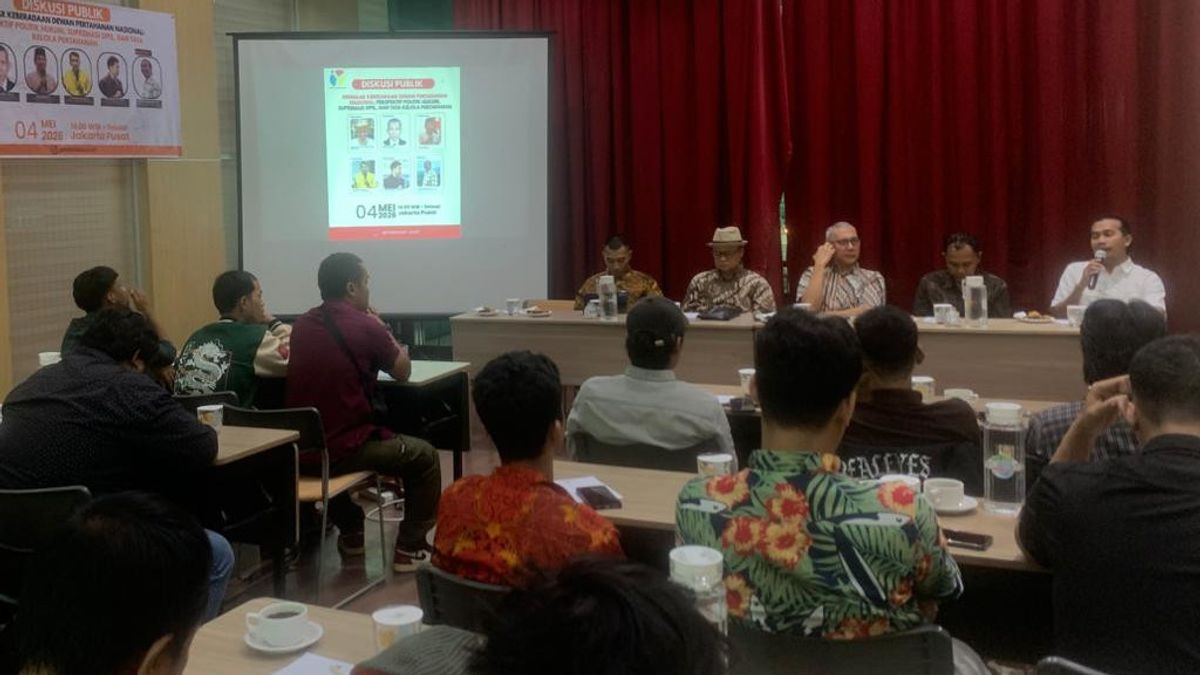


JAKARTA - The existence of the National Defense Council (ND Council) which was formed through Presidential Regulation Number 202 of 2024 has again become the focus of public discussion held by the Indonesian Youth Congress Central Board (DPP IYC) in Jakarta, Monday, May 4. A number of academics emphasized the importance of strengthening transparency and accountability in the governance of the institution.
Public policy and governance researcher, Gian Kasogi, assessed the aspect of openness as the key to ensuring that decision-making in the defense sector remains within the democratic corridor.
"If defense decisions are made behind closed doors, there is no mechanism to prevent power from going too far," Gian said in a discussion paper.
According to him, although the DPN was formed to strengthen coordination, accelerate policy making, and increase national readiness, institutional strengthening must be balanced with an adequate oversight system.
Gian highlighted the structure of the DPN which places the President as chairman, with a major role for the Ministry of Defense in operational, financing, and control aspects. He assessed that this condition has the potential to create a concentration of power if it is not closely monitored.
In addition, the closed nature of DPN's work is also considered to need attention. According to him, secrecy in the defense sector is indeed important, but it should not ignore the principle of public accountability.
"State security and the confidentiality of strategic policies must remain within the framework of supervision, because not all information is included in the category of exceptions according to the 1945 Indonesian Constitution," he said.
He also highlighted the limitations of the DPR's access to carry out oversight of the DPN, as well as the lack of public control space. This condition is considered potentially weakening the checks and balances mechanism in the democratic system.
Gian reminded that the dominance of the Ministry of Defense in the structure and operations of the DPN has the potential to shift the civilian-military relationship, from which it should be based on civilian control to a tendency towards centralization of power.
"Formally the President holds control, but if the operations and information are centralized in the ministry, then the role can be symbolic," he said.
He assessed that the situation risked creating a distance between formal authority and substantive control in strategic policymaking.
However, Gian emphasized that the criticism was not a form of rejection of the existence of the DPN. He assessed that Indonesia still needs a strong defense system, but it must be built with the principle of balance of power and accountability.
Meanwhile, the academic of Political Science at the National University of Jakarta, Firdaus Syam, explained that the DPN is a strategic institution led by the President and tasked with providing consideration and formulating the country's defense policy.
According to him, the presence of the DPN is part of the institutional evolution of the national defense which aims to accelerate decision-making, especially in the face of crisis situations.
Firdaus also highlighted the complexity of current defense challenges which are no longer limited to conventional threats, but also include hybrid threats such as cyber attacks, disinformation, and food and energy crises.
On the other hand, he emphasized that budget constraints and the need for transparency in financing are important factors in the development of a modern and sustainable defense system.
"Modern defense is not enough to rely solely on military power, but must also be supported by broad national resilience and adaptive diplomacy," said Firdaus.
The English, Chinese, Japanese, Arabic, and French versions are automatically generated by the AI. So there may still be inaccuracies in translating, please always see Indonesian as our main language. (system supported by DigitalSiber.id)
Most Popular Tags
#Prabowo Subianto #donald trump #2026 World Cup #Febrie Adriansyah #8791Popular


