
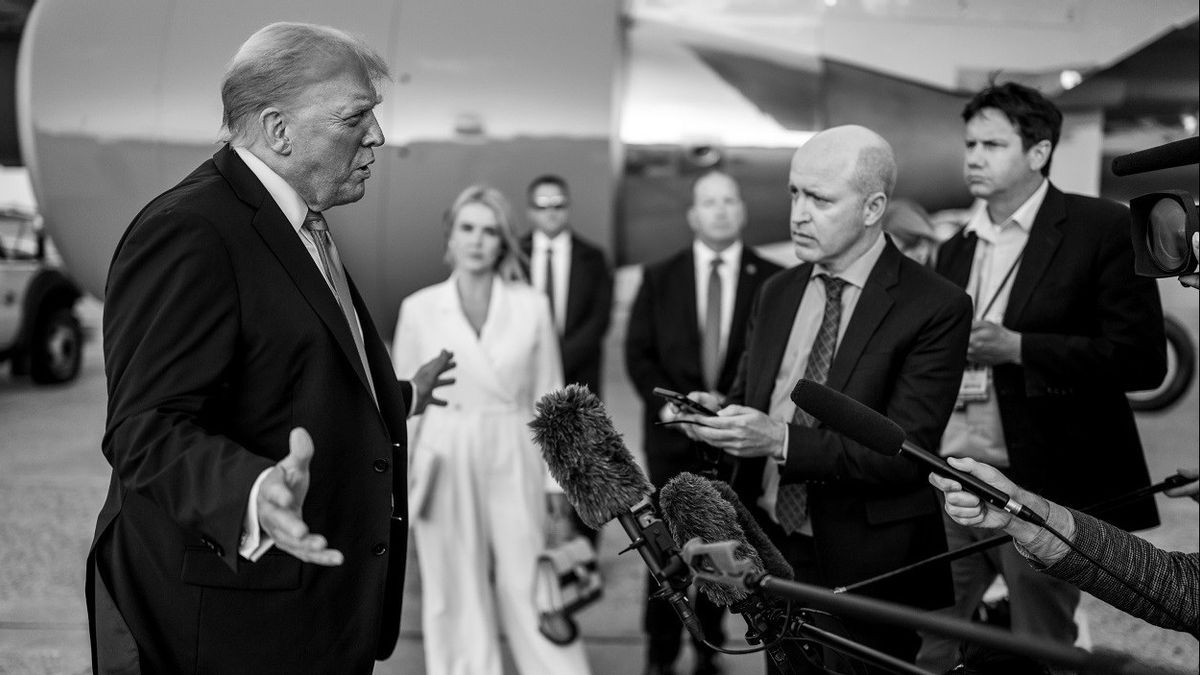


JAKARTA - President Donald Trump in a social media post claimed Iran had asked the United States to open the Strait of Hormuz, telling Washington that Tehran was in a 'state of collapse'.
"Iran has just informed us that they are in a 'state of collapse'. They want us to 'open the Strait of Hormuz' as soon as possible, because they are trying to find a solution to their leadership situation (which I believe they will be able to do!).", wrote President Trump on Truth Social on Tuesday, as reported by Al Arabiya and Reuters (29/4).
However, President Trump did not explain how the information reached him and did not explain further the meaning of the message.
The claim comes as efforts to end the conflict appeared to reach an impasse on Tuesday with President Trump unhappy with Tehran's latest plans.
Iran's latest proposal on settling the two-month war would sideline discussions on its nuclear program until the conflict ends and disputes over shipments from the Gulf are resolved.
Senior Iranian officials, speaking on condition of anonymity, told Reuters the proposal brought by Foreign Minister Abbas Araghchi to Islamabad last weekend envisaged gradual talks, with the nuclear issue set aside at first.
The first step would require an end to the US-Israeli war on Iran and provide assurances that the US cannot start it again. Then the negotiators will resolve the US Navy blockade of Iran's maritime trade and the fate of the Strait of Hormuz, which Iran wants to reopen under its control.
Only after that will talks address other issues, including a long-running dispute over Iran's nuclear program, in which Iran still wants some sort of US recognition of its right to enrich uranium.
President Trump wanted the nuclear issue to be addressed from the beginning, said a US official who was briefed on President Trump's meeting with his staff on Monday.
Iran's previous nuclear deal with the US and the world nuclear powers, the Joint Comprehensive Plan of Action (JCPOA) or the 2015 Nuclear Deal, sharply restricted its nuclear program, which has been maintained for peaceful and civilian purposes. As part of the deal, UN, EU and US sanctions against Iran will be lifted.
The JCPOA failed when Trump unilaterally withdrew the Uncle Sam's country from the deal during his first term, precisely on May 8, 2018, followed by the reimposition of US sanctions against Iran.
Hopes for reviving peace efforts in a conflict that has killed thousands of people, plunged energy markets into chaos, and disrupted global trade routes, faded as Trump's move to cancel envoys, notably Steve Witkoff and his son-in-law Jared Kushner's visit to Pakistan as a mediator last weekend.
Separately, Iranian Government spokeswoman Fatemeh Mohajerani told state media on Tuesday the Mullah's State had been preparing for a maritime blockade scenario since the 2024 US presidential election and had made the necessary arrangements so that "no one needs to worry."
He added that Tehran was using northern, eastern and western trade corridors that did not rely on Gulf ports to neutralize the effects of the blockade.
Meanwhile, Reza Rostami of the Iranian Chamber of Commerce told the Shargh newspaper that private sector operators use four Caspian Sea ports, and a railway line through Turkey and Turkmenistan.
Iran is also negotiating with Oman and Pakistan to channel goods through their ports, he added.
The English, Chinese, Japanese, Arabic, and French versions are automatically generated by the AI. So there may still be inaccuracies in translating, please always see Indonesian as our main language. (system supported by DigitalSiber.id)
Most Popular Tags
#Prabowo Subianto #donald trump #2026 World Cup #Febrie Adriansyah #konflik timur tengahPopular


