
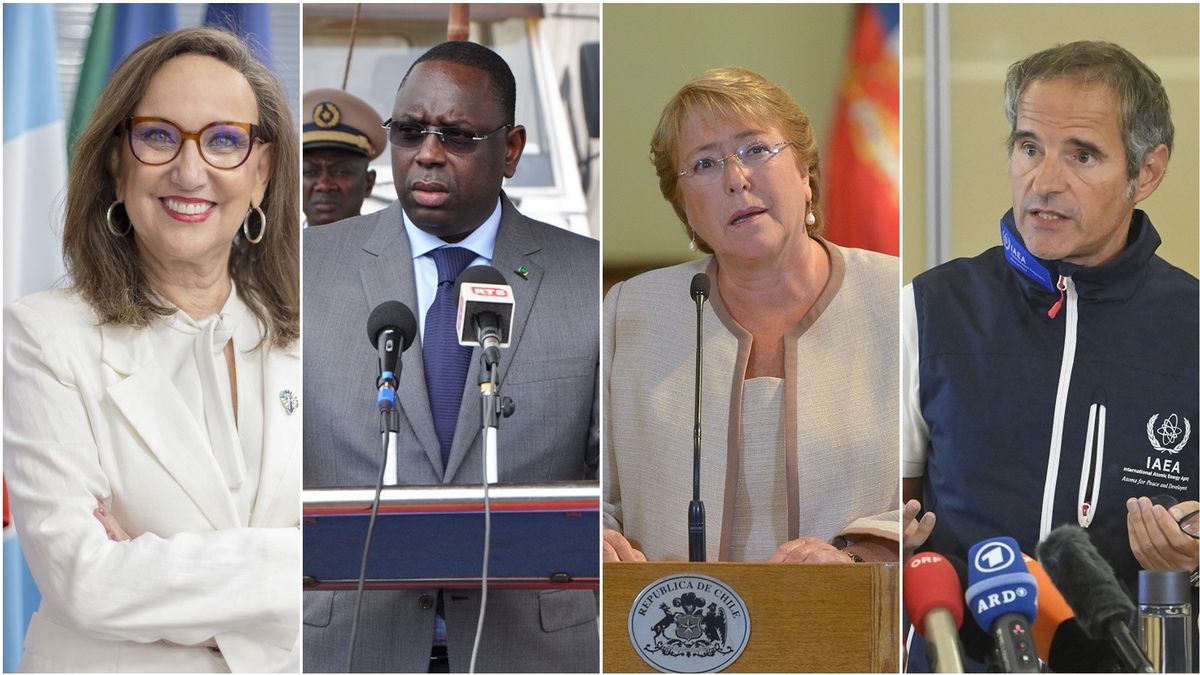


JAKARTA - This week the United Nations enters a crucial phase in the competition to occupy the top of the organization, presenting their visions in public hearings at the world body's headquarters, providing a rare glimpse into the live broadcast of the competition to replace Secretary-General Antonio Guterres.
The new UN Secretary-General will take office on January 1, 2027, at a time when the organization is facing increased financial pressure, unpaid contributions from key member states, and growing doubts about its ability to manage conflicts and enforce its mandates.
Unlike traditional closed selection, this process now includes public interactive talks aimed at increasing transparency and allowing member states and the public to assess competing candidates for the highest office.
The U.N. has never had a woman serve as secretary-general in its nearly 80-year history, a shortcoming the General Assembly acknowledged in a resolution last September calling for stronger consideration of female candidates.
The four candidates are former Chilean President Michelle Bachelet, Argentine diplomat and head of the UN nuclear watchdog (IAEA) Rafael Grossi, Costa Rican economist and former Vice President Rebeca Grynspan, and former Senegalese president Macky Sall, quoted from The National (20/4).
The hearings began on Tuesday with Bachelet and Grossi, followed by Grynspan and Sall on Wednesday.
According to a letter from UN General Assembly President Annalena Baerbock, the interactive dialogue will be held around two thematic segments - the leadership ability, experience, and skills of candidates to lead the organization, and the three core pillars of the UN - peace and security, development, and human rights.
Civil society groups will be able to ask questions to the candidates during each segment, allowing for wider participation in the selection process.
Bachelet is among the most high-profile candidates, having served as Chile's first female president for two terms before heading UN Women.
He also served as the UN High Commissioner for Human Rights from 2018 to 2022.
Meanwhile, Grossi, who was supported by Argentina on the first day of the nomination opening, has drafted his candidacy based on institutional efficiency.
As head of the International Atomic Energy Agency since 2019, he has navigated some of the world's most sensitive nuclear diplomacy and has called on the United Nations to align its operations with the funding that member states are truly ready to provide.
Next is Grynspan, a former secretary-general of the UN Conference on Trade and Development, nominated by Costa Rica.
As an economist with deep experience in multilateral institutions and Latin American governance, he argues that restoring confidence in the UN's ability to deliver tangible results in development, trade, and global stability is the main challenge facing the new UN chief.
Sall, who was nominated by Burundi, brings a different perspective to this election. As President of Senegal from 2012 to 2024, he led one of the most stable democracies in West Africa and became a leading voice for African interests in international forums.
He called for the UN to be fundamentally restructured and modernized, stressing that the organization had fallen behind the speed and complexity of contemporary global crises.
Meanwhile, the United States' position will be central to the election's outcome. The US, as the largest financial contributor to the UN and a permanent member of the Security Council, retains the ability to block any candidate it does not support.
Washington's ambassador to the United Nations, Mike Waltz, said last week the US government would not follow the traditional informal convention that the rotating secretary-general's role is based on region and that the future head of the United Nations should be a Latin American woman.
"We just need the best," Waltz said.
"This institution desperately needs strong and effective leadership."
Under the rules of the UN, the Security Council holds a series of secret ballots among its 15 members, in which each country signals whether it supports, opposes, or has no opinion on each candidate.
Ballots from the five permanent members are printed on different colored paper, allowing for a glimpse of whether there are vetoes blocking a candidate.
Once there is an agreement, the Council adopts a formal resolution, which requires at least nine votes and no vetoes, to recommend a candidate to the General Assembly for final approval.
The English, Chinese, Japanese, Arabic, and French versions are automatically generated by the AI. So there may still be inaccuracies in translating, please always see Indonesian as our main language. (system supported by DigitalSiber.id)
Most Popular Tags
#Prabowo Subianto #donald trump #2026 World Cup #Febrie Adriansyah #8791Popular


