

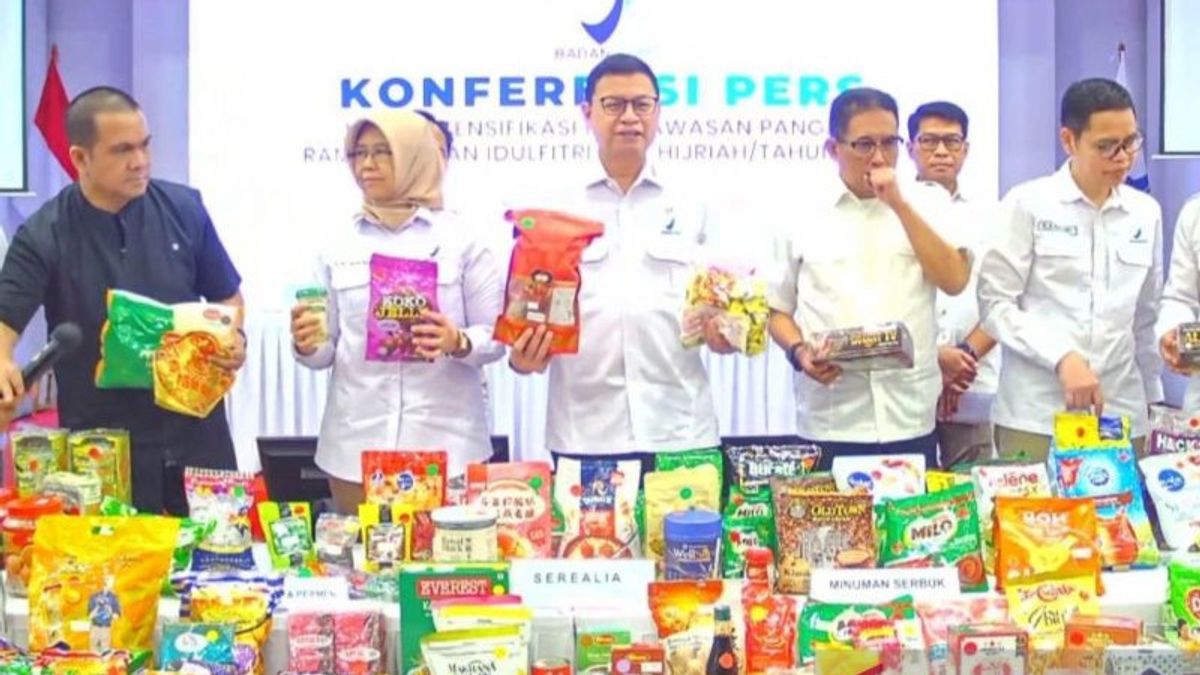


JAKARTA - The Food and Drug Supervisory Agency (BPOM) has found around 7,400 links selling illegal food products on various electronic trading platforms and digital media in Indonesia.
The findings were obtained through intensive cyber patrols carried out by BPOM ahead of Ramadan and Eid al-Fitr 2026.
Head of BPOM Taruna Ikrar said that thousands of links were suspected of selling food products without a distribution permit and products containing chemical drugs.
"The products found in online surveillance are dominated by imported food from a number of countries," said Taruna at a press conference in Jakarta, Antara, Wednesday, March 11.
The products are known to come from several countries, including Malaysia, the United States, Italy, Turkey, and the United Arab Emirates.
Taruna explained that this supervision was the result of intensification to the third stage as of March 9, 2026, which was carried out through cyber patrols and direct inspections in the field.
BPOM noted that the economic value of food findings that did not meet the provisions in the supervision reached more than IDR 103.57 billion.
Of this amount, around Rp102.9 billion came from cyber patrol findings, while around Rp642.6 million came from direct field inspections.
In the offline inspection, BPOM found food products without distribution permits with an economic value of around Rp527.9 million or around 82 percent of the total findings.
In addition, expired food worth Rp86.3 million and damaged food worth Rp28.3 million were also found.
The findings come from a number of areas, including East Nusa Tenggara, West Sulawesi, Ambon, Jambi, West Sumatra, East Java, and Maluku.
According to Taruna, the value of the findings shows the potential for a large risk if illegal food products circulate in the community.
He estimated that the supervision carried out by BPOM together with related institutions could prevent health impacts on more than 52,000 people.
"Intensive food supervision in certain periods such as Ramadan and Eid al-Fitr is important as a preventive measure to protect the community," he said.
BPOM has also requested the removal of links to the sale of illegal products, the withdrawal and destruction of products that do not meet the provisions, to the imposition of administrative sanctions and the revocation of distribution permits.
In addition, if there is an element of criminal violation, BPOM ensures that it will follow up through the legal process.
On the other hand, BPOM also educates the public and provides assistance to MSMEs regarding the licensing process and the implementation of food safety standards.
The English, Chinese, Japanese, Arabic, and French versions are automatically generated by the AI. So there may still be inaccuracies in translating, please always see Indonesian as our main language. (system supported by DigitalSiber.id)


