

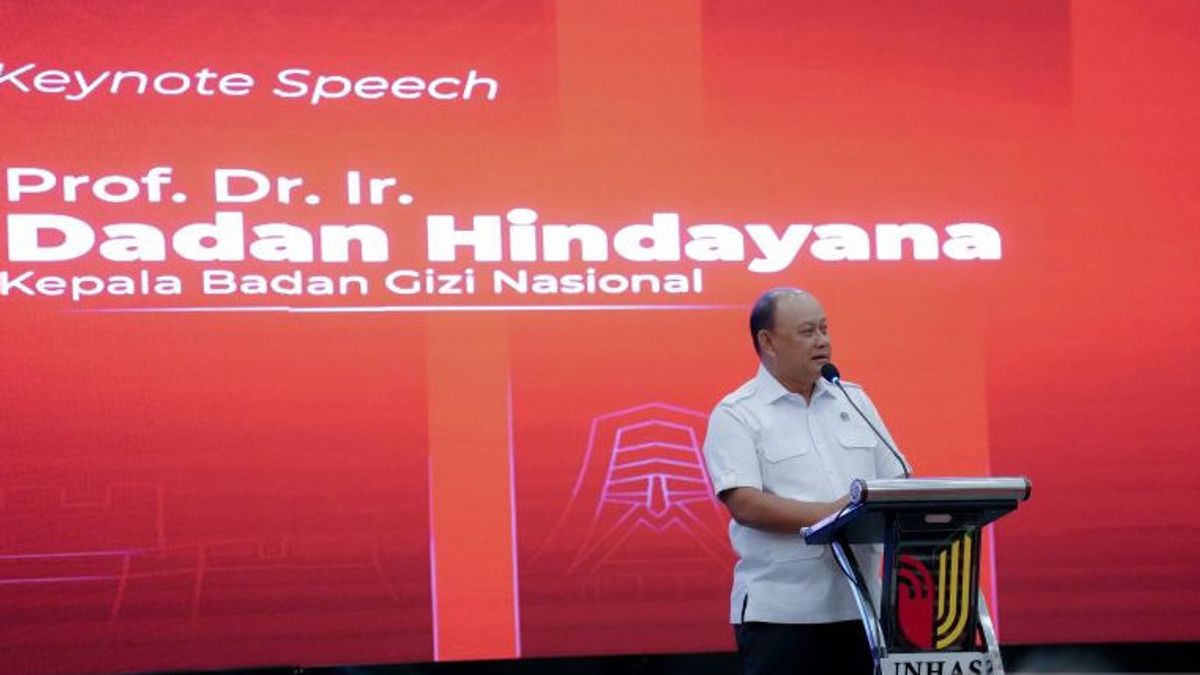


JAKARTA - Head of the National Nutrition Agency (BGN) Dadan Hindayanamengklarifikasi terkait status pemberian insentif pada Satuan Pelayanan Pemenuhan Gizi (SPPG) yang ditangguhkan atau terkenasuspend.
Dadan explained that not all SPPG that were suspended automatically lost incentives, but were determined based on the causes and levels of violations that occurred. In the case of Extraordinary Events (KLB), the granting of incentives depends very much on the source of the problem.
"If the KLB occurs due to the negligence of partners or foundations, such as a kitchen facility that is not suitable or does not meet standards, then the SPPG is not entitled to incentives. The same applies if the food safety incident is triggered by raw materials that are not fresh or errors from partners as suppliers of raw materials," said Dadan as quoted by ANTARA, Wednesday, April 29.
He said that if SPPG was also proven to have unhealthy practices such as monopoly suppliers or price games, then it was clear that it would not get incentives.
However, if the KLB occurs due to technical errors at the kitchen implementation level, for example, not implementing standard operating procedures (SOP) such as cooking too quickly, then the SPPG can still receive incentives even though it is suspended.
Based on the technical instructions (juknis), if the KLB occurs due to technical errors at the kitchen implementation level, for example, not implementing standard operating procedures (SOP) such as cooking processes that are too fast, then the SPPG can still receive incentives even though it is suspended because the errors are considered operational and can still be corrected without indicating systemic violations.
Thus, Dadan ensures that incentives will not be paid if the SPPG is permanently terminated or temporarily suspended due to non-fulfillment of the standby readiness condition, for example, when a major renovation or major repair occurs that makes the SPPG unable to carry out its functions normally.
The head of BGN also detailed the categories of dependents who became the basis for the assessment of incentive grants. First, the category of prominent events that are not caused by the negligence of the recipient of permanent assistance receives incentives. Second, prominent events caused by the negligence of the recipient of assistance do not receive incentives.
Third, the category of non-significant events that require minor repairs still receive incentives. Fourth, non-significant events that require major repairs do not receive incentives.
According to him, the mayor's suspension refers to a condition where SPPG requires many fundamental improvements that cannot be completed in a short time.
"The repair can take a month or more because it involves quite a broad aspect, both in terms of facilities, systems, and operational readiness," he said.
The latest data shows that of the 1,720 SPPG that were temporarily suspended, as many as 1,356 fell into the major category and did not receive incentives. Through this explanation, BGN hopes that all stakeholders understand the mechanism of granting incentives in full, as well as encouraging compliance with food safety standards and good operational governance at each SPPG.
The English, Chinese, Japanese, Arabic, and French versions are automatically generated by the AI. So there may still be inaccuracies in translating, please always see Indonesian as our main language. (system supported by DigitalSiber.id)
Most Popular Tags
#Prabowo Subianto #donald trump #Febrie Adriansyah #8791 #giias 2026Popular


