
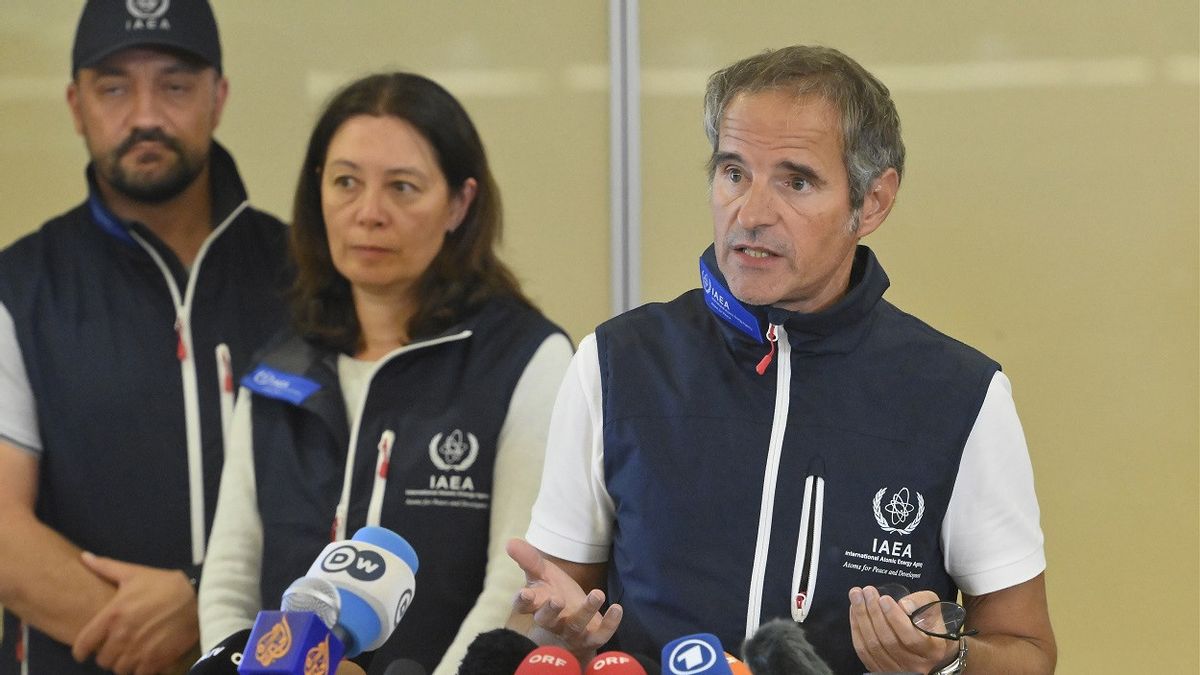


JAKARTA - The head of the United Nations nuclear watchdog Rafael Grossi on Monday said that nearly half of Iran's uranium enriched to 60 percent purity, close to the level of a nuclear warhead, was stored in a tunnel complex in Isfahan and could still be there.
The tunnel complex is the only target that does not appear to have suffered any major damage in the attack on Iranian nuclear facilities launched by Israel and the United States in June 2025.
Diplomats have long said Isfahan has been used to store 60 percent uranium, which the International Atomic Energy Agency (IAEA) confirmed in a report to member states last month, without saying how much was there.
"What we believe is that Isfahan, up until our last inspection, had a little over 200 kg, maybe a little more, of 60 percent uranium," IAEA chief Rafael Grossi said, citing Al Arabiya from Reuters (10/3).
The IAEA estimates that when Israel and the United States launched their first attack in June, Iran had 440.9 kg of 60 percent uranium. If further enriched, it would provide the explosive material needed for 10 nuclear weapons, according to the IAEA benchmark.
Grossi said the stockpile was "mostly" in Isfahan, and some of what was stored elsewhere may have been destroyed.
"The general assumption is that the material is still there. So we haven't seen - and not just us, I think in general all those who observe the facility through satellite imagery and other ways to see what is happening there - movements that indicate that the material may have been moved," said Grossi.
All three known Iranian uranium enrichment plants in operation - two in Natanz and one in Fordow - were destroyed or heavily damaged by the June attacks.
"There is a certain amount of uranium (60 percent) in Natanz as well, which we believe is still there," Grossi said.
Iran itself has not informed the IAEA of the status or whereabouts of the highly enriched uranium since the June attack, nor has it allowed IAEA inspectors back to its bombed-out facilities.
Iran's nuclear program is one of the reasons given by Israel and the US for launching the latest attack on Iran on February 28, on the grounds that Iran is closer to being able to produce a bomb, although US President Donald Trump said in June that the US attack had destroyed the program. The IAEA said it had no credible indications of a coordinated nuclear weapons program.
The English, Chinese, Japanese, Arabic, and French versions are automatically generated by the AI. So there may still be inaccuracies in translating, please always see Indonesian as our main language. (system supported by DigitalSiber.id)
Most Popular Tags
#Prabowo Subianto #donald trump #2026 World Cup #Febrie Adriansyah #8791Popular


