

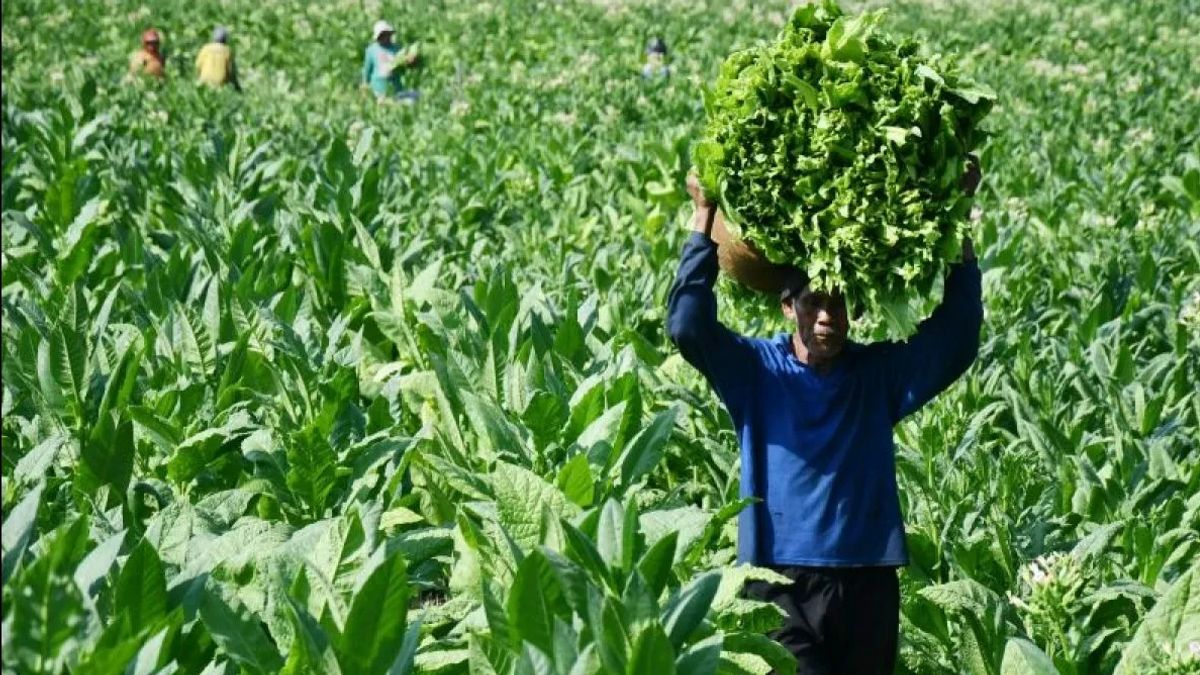


JEMBER - The Jember Branch Leadership Council of the Indonesian Tobacco Farmers Association (DPC APTI) asked the government to pay attention to the fate of tobacco farmers in the country. Do not let there be policies that are full of foreign interventions and make people miserable.
This was conveyed by the Chairman of the APTI DPC, M. Soleh, in response to the attitude of Deputy Minister of Home Affairs Bima Arya who encouraged regional heads to take control measures against the tobacco industry during the 2026 Asia Pacific Cities for Health and Development (APCAT) Summit forum.
"Until today, there are still many people who live and depend on tobacco. The material of this nation and country also enjoys income from cigarette taxes. We reject foreign interference that wants to make arbitrary rules prohibiting tobacco," said Soleh, quoted Friday, January 30.
Soleh also expressed his disappointment with the Ministry of Home Affairs, which tends not to side with small groups of people, such as tobacco farmers. "We don't accept our livelihoods to be messed up," he said.
"Don't let there be state officials who want to monopolize tobacco but the state itself enjoys the results of tobacco. Please think about the fate and livelihood of small people," he continued.
Similarly, Buang Kurniawan as a clove farmer from East Java also rejected foreign intervention related to the entire tobacco ecosystem. He said, kretek and clove are the main commodities that are inseparable in the kretek industry which is a typical product of the archipelago.
This rejection is also aimed at protecting the economic and cultural values that have long been attached to the community in the producing areas. "Why is it so easy to be influenced by foreign powers to intervene in the independence of this nation, to the point of wanting to interfere in economic affairs and autonomy," said Buang.
"We remind policy makers to consider the negative effects of all regulations that will and have been made. Don't let small people, such as farmers, be victims," he said.
Buang explained that the tobacco ecosystem is a focus for 6 million workers from upstream to downstream. The more the tobacco ecosystem is suppressed, the direct impact on labor absorption, commodity absorption, and state revenue will be felt.
"It must be admitted that tobacco and cloves are commodities that are the economic mainstay of the community, ranging from farmers, factory workers, MSMEs, creative workers, and many more. So that no regulations are born that end up demolishing the economic mainstay," he concluded.
The English, Chinese, Japanese, Arabic, and French versions are automatically generated by the AI. So there may still be inaccuracies in translating, please always see Indonesian as our main language. (system supported by DigitalSiber.id)
Popular


