

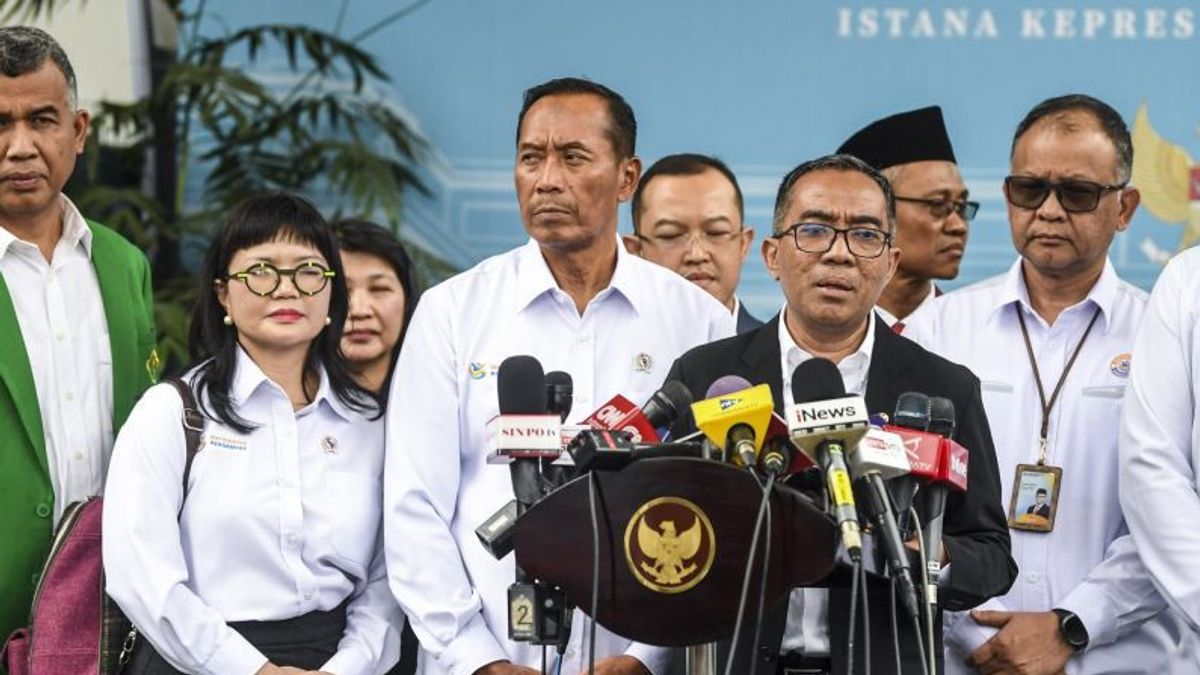


JAKARTA - The government has issued permits to open 156 specialist and subspecialist medical study programs to strengthen national health services.
Minister of Higher Education, Science and Technology (Mendikti Saintek) Brian Yuliarto said the policy was a direction from the President of the Republic of Indonesia Prabowo Subianto, the Ministry of Science and Technology together with the Ministry of Health.
"The Ministry of Health has issued 156 new specialist degree permits, 126 specialist degrees and 30 subspecialist degrees," Brian said at a dialogue meeting between President Prabowo Subianto and 1,000 academics at the State Palace, Jakarta, Thursday, January 15.
He said that the policy had a direct impact on the increase in the number of medical students. At the beginning of 2026, the total increase in new students was recorded at 3,150 people.
"Currently there are around 5,000, so the total is 8,650 students," he said as quoted by ANTARA.
In addition to the health sector, Brian also reported that national research funding support continued to increase.
Currently, the total research budget has exceeded Rp. 8 trillion, both managed by the Ministry of Research and Technology and jointly with the National Research and Innovation Agency (BRIN).
The ratio of research budgets to Indonesia's Gross Domestic Product (GDP) now reaches 0.34 percent.
Following President Prabowo's instructions, said Brian, the national research was directed not to run on its own, but to become a bridge between the development of science and the real needs of the national industry with Danantara as the driving locomotive.
Brian said that several studies related to the domestic industry that are being worked on are the development of the solar energy industry to nuclear power plants (PLTN).
"Several studies related to national industries that are being worked on include the development of the solar energy or solarcell industry, rare earth metals, waste management and circular economy, the development of nuclear power plants, semiconductor industries, shoe industries, textiles, cosmetics," he said.
In addition, said Brian, other studies also target food security, namely garlic, soybeans, and wheat.
The English, Chinese, Japanese, Arabic, and French versions are automatically generated by the AI. So there may still be inaccuracies in translating, please always see Indonesian as our main language. (system supported by DigitalSiber.id)
Most Popular Tags
#Prabowo Subianto #donald trump #firearm #8791 #giias 2026Popular


