

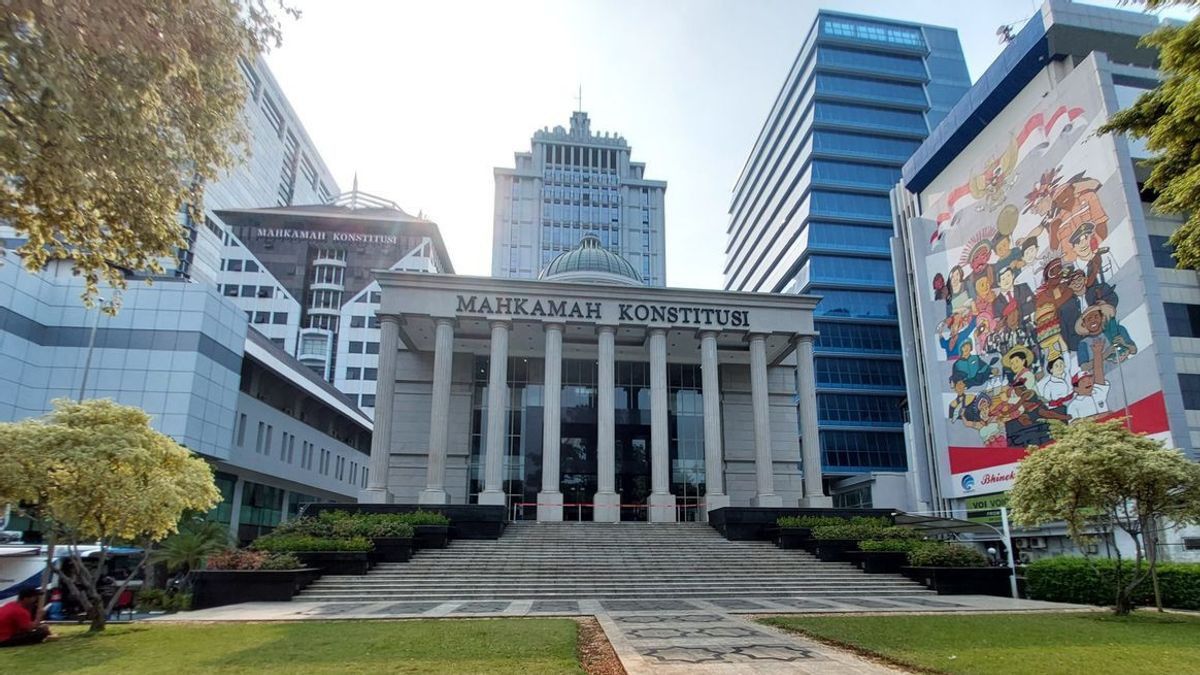


JAKARTA - Less than a week has passed since Friday, January 2, the latest Criminal Code (KUHP) has immediately faced a wave of material test lawsuits at the Constitutional Court (MK). The KUHP, the result of the codification of national criminal law, has attracted widespread attention from various circles.
Based on the official MK website accessed by VOI.ID on Tuesday, January 6, at least eight petitions for a material test against Law Number 1 of 2023 concerning the Criminal Code have been registered. Interestingly, some of the lawsuits were even filed before the New Year's Eve 2026, or when the new Criminal Code has not yet been effectively implemented.
This phenomenon shows the high public attention to the implementation of the new Criminal Code, as well as reflecting the concerns of a number of parties regarding articles that are considered potentially causing constitutional problems later.
The applicants tested various articles that were considered problematic or potentially violating the constitutional rights of citizens. These articles touch on crucial issues in democratic life and law enforcement, ranging from corruption, contempt of government and state institutions, dissemination of insulting content, the death penalty, adultery, assault on the dignity and dignity of the president and vice president, demonstrations, to embezzlement.
The variety of the substance of the lawsuit shows that the validity of the new Criminal Code is not only questioned from a technical legal perspective, but also relates to civil liberties, human rights, and the relationship between the state and citizens.
From the background of the applicant, the majority of the lawsuits were filed by students, especially students of law faculties from various universities. However, there are also applicants from workers and former employees of the banking sector.
The first lawsuit was recorded on December 22, 2025 and registered with case number 267/PUU-XXIII/2025. The application was filed by Lina and Sandra Paramita who tested the embezzlement article in the new Criminal Code, as well as provisions related to the title of the case and the determination of the investigation in the latest Criminal Procedure Code.
On December 24, 2025, as many as 13 students filed a material test against the demonstration article in the Criminal Code. This lawsuit highlights the potential for restrictions on the right to publicly express opinions.
The wave of lawsuits continued on December 29, 2025. A total of 11 students sued Article 302 of the Criminal Code regarding the prohibition of inciting people to become non-religious (Case 274/PUU-XXIII/2025). On the same day, Afifah Nabila Fitri along with 11 students of the Open University Law Study Program filed a material test against the article insulting the president and vice president (Case 275/PUU-XXIII/2025).
On December 30, 2025, Susi Lestari and 10 students from Universitas Terbuka sued for adultery in the latest Criminal Code (Case 280/PUU-XXIII/2025). Still on the same day, eight students from Universitas Terbuka sued the death penalty provision (Case 281/PUU-XXIII/2025), while nine other students - some of whom are private employees - filed a material test against the article insulting the government and state institutions (Case 282/PUU-XXIII/2025).
The wave of lawsuits was closed on December 31, 2025 with a request for a material test filed by a former bank employee. The applicant sued two articles in the Corruption Crime Law as well as two recent articles of the Criminal Code related to corruption.
With the large number of requests for material tests, the Constitutional Court is expected to face a series of important trials that have the potential to determine the direction and implementation of the new Criminal Code in the national criminal justice system in the future.
The English, Chinese, Japanese, Arabic, and French versions are automatically generated by the AI. So there may still be inaccuracies in translating, please always see Indonesian as our main language. (system supported by DigitalSiber.id)
Most Popular Tags
#Prabowo Subianto #donald trump #earthquake #independence day #8791 #hut riPopular


