

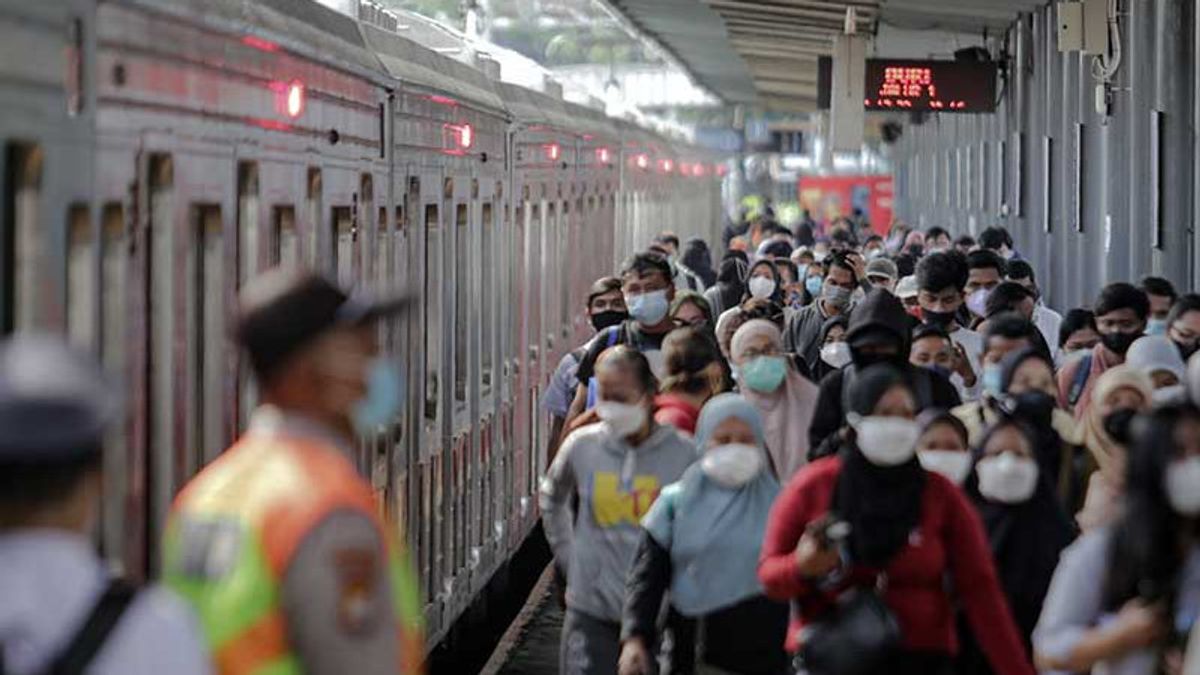


JAKARTA - Deputy Chairman of Commission V DPR RI, Andi Iwan Darmawan Aras suggested that KRL operating hours on a number of Jabodetabek routes, especially congested lanes for workers to be extended until early morning. Iwan supports the steps taken by the Minister of Transportation (Menhub) Dudy Purwagandhi, who will review the KRL operational plan for 24 hours.
Hal tersebut disampaikan Iwan menanggapi banyak keluhan pekerja shift malam yang kesulitan pulang, seperti fenomena 'penginap' di Stasiun Cikarang karena lagginggal perjalanan terakhir layanan KRL Commuter Line.
According to Iwan, the issue of limited operating hours of KRL has had three major consequences. First, economic impacts such as increased transportation costs for limited-income workers.
"When KRL stopped operating earlier, night shift workers had to switch to online motorcycle taxis or taxis at a cost of two to five times the cost of KRL. For workers with daily wages or limited overtime wages, this cost burden reduces their ability to meet basic needs," said Iwan Aras to reporters, Friday, November 21.
In addition, continued Iwan, there are increasing health impacts and risks of fatigue. He assessed that workers who returned home after midnight often arrived home much later because they had to wait for a vehicle or travel longer.
"The repeated lack of rest increases the risk of work accidents, decreased focus, and chronic health problems, especially for industrial workers and health services," said Iwan.
The leadership of the House of Representatives Commission in charge of transportation and infrastructure affairs also touched on the social impact where night mobility is often unsafe. Moreover, said Iwan, for female workers and young workers who return alone, late night trips with alternative modes of transportation contain security risks.
"Well, KRL, as a regular and supervised rail-based mode, should be the safest option for passengers at night," he said.
Therefore, the Gerindra legislator from the South Sulawesi II electoral district suggested that the KRL operating hours be extended. For example, said Iwan, if the early hours of KRL operation were at 04.00 am, then maintenance could start at around 01.00 or 02.00 WIB.
"And this is not only from Cikarang station but also transit stations such as Manggarai, Tanah Abang or Jatinegara. Because the factory workers wish the last train was rushed from Cikarang Station at 23.40 an, but it didn't arrive in Manggarai. Even though there are houses in Depok and so on," explained Iwan.
SEE ALSO:
-
 | BERITA
5.500 Lokasi Beracun di AS Diperkirakan Kebanjiran Tahun 2100, Termasuk di New York
20 November 2025, 20:39 -
 | BERITA
Restoran Jepang di China Kena Imbas PM Takaichi Campur Tangan Urusan Taiwan
20 November 2025, 19:37

Iwan also encouraged the implementation of longer operating hours, not only for routes from Cikarang or Bekasi to accommodate night shift factory workers.
Because from Jakarta there are also not a few night shift workers. For example, office workers who have to work overtime, event or entertainment workers, and even F&B workers who 24 hours. They have a shift system, "he said.
Furthermore, Iwan also suggested that for several congested KRL routes, operating hours were extended to 21-22 hours. According to him, there is still a 2-hour gap for maintenance or repair.
"So it's not only for Cikarang factory workers, but also for accommodating all night shift workers. Including those who work in Jakarta but their houses are in Depok, Bekasi and so on," added Iwan.
Iwan assessed that the operational needs of KRL are longer on certain routes, not just sectoral discourse, but the strategic needs of megapolitan areas whose economies move 24 hours.
"Jabodetabek is no longer a city with a conventional work pattern. Jabodetabek is an industrial area, a public service center, and an economic epicenter that depends on night labor," he concluded.
The English, Chinese, Japanese, Arabic, and French versions are automatically generated by the AI. So there may still be inaccuracies in translating, please always see Indonesian as our main language. (system supported by DigitalSiber.id)
Most Popular Tags
#Prabowo Subianto #donald trump #firearm #8791 #giias 2026Popular


