
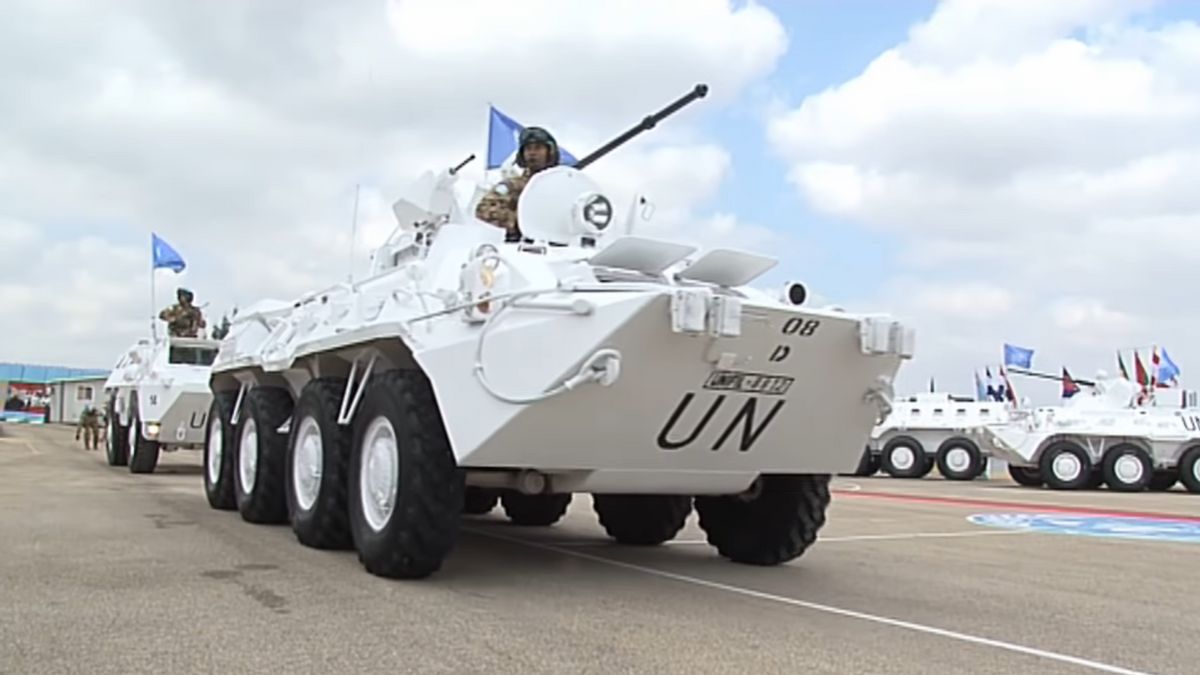


JAKARTA - The United Nations Interim Forces in Lebanon (UNIFIL) have warned its operations could be disrupted by the UN's recent decision to reduce peacekeeping personnel worldwide by 25 percent, following cuts in US funding for the world body.
A senior UN official, speaking on condition of anonymity, told reporters last week thousands of peacekeepers could be withdrawn from remote hotspots over the coming months as the US, the United Nations' largest donor, adjusted its contribution according to President Donald Trump's "America First" agenda. UNIFIL confirmed the report.
"UNIFIL is still studying the impact of the peacekeeper's budget shortfall on our mission in southern Lebanon, but we know we will face some difficult decisions," Kandice Ardiel's spokesman told The National.
"We are currently in the process of finalizing our plans, but we already know this will have a direct impact on our ability to fully carry out the tasks we have," he added.
It is not clear how many peacekeeping forces will be affected by the cuts.
UNIFIL currently consists of 10,800 military and civilian personnel from nearly 50 countries. In August, the Security Council decided to extend the troop mandate until December 2026.
Washington is the biggest contributor to the United Nations peacekeeping fund, providing more than 26 percent of total funding, followed by China, which accounts for nearly 24 percent.
The US was previously expected to account for 1.3 billion US dollars from a budget of 5.4 billion US dollars for the 2025 '2026 peacekeeper operation. However, Uncle Sam's country has told the United Nations it will only pay about half, 680 million US dollars.
President Trump has consistently argued that international institutions have exploited the US, which led to his decision to significantly reduce foreign aid.
It is known that UNIFIL was founded in 1978 following Israel's invasion of southern Lebanon. Its initial mandate was to confirm Israel's withdrawal, restore peace and security, and assist the Lebanese government in rebuilding its authority in the region.
Over time, especially after the 2006 war between Israel and Iran-backed militant group Hezbollah, the UNIFIL's role was expanded based on UN Security Council Resolution 1701 to include monitoring the cessation of hostilities, support for the Lebanese Armed Forces in southern Lebanon, and assistance to ensure territory between the Litani River and Blue Line, the border set by the United Nations with Israel, remains free of armed personnel or illegal weapons.
After the 14-month war between Israel and Hezbollah which ended in November 2024, UNIFIL has helped the Lebanese government to assert control over its southern region.
Under a US-brokered ceasefire, Hezbollah and Israel are both required to withdraw from southern Lebanon, while UN forces were deployed there with the Lebanese military, in part to help dismantle Hezbollah's infrastructure.
SEE ALSO:
-
 | BERITA
Kelompok Militan Hamas Kembali Memulangkan Jenazah Sandera yang Tewas
15 Oktober 2025, 07:15 -
 | BERITA
PM Palestina Mustafa Sebut Penghentian Perang Tidak Cukup untuk Mengakhiri Penderitaan
15 Oktober 2025, 06:00 -
 | BERITA
ICRC Sebut Pemulangan Semua Jenazah Sandera yang Tewas Mungkin Membutuhkan Waktu
14 Oktober 2025, 21:10

However, Israel continues to carry out routine attacks in Lebanon against what it calls Hezbollah's targets, and places its troops in five locations it considers strategically important.
"We will work closely with the Lebanese authorities and our troop-prone countries to implement any necessary changes in a minimal way that may be disruptive," Ardiel explained.
"We will also do everything we can to ensure we continue to carry out our most important tasks based on Resolution 1701," he said.
The English, Chinese, Japanese, Arabic, and French versions are automatically generated by the AI. So there may still be inaccuracies in translating, please always see Indonesian as our main language. (system supported by DigitalSiber.id)
Most Popular Tags
#Prabowo Subianto #donald trump #firearm #8791 #giias 2026Popular


