

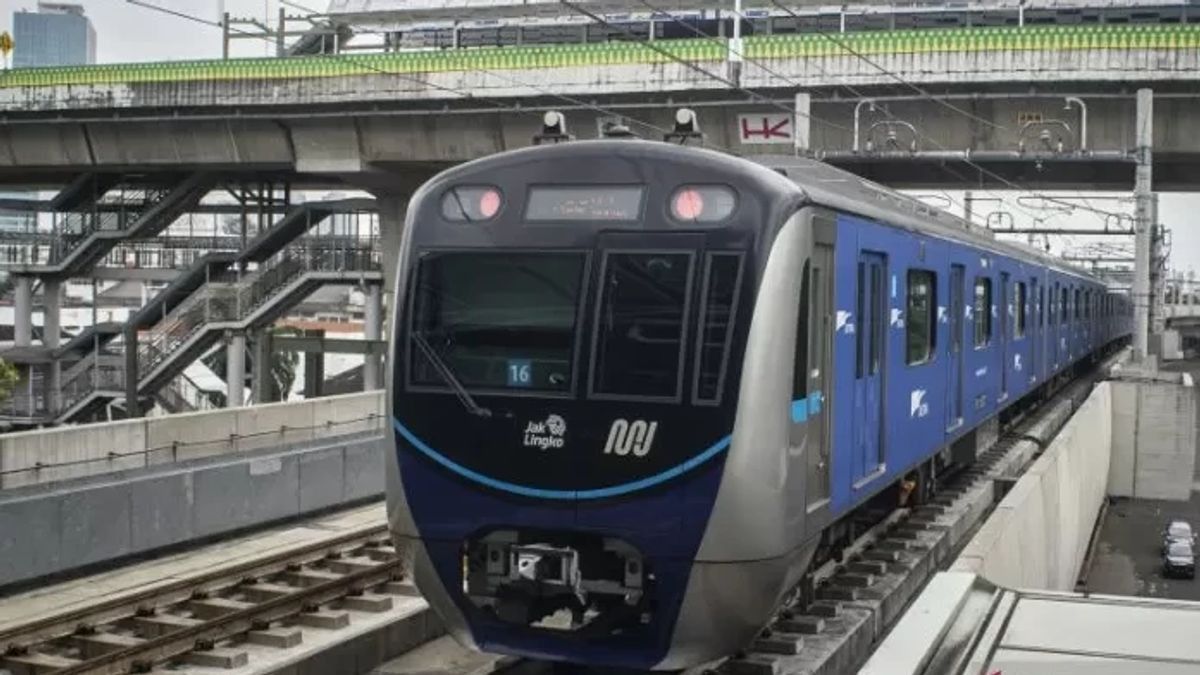


JAKARTA - The Jakarta Provincial Government ensures that MRT and LRT Jakarta rates will not increase amid the discourse on the efficiency of transportation subsidies, following the cuts in transfer funds from the central government to the regions (TKD).
"I make sure the MRT and LRT rates don't go up. Studies on willingness to pay (paying availability) and affordability to pay (paying ability) show that the applicable tariff is still within the current tariff limit," said Head of the Jakarta Transportation Agency Syafrin Liputo, Thursday 9 October.
According to Syafrin, based on calculations related to the economy last year, the MRT tariff was IDR 13,000. However, the tariff imposed is IDR 7,000. This means that the average number of subsidies in 2024 per customer is around IDR 6,000. This figure is still considered to be included in the transportation subsidy scheme that has been designed.
Unlike MRT and LRT, Syafrin revealed that the Transjakarta tariff was last set in 2005, which was IDR 3,500. In the last 2 decades, the provincial minimum wage (UMP) has increased sixfold and cumulative inflation has reached 186.7%.
Based on this analysis, the adjustment of Transjakarta tariffs is considered to have been done to maintain the sustainability of the service.
"Cost recovery Transjakarta fell from 34% in 2015 to 14% today. This means that the costs required to close it are getting higher, but there is no (adjustment) figure, it is still being detailed," he said, quoted from ANTARA.
Cost recovery shows how much operational costs can be covered from the rates paid by passengers. The rest is usually borne by the government through subsidies.
On the same occasion, the President Director of PT MRT Jakarta Tuhiyat said that routes such as the HI-Lebak Bulus roundabout, the actual economic value reached Rp. 32,000, while the fare paid by passengers was only Rp. 14,000. The difference of Rp. 18,000 is borne by the government through a public service obligation (PSO) scheme or public service subsidies.
"In order for the company to continue, we are developing revenue from non-fareboxes," said Tuhiyat.
To maintain operational sustainability, MRT Jakarta relies on various sources of income beyond passenger rates, such as naming (named rights), renting retail and commercial spaces, as well as digital and media activities.
Previously, Jakarta Governor Pramono Anung stated that the provincial government would review the public transportation subsidy scheme as part of the budget efficiency step, following the cuts in transfer funds from the central government to the regions.
However, Pramono emphasized that the study would not necessarily lead to an increase in public transportation rates in Jakarta.
"Our transportation subsidy is huge, but that doesn't mean the tariff will be increased immediately. This is just an example," said Pramono, Monday.
SEE ALSO:
-
 | BERITA
Trump-Maduro Bersitegang, Qatar Ajukan Diri Jadi Mediator AS-Venezuela
10 Oktober 2025, 00:01 -
 | TEKNOLOGI
Apple dan Google Hapus Aplikasi Pelacak ICE Setelah Tekanan Pemerintah
10 Oktober 2025, 04:05

He revealed that the current amount of public transportation subsidies in Jakarta reaches almost IDR 15,000 per person, so it needs to be reviewed so that it remains in line with regional fiscal conditions without sacrificing the accessibility of public services.
The cuts in transfer funds to regions, including profit-sharing funds (DBH), have made the 2025 Jakarta APBD projections decrease significantly from Rp 95.35 trillion to Rp 79.03 trillion.
The English, Chinese, Japanese, Arabic, and French versions are automatically generated by the AI. So there may still be inaccuracies in translating, please always see Indonesian as our main language. (system supported by DigitalSiber.id)


