
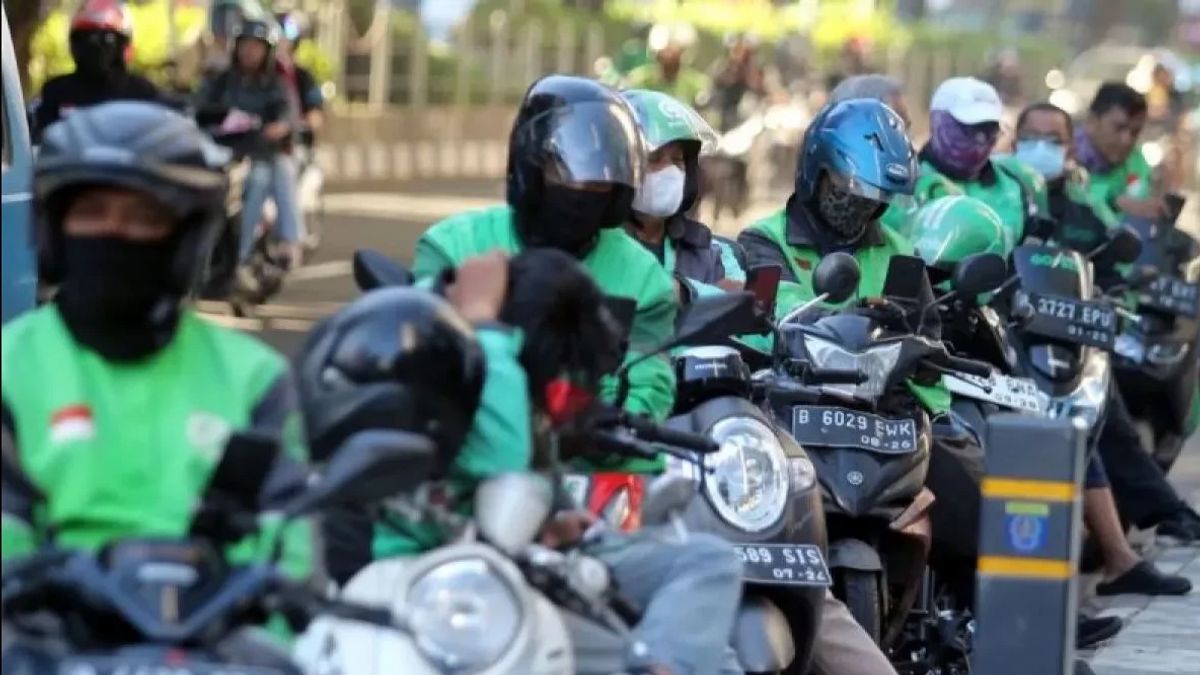


JAKARTA - The Indonesian Digital Mobility and Delivery Industry Association or MODANTARA has noted President Prabowo Subianto's statement regarding the protection of online transportation workers, the expansion of social security, and plans to increase the proportion of income for driver partners.
MODANTARA emphasized that it respects the President's concern for the welfare of driver partners.
For the industry, driver partners are a key part of the digital mobility and delivery ecosystem. Therefore, every effort to strengthen social protection, occupational safety, and income sustainability for partners needs to be supported.
However, MODANTARA considers the plan to limit the revenue sharing between partners and application platforms to a maximum of 8% is a policy that is too drastic, too forced, and risks having systemic impacts that could stop the pulse of Indonesia's digital economy, if implemented without in-depth study and discussion with industry players.
In response to this, MODANTARA strongly requests the government to thoroughly review the platform revenue share figure which has been changed to 8% by involving various stakeholders.
MODANTARA believes that good intentions to improve the welfare of partners should not turn into a new crisis.
"We understand the government's spirit to improve the welfare of driver partners, but good policies must be based on data, economic reality, and ecosystem sustainability. The 8% cut limit may sound simple, but the impact can be very wide, even reducing the platform's space to maintain the quality of services, incentives, and safety of partners," said MODANTARA Executive Director, Agung Yudha, in a written statement, Sunday, May 3.
"This ecosystem has become a social cushion for millions of people, so the policies taken need to maintain its sustainability," he continued.
According to MODANTARA, the issue of partner welfare cannot be simplified to just a platform deduction figure. The digital mobility and delivery ecosystem involves complex cost structures, ranging from technology, safety, customer service, risk protection, promotions, partner education, payment systems, transaction security, to sustainable investment to maintain service quality.
The digital mobility and delivery sector is a vital part of modern society. Currently, the digital mobility and delivery sector has involved 2-4 million active driver partners and has become a main and additional source of income; contributing hundreds of trillion rupiah per year to the national economic turnover; and supporting millions of MSMEs and workers in other sectors that depend on logistics and mobility services.
Sustainability is not only about the platform as a business entity, but also the entire ecosystem connected within it - from millions of driver partners, MSMEs, to workers in various sectors that rely on mobility and delivery services in their daily activities, including people who depend on online motorcycle taxi and online taxi services to work and work.
This 8% limit will reduce the operating space of the platform by 60%, and will force some platforms to change their business models in a very significant and sudden manner. The effects are complex, systemic, and can even threaten economic stability and the investment climate.
Each platform has a different business model with different commission offers, adjusting to the segmentation of services, target markets, technological innovations, and partner needs. Therefore, partners have the freedom to choose services with revenue sharing that is tailored to their needs without having to force uniformity.
"The proceeds or platform cuts cannot be standardized like parking rates. The question is: will the 8% limit really strengthen the income of partners in the long run, or will it actually reduce the demand, services, and flexible employment opportunities that have supported them so far?" said Agung.
MODANTARA sees that the imposition of a single platform cut can:
● Eliminate competition which is the foundation for innovation in service and empowerment programs for partners
● Potential for price adjustments to consumers
● Threatening the sustainability of services, especially in areas with low margins, because the platform must focus on larger volumes
● Forcing platforms to operate with lean cost structures and excessive efficiency that impacts the quality of consumer services. [In India, for example, the low-commission platform Ola was forced to cut the number of company employees and significantly reduce driver incentives in order to operate with low commissions]
● Operational efficiency that can impact service quality
In addition, the 8% commission limit policy has the potential to be the lowest in the world set by the government. Globally, the average platform fee is in the range of 15-30% for ride-hailing and delivery services, depending on the business model and market stage.
This will have a negative impact on Indonesia's attractiveness as an investment destination in the world and efforts to attract investors to Indonesia.
Until now, MODANTARA has not received a copy of Presidential Regulation 27/2026 which regulates the protection of online transportation workers which is stated to have been signed by the president, so that it can review and study further and in detail.
However, MODANTARA stated its readiness to sit down with regulators and all stakeholders to formulate balanced, implementable, and sustainable policies.
MODANTARA believes that good policies must maintain a balance between worker protection, business sustainability, consumer interests, investment competitiveness, and national digital economic growth.
The English, Chinese, Japanese, Arabic, and French versions are automatically generated by the AI. So there may still be inaccuracies in translating, please always see Indonesian as our main language. (system supported by DigitalSiber.id)


