

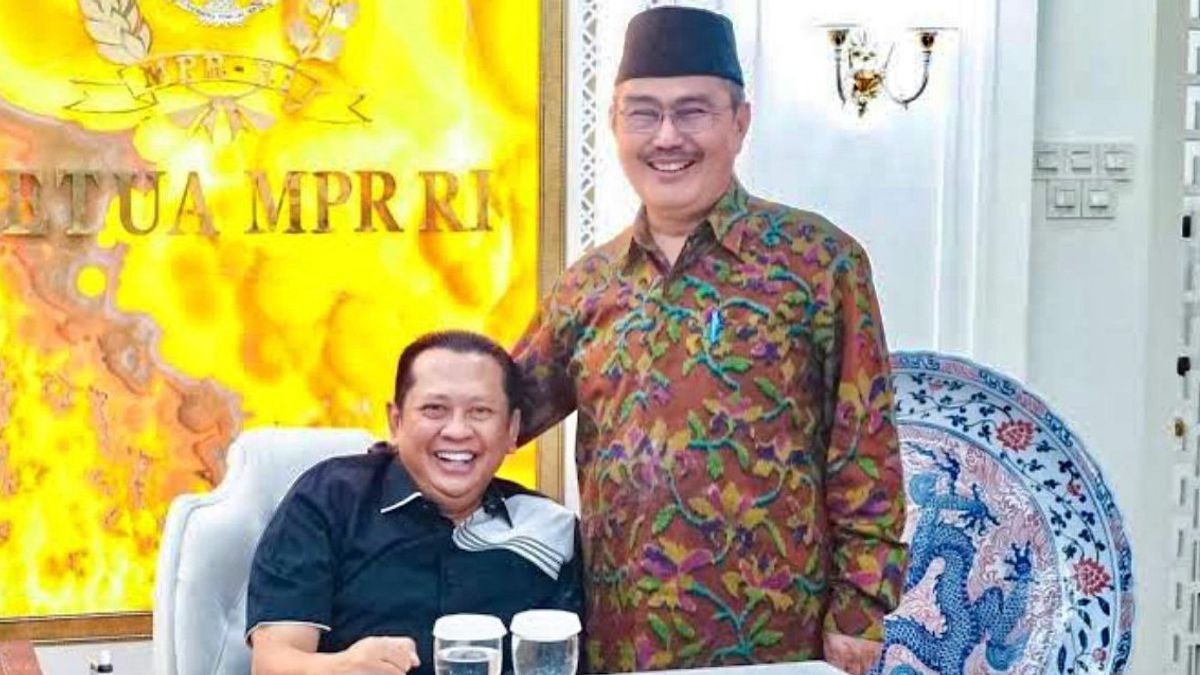


JAKARTA - Deputy Chairperson of the Golkar Party as well as member of the Indonesian House of Representatives, Bambang Soesatyo (Bamsoet), supports the proposed fifth amendment to the 1945 Constitution of the Republic of Indonesia which was submitted by the former Chief Justice of the Constitutional Court, Prof. Dr. Jimly Asshiddiqie. According to Bamsoet, more than two decades of reform have not brought Indonesia to find a state system that really answers the dynamics of the times as a whole.
"Four changes to the 1945 Constitution in 1999'2002 have indeed resulted in a major transformation. But in fact, there are still many structural problems in governance of public power, law, and ethics that have not been resolved. The fifth amendment did not appear suddenly, but departed from a critical evaluation of constitutional practices that have not been optimal. Even in some aspects, it has experienced setbacks," said Bamsoet in Jakarta, Monday, June 30.
He emphasized that the political oligarchy that controls the space of democracy, weak checks and balances, as well as the lack of ethical accountability of public officials is proof that institutional design is not ripe. "We cannot constantly blame the implementation if the design itself is not perfect," he said.
Bamsoet also supports the idea of restructuring representative institutions. DPDs that are considered ineffective are proposed to be removed and converted into regional delegates within the DPR. Thus, regional votes remain present in every national decision. At the same time, the MPR is strengthened by the group's messenger faction to represent professional groups, religions, customs, and civil society which are often marginalized by party-based political systems. The MPR will also re-establish the Principles of State Policy (PPHN) as the direction of the nation's strategic policies.
"Strengthening the national leadership system is also crucial. In the proposal of Prof. Jimly, the president is still directly elected by the people, while the vice president is proposed by the elected president to be approved by the MPR. This model can prevent the trap of a transactional coalition that often takes the government hostage," said Bamsoet.
He also considered the need to form a National Ethics Court. This institution will be the pinnacle of ethical courts to supervise judges, state officials, and other public officials. "The ethics crisis in bureaucracy and legal institutions cannot be tolerated. The Ethics Court is an important step so that the morality of state administrators runs in line with the law," he stressed.
SEE ALSO:



He added that the system of supervision and law enforcement must also be strengthened. The authority to examine regulations between the Supreme Court and the Constitutional Court needs to be integrated so as not to overlap. In addition, BPK supervision must synergize with actions centered in the Attorney General's Office, together with other law enforcement agencies in an integrated system.
Bamsoet emphasized the importance of strengthening the ideology of the Pancasila economy. Article 33 of the 1945 Constitution is proposed to be changed by changing the term 'family principle' to 'middle cooperation' to better reflect the nation's original values. The phrase 'earth and water' is also expanded to 'earth, water, and air' to answer the challenges of digital sovereignty and national airspace.
"Indonesia's constitution must be a living document capable of answering the challenges of the times without leaving its roots. The fifth amendment proposal does not touch controversial issues such as extending the presidential term. On the other hand, this is directed at strengthening institutions, improving systems, and improving more substantive democratic practices," concluded Bamsoet.
The English, Chinese, Japanese, Arabic, and French versions are automatically generated by the AI. So there may still be inaccuracies in translating, please always see Indonesian as our main language. (system supported by DigitalSiber.id)
Most Popular Tags
#Prabowo Subianto #donald trump #Febrie Adriansyah #8791 #giias 2026Popular


