
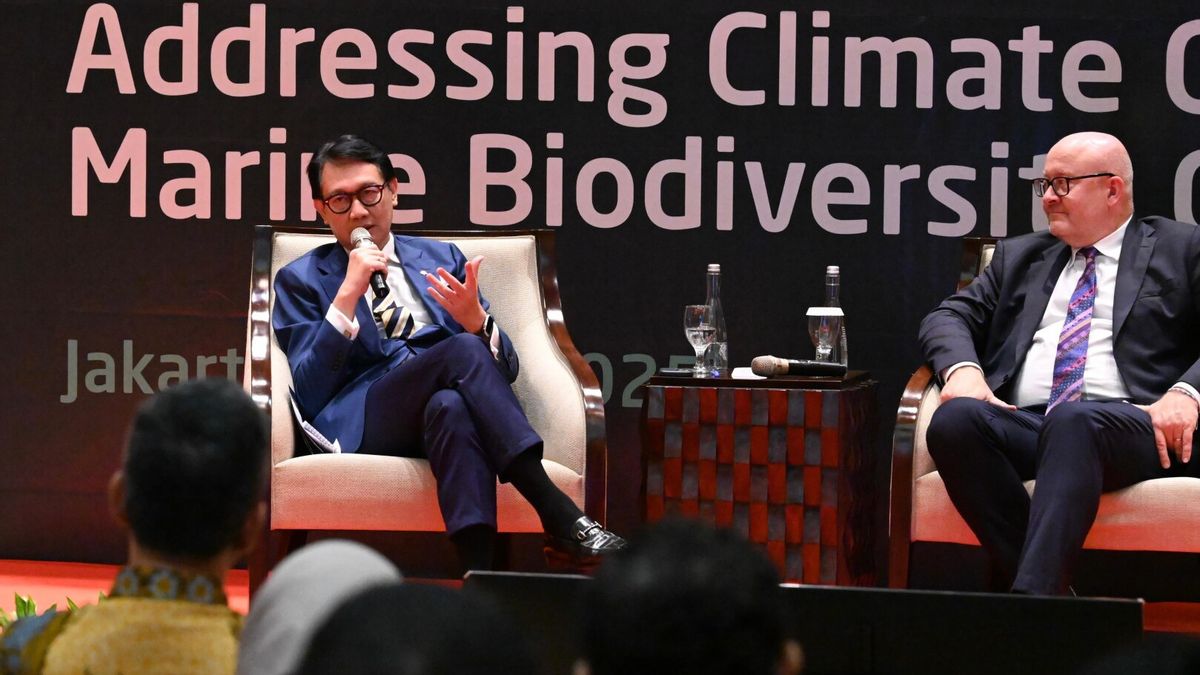


JAKARTA - The Ministry of Foreign Affairs of the Republic of Indonesia, in collaboration with the Indonesian Ocean Justice Initiatives (IOJI) held an activity entitled "Advancing the Law of the Sea: Addressing Climate Change and Marine Biodiversity Challenges" on Friday.
The event, which was held at the Indonesian Ministry of Foreign Affairs in Jakarta, consists of two panel sessions, which are part of an effort to formulate national marine law policies that are responsive to the latest developments in international law, particularly related to the issue of climate change and marine biodiversity.
The first panel presented the President of the International Court for Maritime Law/International Tribune for the Law of the Sea (ITLOS) Judge Tomas H. Heidar, Deputy Minister of Foreign Affairs, Arif Havas Oegroseno, discussing the Advisory Opinion issued by ITLOS on climate change in May 2024.
In the second panel, the Dean of Pancasila University, Prof. Dr. Eddy Pratomo, SH, MA, Head of Public Relations and Foreign Cooperation Bureau of the Ministry of Maritime Affairs and Fisheries, Zaki Mubarok, SIP, MILIR., Ph.D., and Senior Researcher of the National Research and Innovation Agency, Hagi Yulia Sugeha, SC., Ph.D., discussed the Agreement on the Conservation and Sustainable Use of Marine Biological Diversion of Areas beyond National Jurisdiction or better known as BBNJ Agreement.
"This activity is a strategic forum to explore how the ITLOS Advisory Opinion on Climate Change and Agremeent BBNJ will affect Indonesia's obligations as a coastal country based on the 1982 United Nations Convention on Maritime Law (UNCLOS)," the Ministry of Foreign Affairs said in a statement, Friday, May 9.
The first panel reviewed the legal implications of ITLOS Advisory Opinion on Climate Change published on May 21, 2024, including its interpretation of the definition and scope of marine pollution based on UNCLOS, as well as the state's obligation to prevent, reduce, and control pollution arising from the impact of climate change.
The discussion also discussed the consequences of the Advisory Opinion for archipelagic countries, especially Indonesia, and provided insight into how the national legal framework and policy can adapt to answer these challenges.
In the second panel, discussing a comprehensive picture of the main provisions in the BBNJ Agreement which has just been adopted globally and is in the process of ratification by Indonesia.
Panel dig deeper into the relevance of Agreement to Indonesia's national interests in conservation and continued utilization of marine biodiversity outside of national jurisdiction. This discussion includes aspects of Indonesia's readiness to implement this agreement, including adjustments to the necessary national institutions and laws.
In addition, there are also opportunities for regional and multilateral cooperation that Indonesia can use to support the implementation of the agreement effectively.
SEE ALSO:




Indonesia, as an archipelagic country with a broad marine jurisdiction, has an interest in ensuring that the implementation of international marine law is in line with national interests as well as the principles of justice and sustainable development.
"In this context, the formulation of Indonesia's marine law policies in the future will integrate the principles contained in the Advisory Opinion on Climate Change and BBNJ Agreement into domestic policies and international positions," the ministry said.
The Indonesian Ministry of Foreign Affairs added that the results of this activity were preserved to strengthen Indonesia's position in international forums, as well as enrich the process of drafting an adaptive and progressive national marine law policy.
The English, Chinese, Japanese, Arabic, and French versions are automatically generated by the AI. So there may still be inaccuracies in translating, please always see Indonesian as our main language. (system supported by DigitalSiber.id)
Most Popular Tags
#Prabowo Subianto #donald trump #firearm #8791 #giias 2026Popular


