
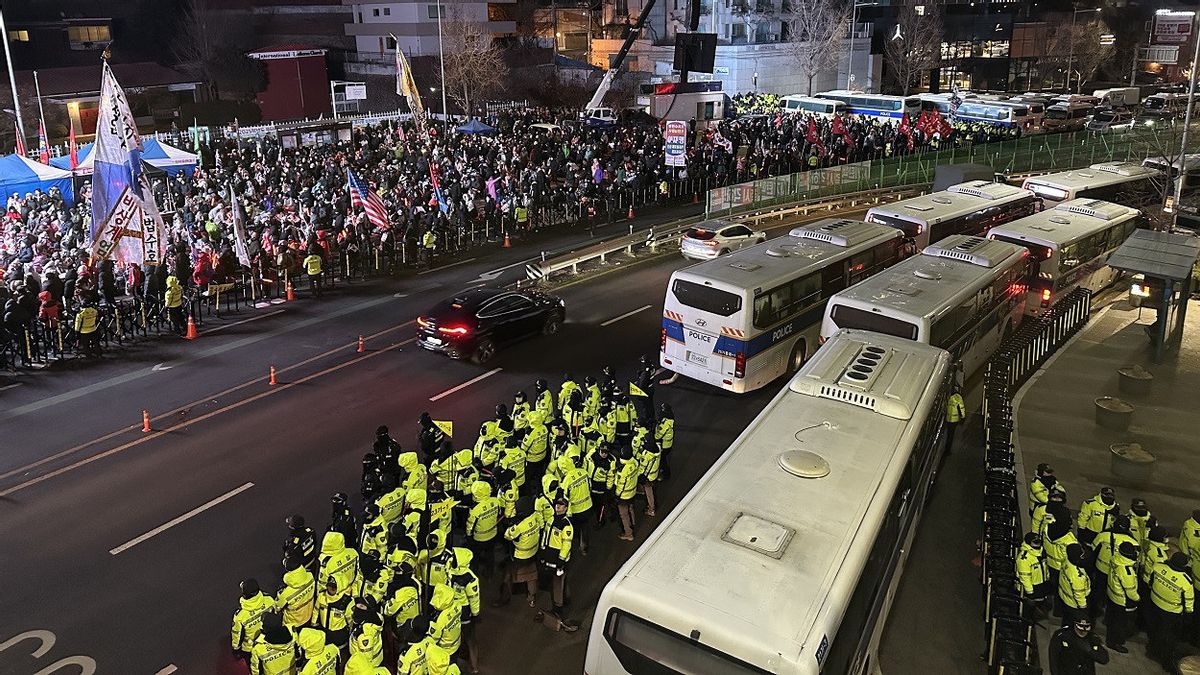


South Korean police officials said on Wednesday police would deploy about 14,000 antihuru-hara troops in Seoul on the day of the Constitutional Court's impeachment decision, anticipating possible social unrest.
The number represents 60 percent of all available riot control forces for national mobilization under the highest level security warning from police, the official said.
The court completed Yoon's impeachment trial for an emergency military declaration, which took place on December 3, 2024, late last month and is scheduled to immediately decide whether to remove him from office or remain in power.
However, the day the verdict hearing will be held has not been announced.
Previously, the police planned to deploy 12,000 officers in Seoul. Later, the numbers have been added to anticipate unexpected situations that may arise from large-scale crowds and possible attacks on key facilities, including courts and their judges.
In preparation for a state of emergency, criminal justice police officers will be deployed to the Constitutional Court building and special police forces will also be on standby nearby, officials said, adding that any protesters who storm the court will be arrested on the spot.
Areas around the court have been designated as a no-fly zone since last Thursday, but police will deploy anti-drone equipment there to prepare for possible illegal drone flights.
Schools, one subway station, one gas station and four construction sites near the court will all stop operations on the day of verdict and access to the roof entrance of 22 adjacent buildings have also been restricted, officials said.
Earlier this week, Democratic Party, South Korea's opposition urged the country's Constitutional Court to immediately decide on President Yoon Suk Yeol's impeachment.
It said allowing the state to wait was considered "irresponsible" and deepened social divisions over the court's decision to impeach Yoon.
The court settled the argument on February 25, in which Yoon said his military emergency declaration was necessary to eradicate "anti-state" elements but he never intended to fully enforce emergency military rules.
"The state and the people have reached their peak," said a member of the Democratic Party leader Kim Min-seok.
"We are waiting for the court's decision to be held accountable. Further delays are not normal and irresponsible," he said at a party meeting.
It is known that Yoon's supporters stormed Seoul's Western District Court in protest against the court's decision to formally arrest the suspended president in January.
President Yoon declared martial law on the night of December 3 last year, but was lifted by the opposition-led National Assembly hours later. That led to an impeachment proposal, quoted from Xinhua.
Yoon's impeachment proposal was passed by the National Assembly on December 14, and since then the Constitutional Court has held 11 sessions of Yoon's impeachment with a final verdict expected to be delivered this week.
SEE ALSO:
He was arrested at the president's official residence on January 15 and charged with detention on January 26 as a suspect in the leader of the uprising, becoming the first president to serve in the country to be arrested and prosecuted.
The Seoul Central District Court approved the release of the arrested president, accepting Yoon's request to cancel his detention filed by his legal team on February 4.
Yoon was released on March 8 as prosecutors decided not to appeal the court's release approval.
The English, Chinese, Japanese, Arabic, and French versions are automatically generated by the AI. So there may still be inaccuracies in translating, please always see Indonesian as our main language. (system supported by DigitalSiber.id)


