
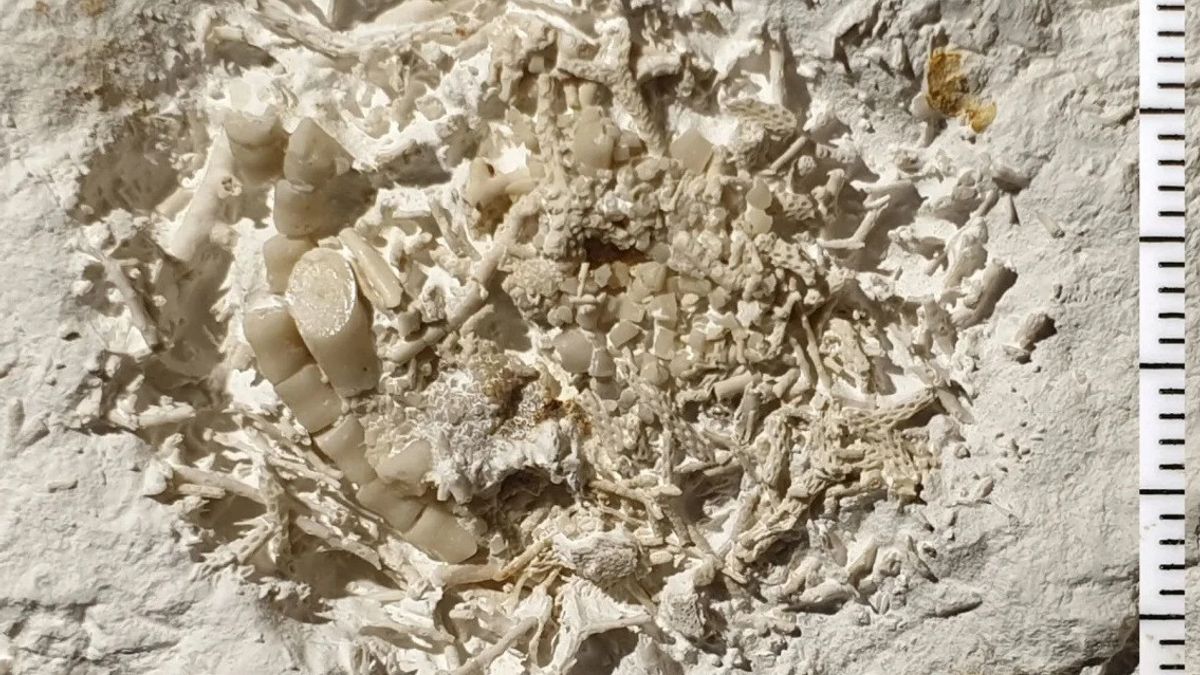


JAKARTA - Amateur fossil hunters managed to find a piece of animal vomit dating back 66 million years on the Danish coast.
Peter Bennicke saw a "small bowl of strange licor flower pieces in a piece of limestone" on Stevns Klint, eastern Denmark, according to a statement from Geomuseum Faxe, the local museum where the discovery was set to be displayed which was sent to CNN last month.
Bennicke took the fossil to the museum, where the fossil was cleaned and examined by John Jagt, a liyan flower expert from the Netherlands.
Jagt said the group contained at least two species of libricant flowers combined in round clumps, which may have been part of the digested libon flower that was vomited by the animal that ate the plant.
"In technical terms, this type of discovery is called regulatory, and is considered very important when reconstructing ancient ecosystems because it provides valuable information about which animals are eaten by," reads the statement, quoted by CNN on February 5.
Meanwhile, Jesper Milmen, curator at Geomuseum Faxe, said the fossil was "a truly an extraordinary discovery."
"Bunga lilit is not a very nutritious food, because most of it consists of calcium plates that are united by very few soft tissues," he said in the statement.
SEE ALSO:
-
 | BERITA
Kunjungi 42 Museum Kurang dari 12 Jam, Pria Ini Pecahkan Rekor Guinness World Records
08 Februari 2025, 21:00 -
 | BERITA
Restoran Indonesia Hadir di Oslo, Dubes Faizasyah: Dari Rasa Turun ke Hati
08 Februari 2025, 18:00 -
 | BERITA
Awak Pesawat Tidak Sengaja Buka Perosotan Darurat, Penerbangan ke Hawaii Dibatalkan
08 Februari 2025, 15:00 -
 | BERITA
Resmikan Kampung Indonesia di Hatay Turki, Dubes RI: Wujud Persaudaraan dan Solidaritas
08 Februari 2025, 12:00

"But here we have an animal, most likely a type of fish, which 66 million years ago ate a libricant that lived on the seabed of Cretaceous and then vomited the skeleton part," he explained.
Milten added the discovery "provides important new knowledge of the relationship between predators and prey as well as food chains in the Cretaceous sea."
The English, Chinese, Japanese, Arabic, and French versions are automatically generated by the AI. So there may still be inaccuracies in translating, please always see Indonesian as our main language. (system supported by DigitalSiber.id)
Most Popular Tags
#Prabowo Subianto #donald trump #Febrie Adriansyah #8791 #giias 2026Popular


