
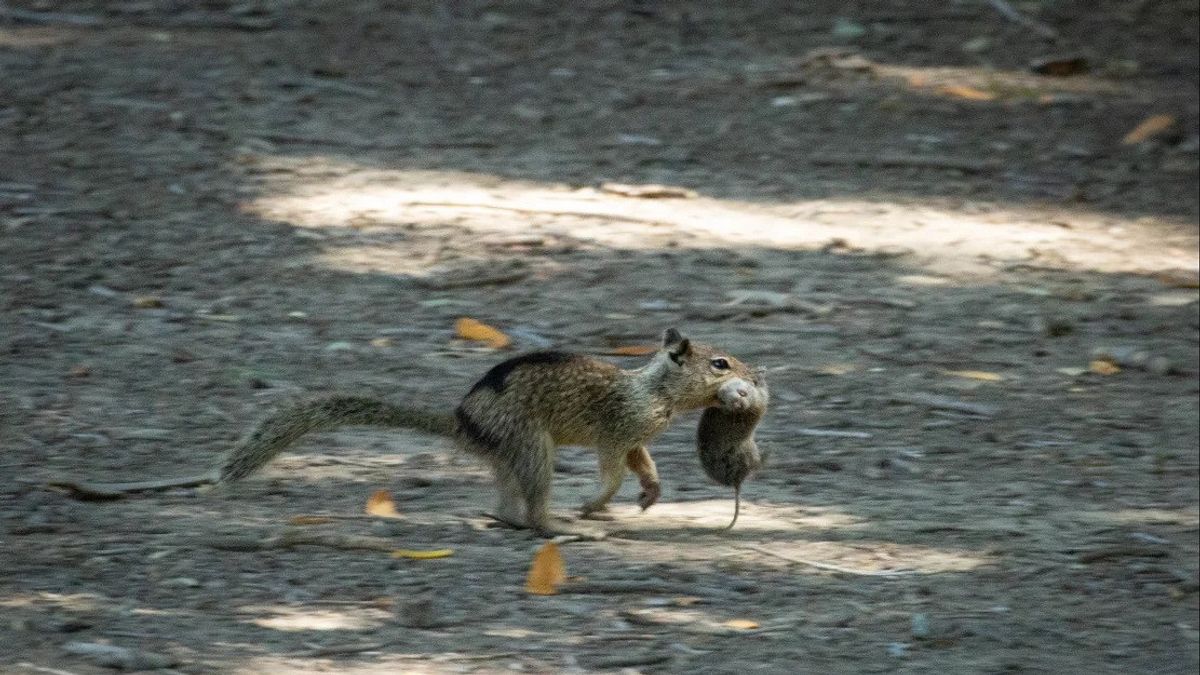


JAKARTA - The study, published in a scientific journal last month, for the first time revealed that California's earth squirrels preyed on other squirrels, instead of the nuts they usually eat.
In a study published last month in 'Journal of Ethology' which is part of the Long-Term Conduct Ecology Project of California Land Economy in the Briones Regional Park in Contra Costa County.
The project examines how California earth squirrels originating from the state's trims adjust their behavior in response to environmental changes, in this case an increase in the local mouse population.
In parts of Northern California, ground rat attacks have been observed. At the research site, study authors noted the number of ground rats much higher than the average over the past decade.
Californian soilferencing is usually seen as a herbivore or granivorous, which mostly eats plants and grains.
The new findings offer the first documentation of a species that actively preys on other living vertebrates underlined its ability to respond to changes in the ecosystem.
"This research radically changes our perception of squirrels, one of the most known mammals in the world," said study lead author Jennifer Smith, professor of biology at the University of Wisconsin-Eau Claire, via email, reported by CNN January 27.
"In the face of human disturbances such as climate change and drought, these animals are resilient and have the potential to adapt to life in a changing world," he explained.
pemadik merupakan bagian penting dari ekosistem California, dan memahami apakah penemuan makanan merupakan sifat yang disampaikan secara sosial dalam populasi ini dapat memberikan pengetaran utama tentang bagaimana spesies lain akan menyesuaikan diri dengan lingkungan yang berubah, kata Smith.
Smith and his colleagues observed the behavior of eating squirrel meat during the study period from June 10 to July 30. During that time, scientists used live traps to capture, mark and release California earth squirrels every two weeks.
The study team collected detailed data on each squirrel, including gender, reproductive status and body mass, labeling each animal with two unique identifications and fur signatures using dyes to ensure all squirrels examined could be tracked during the observation period.
Smith explained that squirrels are very useful for studying animal resistance to environmental changes because they are active during the day and easy to catch, characterized and observed.
The researchers divided the squirrel into three groups and observed animal behavior in the days without arrest. The team recorded 74 interactions between squirrels and mice, with 42 percent of the encounter involving squirrels including young and adult male and female squirrels actively hunting and eating mice.
"We already know (the California earthline) can live (at) various heights and eat (from) various plants, but the most striking and extraordinary is their speed of changing their behavior towards local spikes in mouse abundance," Smith explained.
The study also revealed other previously undocumented social dynamics between squirrels and mice. Some of the interactions between the animals are positive, including looking for food, greeting, and playing. Other behaviors are competitive, characterized by chasing, physically pushing, pounceing and biting.
"The soil tip (starts) recognizing the squirrel as a predator," said John Koprowski, dean of Haub School for Environment and Natural Resources at Wyoming University, who was not involved in the study.
"There may be very good interaction between the two species because eating is usually not a good way to continue your genes," he said.
The findings of these studies suggest the squirrels may best be classified as opportunistic omnivores based on their desire to hunt and eat live prey, especially when supplies are abundant.
Protein is a limited but important resource for squirrels to thrive, and hunting ground mice is likely to give them faster and more accessible nutritional boosts than grains, explains Koprowski.
"This is an extraordinary way for them to take advantage of very abundant resources to provide enough food for many (airlines) to use," he said.
Although humans usually categorize animals based on their eating habits, it's not unusual for the strictest carnivorous to eat fruit occasionally, Koprowski added.
The phenomenon in which animals take advantage of the resources needed when available to them is known as food plasticity, according to Koprowski.
If an animal does not adapt to utilizing these resources, it is likely that other species will take advantage of it.
While this discovery may initially seem worrying to some, Koprowski said such a change in diet was quite normal for animals.
Rats often experience a surge in population growth and are considered pests, so having new predators like California ground squirrels will help control the number of mice, he said.
SEE ALSO:
-
 | BERITA
Wamenlu Ryabkov Soroti Belum Disetujuinya Duta Besar Rusia untuk Amerika Serikat
01 Februari 2025, 05:00 -
 | BERITA
Garda Revolusi Iran akan Gunakan AI untuk Operasi Angkatan Laut hingga Pertahanan Udara
01 Februari 2025, 04:00 -
 | BERITA
Kremlin Sebut Belum ada Pembicaraan Putin-Trump Usai Kecelakaan Penerbangan di Washington
01 Februari 2025, 03:00 -
 | BERITA
Junta Militer Myanmar Perpanjang Status Darurat Enam Bulan untuk Persiapan Pemilu
31 Januari 2025, 17:00

According to Smith, these new findings can also help prepare future research on the adaptability of various squirrel species and other mammals in the face of environmental changes.
"Animals can adapt or become extinct in a human-affected world," Smith said.
"These animals show us the extraordinary resilience of some species and by studying these processes, we can offer meaningful insights for conservation," he added.
The English, Chinese, Japanese, Arabic, and French versions are automatically generated by the AI. So there may still be inaccuracies in translating, please always see Indonesian as our main language. (system supported by DigitalSiber.id)


