

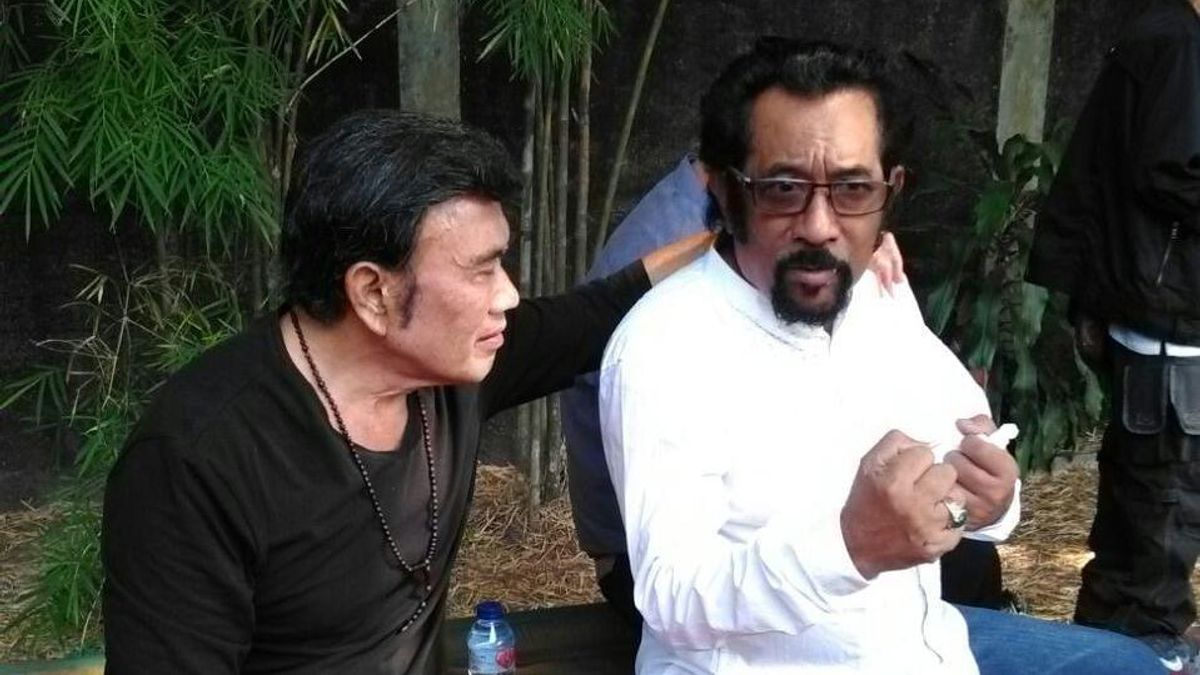


JAKARTA - Indonesia has lost again one of the great talents who has colored the entertainment world in the country. Singer Hamdan ATT died at the age of 76 on Tuesday, July 1 at 12.00 WIB
In the last eight years, Hamdan has had a disease that has forced him to undergo intensive care several times in hospitals.
However, in the midst of his not good health condition, the singer who became iconic with the song 'The Poorest in the World' received a special award, Lifetime Achievement Award, at the 2021 Indonesian Dangdut Awards.
The award is proof of Hamdan ATT's big role in the country's music industry, especially in the realm of dangdut, which has a large number of connoisseurs and also has its own militancy.
Hamdan is one of the swordduts that has been able to maintain its characteristics for more than three decades. He was transformed into a melancholic dangdut icon that is remembered across generations.
Hamdan ATT's musical journey began as a teenager. His interest in music brought him to appear on many small stages, until the 1970s became a turning point in his career.
When dangdut began to take root as the identity of people's music, Hamdan appeared as a dancer who brought a melancholic feel in his work and appearance with a more subtle and emotional approach.
SEE ALSO:


Hamdan reached the peak of his career in the 1980s to 1990s. He released a series of songs that quickly penetrated the market. Some of his most well-known works include The Poorest in the World', Holy Prayers, 'Blood Waters', and Defect Girlfriend.
Albums such as "Old Luka", "Sengsara Become Heritage", and "Live in Sina" received good comments among dangdut lovers. In his time, Hamdan ATT's cassettes were said to have reached sales of hundreds of thousands of copies.
If many dangdut singers appear in a glamorous and expressive style, Hamdan ATT chooses a different image, tends to be simple, both in appearance and in vocal style.
Even though it rarely appears in the last years, Hamdan ATT's influence still feels strong. The songs are often replayed, both by modern dangdut singers, talent search event participants, as well as in nostalgic content on YouTube.
The English, Chinese, Japanese, Arabic, and French versions are automatically generated by the AI. So there may still be inaccuracies in translating, please always see Indonesian as our main language. (system supported by DigitalSiber.id)


