

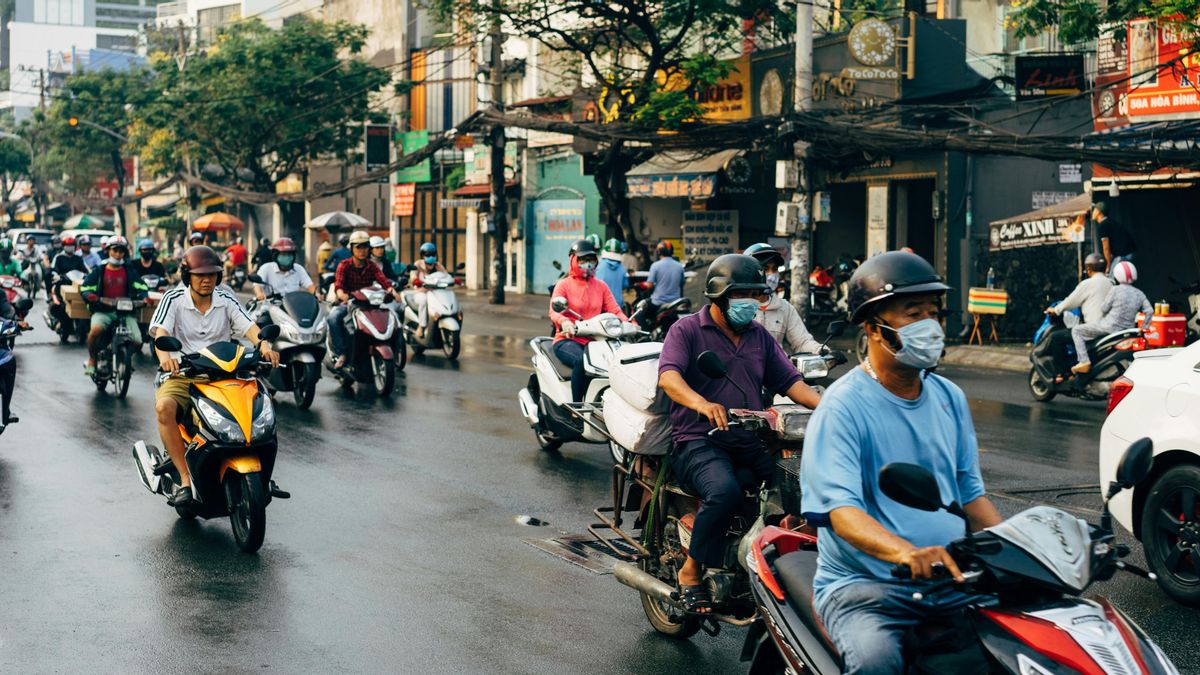


JAKARTA - The Vietnamese government will ban the use of gasoline-engined motorcycles next year. The policy immediately received a reaction from Japan and also several leading producers in the country.
As reported by Reuters, Saturday, October 25, Vietnamese Prime Minister Pham Minh Chinh issued a directive prohibiting gasoline-fueled motorcycles from entering the center of the capital starting in mid-2026. This is an effort by the country to reduce high levels of air pollution.
The wider restrictions will be imposed in 2028 and the ban is expected to expand to other regions of the country. In response to this, the Japanese Embassy in Hanoi immediately sent a letter to the Vietnamese authorities.
He stated that the sudden ban could have an impact on employment in the supporting industry. Workers at motorcycle dealers and suppliers of spare parts can be laid off due to the policy.
As well as disrupting the $4.6 billion market dominated by Honda. The embassy also urged Vietnamese authorities to consider "precise roadmaps" for electrification which will include a period of preparation and gradual implementation of regulations.
SEE ALSO:
-
 | MOTOR
Biodiesel dari Limbah Ikan Bawa Siswa Ini Raih Emas di AHM Best Student 2025
25 Oktober 2025, 09:53
It is known that the motorcycle market in Vietnam is one of the largest in the world. The number of motorbikes registered last year is close to 80 percent of the country's 100 million population, one of the highest ownership rates in the world.
The main trading group for foreign motorcycle manufacturers in Vietnam, led by Honda and includes Yamaha and Suzuki, sent its own letter to the Vietnamese government last July. The brand warned that the ban could result in production disruptions and bankruptcy risks for companies in supply chains.
Manufacturers say the ban could have an "extensive impact" on hundreds of thousands of workers and mention potential disruption to nearly 2,000 dealers and about 200 component suppliers.
They urged the implementation of the transition period with a minimum preparation time of two to three years to give them time to adjust the production line while the charging station network and safety standards are expanded.
Reportedly, Vietnamese officials have so far refused to follow up on requests from the Japanese government and manufacturers. Responding to concerns about the switch to electric vehicles, Prime Minister Chinh told Japanese executives that emission reduction is a global issue that requires joint efforts to choose the most optimal solution with the appropriate roadmap.
Honda, which last year managed to sell 2.6 million motorcycles in Vietnam, is likely to consider reducing production. One of the sources from the Japanese manufacturer also said it was monitoring the situation closely, but had no plans to close the factory.
Honda owns four factories in Vietnam, almost all of the motorcycles it sells in Vietnam and elsewhere use gasoline. However, they also offer models of CUV e: and ICON e: battery power in the country.
The English, Chinese, Japanese, Arabic, and French versions are automatically generated by the AI. So there may still be inaccuracies in translating, please always see Indonesian as our main language. (system supported by DigitalSiber.id)
Most Popular Tags
#Prabowo Subianto #donald trump #Febrie Adriansyah #8791 #giias 2026Popular


