

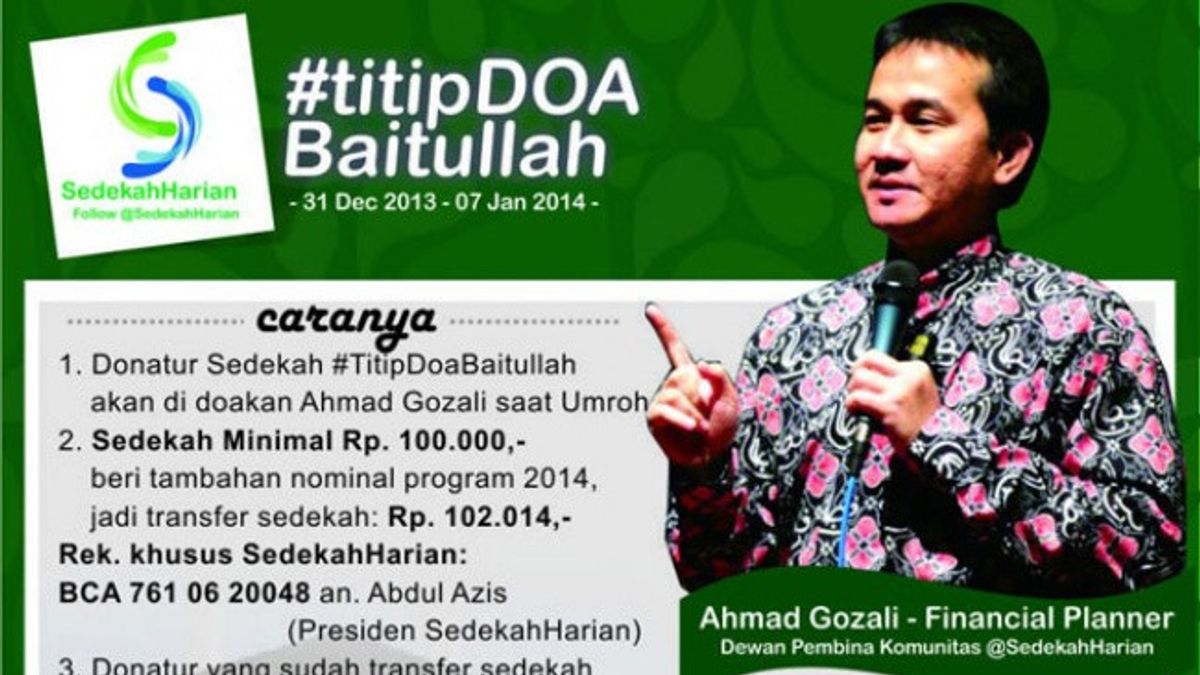


JAKARTA - History today, 12 years ago, January 2, 2014, the Indonesian Ulema Council (MUI) did not allow paid prayer. MUI emphasized that prayers were generally delivered directly to God. Prayers can be delivered individually or together.
Previously, social media was abuzz with the presence of a paid prayer prostration by the Sedekah Harian institution. The prayer was pegged at a minimum payment of Rp. 100 thousand. Later, the Sedekah Harian will pray directly in front of the Ka'bah, Mecca.
Many people believe that the power of prayer has great benefits. Whoever has a wish can convey prayers directly to God - personal or collective wishes. However, Sedekah Harian sees prayer as a way to raise new charity funds.
This condition made Sedekah Harian immediately roll out a program with the hashtag titipDOABaitullah. Anyone who wants to be prayed for is expected to immediately send a minimum of Rp. 100 thousand + additional nominal Rp. 2,014 as a confirmation that the program took place in 2014.
Later, the donor will be prayed for by the Board of Trustees of the Daily Charity Institution, Ahmad Gozali in front of the Ka'bah during the umrah. Instead of getting a response, the program became a polemic. Moreover, the matter became a discussion and went viral on social media like Twitter/X.
Those who are against the Daily Charity program are in trouble. Ahmad Gozali, who is known as a financial planner, is considered to not understand religion. Ahmad is seen as commercializing religion, even though it is wrapped in alms.
Other Muslims were angry. They considered that prayer could not be delegated. Prayer is a special relationship with God, both individually and together. In general, it cannot be delegated. Ahmad also tried to provide clarification.
He considers the idea of prayer custody to have come from the proposal of several donors from Sedekah Harian. As a result, Ahmad also carried out the idea because he considered it his agency's obligation to pray for donors.
"About praying is the obligation of every person who is given alms to pray for the donor, anytime, anywhere," said Ahmad as quoted by lamandetik.com, January 2, 2014.
Ahmad's answer did not satisfy many parties. The prayer of tithes ala Sedekah Harian is still considered controversial. This condition makes MUI speak up. MUI confirmed that it did not allow tithes, let alone paid on January 2, 2014.
MUI considers that prayer is direct - whether it is done by an individual or together. The institution of scholars believes that there is no prayer that uses an intermediary. Moreover, people have to pay a certain amount.
There is also no basis for considering that prayers can be represented and must be paid for. MUI considers the idea of praying for prayers can actually trap Muslims in a narrative of commercializing religion. A thing that is considered to damage the view of others to Islam.
"Prayers like that are not right, the prayer is direct," said the Head of the MUI for Halal Products, Amidhan Shaberah, as quoted by the lamantempo.co website, January 2, 2014.
The English, Chinese, Japanese, Arabic, and French versions are automatically generated by the AI. So there may still be inaccuracies in translating, please always see Indonesian as our main language. (system supported by DigitalSiber.id)
Most Popular Tags
#Prabowo Subianto #donald trump #firearm #8791 #giias 2026Popular


