

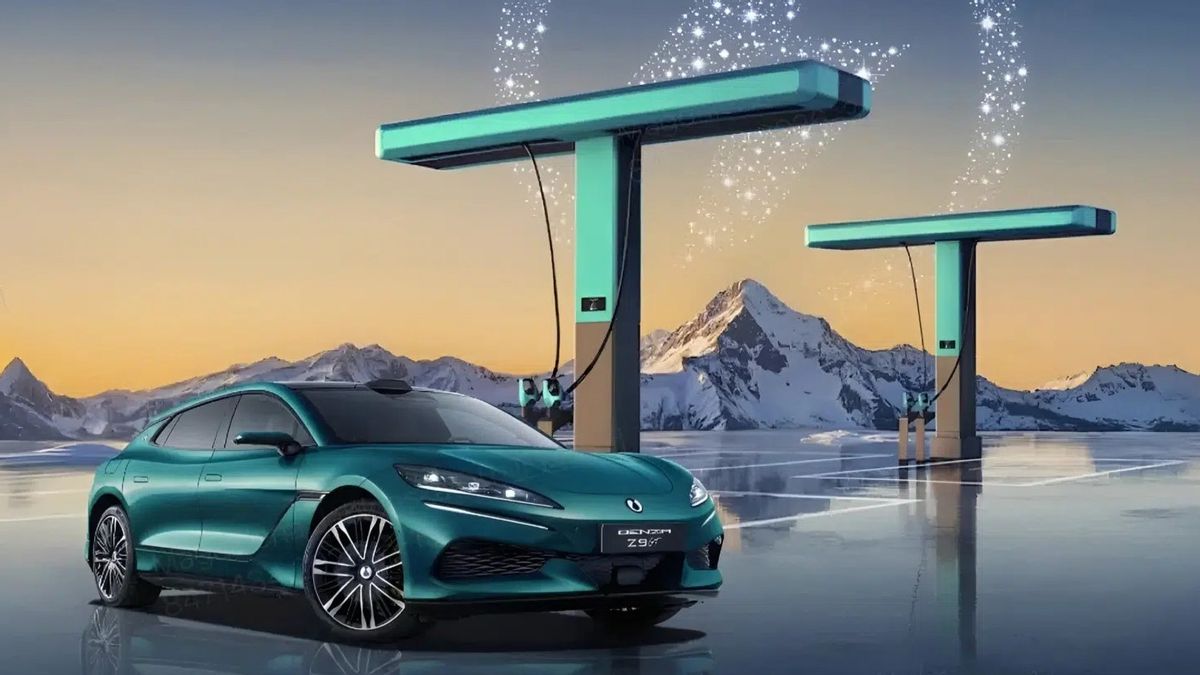


JAKARTA - Chairman and President of BYD Wang Chuanfu, revealed that the company is still facing battery supply constraints as mass production of a number of new models in the Dynasty, Ocean, Denza, and Yangwang lines increases. The statement was made at the Yangwang Business Research Institute 2026 conference.
Wang explained that BYD's current battery production capacity is still not able to fully meet the surge in demand. However, he is optimistic that the company's monthly sales will continue to increase as battery production capacity increases in the future.
Quoted from Carnewschina, Saturday, May 16, the statement came as BYD was aggressively launching electric vehicles with ultra-fast charging technology supported by the latest generation of Blade Batteries.
Some of the new models that have been introduced include the Denza B5 and B8 flash-charge versions with DiSus-P suspension technology, as well as the latest Atto 3 (Yuan Plus) crossover equipped with flash charging features and a 240 kW rear motor.
In recent months, BYD has also continued to expand its range of EVs that support fast charging technology. Industry sources in China say the high interest in the latest models with the second generation Blade Battery is one of the main causes of limited battery supply.
On the other hand, discussions regarding battery supply also sparked public attention after an online debate regarding thermal management during a demonstration of BYD's ultra-fast charging. In a live broadcast, the surface temperature of the battery was said to have exceeded 76 degrees Celsius when the high-speed charging process took place.
Throughout April 2026, BYD recorded the shipment of batteries of 20.98 GWh. Thus, the total distribution of the company's batteries since the beginning of the year has reached 81.2 GWh. However, the company has not revealed in detail the allocation of these batteries for the domestic electric vehicle market in China.
A number of market estimates in China even say that the order queue for the second generation Blade Battery-based fast charging model has exceeded 140,000 units. Some models that are said to have high demand include Feng Cheng Bao Ti 7 EV and Denza Z9 GT. Even so, the figure has not been officially confirmed by BYD.
Not only focusing on vehicles, BYD is also continuing to expand its network of fast charging infrastructure in China. In the period from May 7 to 14, the company added 55 new fast charging stations, bringing the total to 5,979 stations spread across 312 cities. BYD's fast charging application is now also claimed to have been used by more than 1 million users.
Previously, until May 6, 2026, BYD had completed the construction of 5,924 fast charging stations with a total cumulative charging volume exceeding 21 million kWh. The company officially launched the second generation Blade Battery along with its fast charging technology on March 5.
BYD claims that the system is capable of charging the battery from 10 percent to 70 percent in just five minutes, and from 10 percent to 97 percent in nine minutes under certain conditions. In April, BYD also entered into a strategic partnership with AutoNavi to provide visibility of fast charging stations directly on the digital mapping platform.
Through the "Flash Charging China" initiative, the company targets the construction of 20,000 fast charging stations across China by the end of 2026. Separately, Stella Li said BYD is still exploring discussions with a number of European automotive manufacturers regarding the potential use of the region's unoptimized factory capacity.
This step is part of the company's global expansion strategy, including increasing exports from China and localizing production in several countries. Based on China EV DataTracker data, BYD recorded EV battery installations of 10.49 GWh in China during April 2026 or equivalent to a domestic market share of 16.83 percent.
Meanwhile, the total installation of electric vehicle batteries in China in the same month reached 62.4 GWh, up 15.2 percent from the same period last year. On the same occasion, Wang also assessed that Chinese automotive manufacturers are now entering the best phase to build global brands.
The English, Chinese, Japanese, Arabic, and French versions are automatically generated by the AI. So there may still be inaccuracies in translating, please always see Indonesian as our main language. (system supported by DigitalSiber.id)
Most Popular Tags
#Prabowo Subianto #donald trump #firearm #8791 #giias 2026Popular


